
A watch has one actual job: telling the time. Hours, minutes, and seconds, read off a dial. Everything beyond that, every extra hand and window and tiny dial-inside-the-dial, is called a complication. That is the industry’s own word for it, and it is a good one, because each of these features literally complicates the movement. More parts, more things to assemble, more things that can go wrong. Watch people say it with love. Complications are the whole reason mechanical watches are interesting beyond just telling time.
Here are the four you will run into first, roughly in order of how common they are.

A chronograph wristwatch, with its stopwatch subdials and twin pushers beside the crown. Photo: Wikimedia Commons, CC BY-SA 4.0.
The date
The date is the complication so normal that most people forget it counts as one. A little window, usually at 3 o’clock, showing today’s number. It exists because checking the date is genuinely useful and a mechanical watch is a convenient place to put it. The mechanism behind it is a wheel that clicks forward one step at midnight, which sounds simple until you learn that most date wheels assume every month has 31 days, so five times a year you get to manually advance it past the 31st. February is its nemesis. Annual calendars and perpetual calendars are just fancier answers to the same problem, machines that remember which months are short: annual calendars handle the 30- and 31-day months but still need a correction after February, while perpetual calendars account for leap years too. The humble date window is the one complication with a real daily job.
The chronograph
A chronograph is a stopwatch built into a watch. Two pushers (the little buttons above and below the crown) start, stop, and reset it, and small subdials on the face count the elapsed seconds, minutes, and sometimes hours. It was invented for timing things: horse races, car races, science experiments, artillery. Today its main function is looking fantastic. Almost nobody with a chronograph times anything more serious than a parking meter, and plenty of owners have never pressed the pushers at all. That is fine. A chronograph is the most visually exciting complication on this list, all those subdials and pushers give the dial a busy, instrument-like look, and “it looks cool” has always been a legitimate reason to like a watch. Just know what you are buying: a miniature stopwatch you will mostly use as decoration.
GMT and dual time
A GMT watch tracks a second time zone. Usually there is an extra hand, often brightly colored, that circles the dial once every 24 hours, pointing at a 24-hour scale on the bezel (the rotating ring around the dial). Set it to home time, set the regular hands to wherever you landed, and you can glance down and know whether it is a decent hour to call the office. The complication was born in the 1950s for airline pilots crossing time zones; Rolex’s GMT-Master arrived in 1955 and became one of the most influential GMT designs, although Glycine’s Airman had already introduced a different two-time-zone solution in 1953. Frequent travelers and people with family overseas still get real use out of it. For everyone else, it is a very handsome extra hand. There is also a simpler cousin, the dual-time watch, which just shows two times with two hour hands and skips the 24-hour math.
The moonphase
A moonphase shows the current phase of the moon through a little window, usually a golden moon drifting across a starry disc. The mechanism tracks the moon’s cycle of about 29 and a half days using a gear with 59 teeth that advances one tooth per day. Here is the honest part: it does nothing for you. It will not change a single decision you make all month. It is, by every practical measure, the most useless complication on this list, and it is also the prettiest, which is exactly why people love it. A moonphase is a watchmaker showing off, a tiny mechanical planetarium on your wrist, and its entire purpose is to make you smile when you notice it. That is a real purpose, just not a practical one.
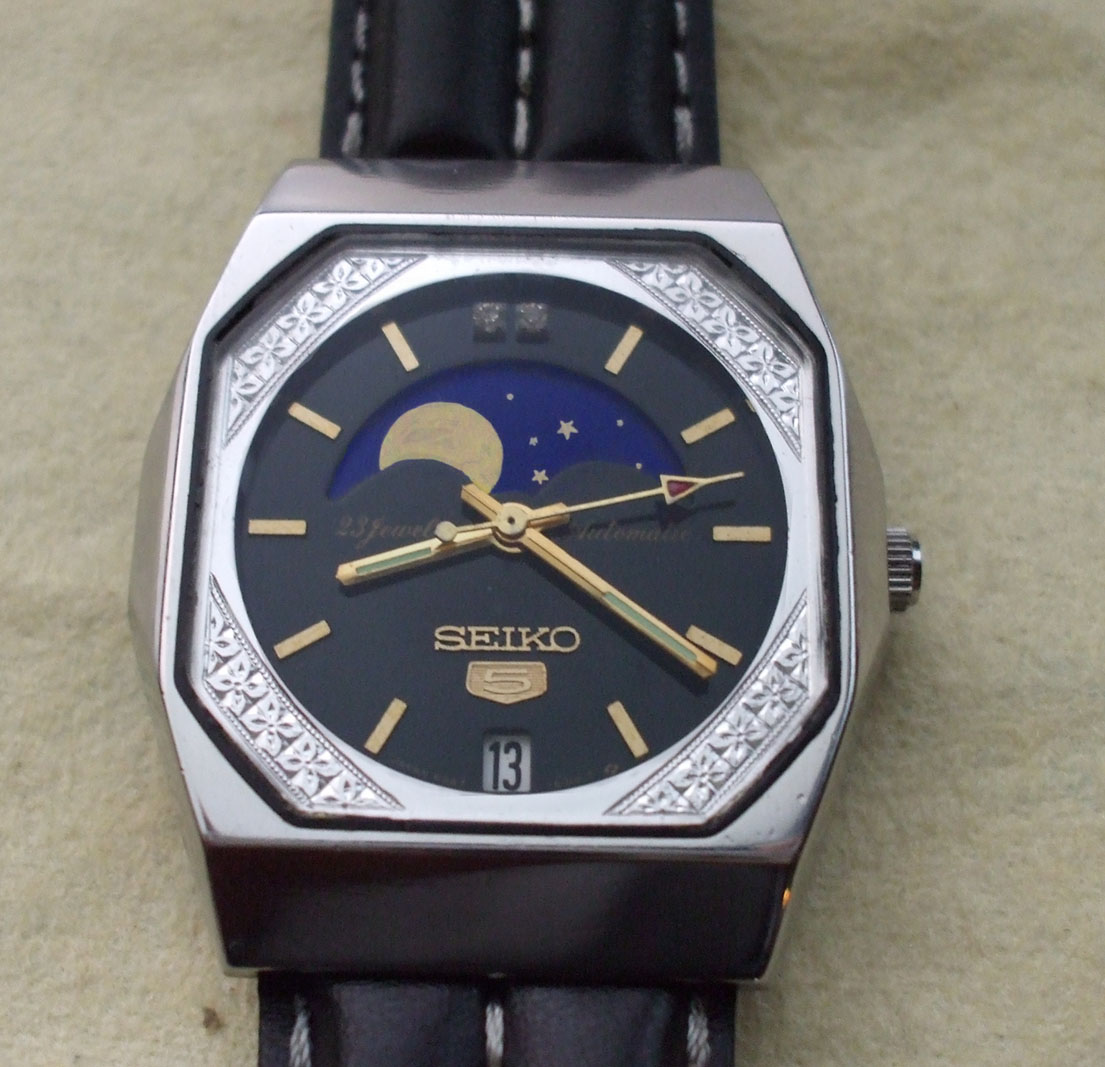
A moonphase complication: a small window tracking the moon’s 29.5-day cycle. Photo: Wikimedia Commons, CC BY-SA 4.0.
Why complications cost more
Two reasons, and both are straightforward. First, parts and labor. A basic three-hand movement has around a hundred parts. Add a chronograph and you can double that, with additional gears, levers, and springs that increase manufacturing complexity and give a watchmaker more to take apart at service time. A moonphase disc has to be printed, the gears behind it have to mesh perfectly, and someone has to regulate the whole thing so it keeps time anyway. Second, servicing. As covered in Lesson 2, mechanical watches need periodic servicing, and a complicated movement takes the watchmaker longer to take apart and put back together, and the bill reflects that.
There is also a third reason nobody puts on the spec sheet: complications are how brands justify higher prices. A date window adds a few dollars of parts and a meaningful bump to the price tag, because the customer perceives it as a more serious watch. That gap between parts cost and price is simply how pricing works, and knowing it keeps you honest when you are deciding what something is worth to you.
The honest truth
Here is what took me an embarrassingly long time to accept: you do not need any of these. Your phone tells the date, runs a stopwatch, shows every time zone on earth, and knows the moon phase, all better than any mechanical watch ever will. Every complication on this list is, strictly speaking, unnecessary. The date comes closest to earning its keep, and even that is a convenience, not a necessity.
And that is completely fine, because nobody buys a mechanical watch for necessity. You buy the moonphase because the little golden moon makes you happy every time you catch it in the corner of your eye. You buy the chronograph because the dial looks like the cockpit of something fast. You buy the GMT because you like the idea of keeping track of home, even if home is twenty minutes away. Buy complications for joy, not for utility, and you will never be disappointed by them. Buy them expecting them to be useful and you will feel silly the first time you time a frozen pizza with a machine that cost more than your car.
Keep digging
Each of these four has its own Reference page with the full story: how the mechanisms work, the history behind them, and what to look for when you are shopping.
Why it matters
Complications are where watch marketing does its heaviest lifting, and they are also where beginners overspend the fastest. Knowing what each one actually does (and, more importantly, what it does not do for your life) is the difference between buying a watch you will love for decades and buying one that impresses a salesperson for an afternoon. The moonphase is not useful. It is wonderful. Learn to tell those two things apart and you will navigate the entire watch world with your eyes open.
Thanks for reading this.
Course Index | Previous: The movement | Next: The outside

