
Every watch is two products stuck together. There is the part you look at (the dial, the hands, the case) and there is the part that does the work. The part that does the work is the movement: a small machine, usually around three centimeters across, made of a hundred or more tiny parts, living inside the case in the dark where you will never see it unless you flip the watch over. Almost every specification that matters about a watch is really a specification about its movement.
Watch people call a specific movement design a caliber (pronounced kal-ih-burr, from the French). It is just the movement’s model name. When a spec sheet says “Cal. 6R35,” that means caliber 6R35, a movement made by Seiko. Some brands design and build their own calibers. Many buy them from specialist companies like ETA, Sellita, or Miyota and drop them into their own cases. Two watches that look completely different can have the exact same movement inside, and two watches that look identical can be totally different machines. The caliber is the part that tells you which one you are dealing with.

A Seiko 7S26 automatic movement, the engine inside millions of affordable Seiko watches. Photo: Wikimedia Commons, CC BY-SA 4.0.
How to read a spec sheet
Spec sheets look intimidating for about a week, and then they become one of the most satisfying things in this whole pursuit. Here is what the common lines actually mean, in plain language.
Jewels. A jewel is a tiny synthetic ruby used as a bearing, which is a fancy word for a low-friction surface that a moving part spins against. Metal rubbing on metal wears out and needs oil; ruby rubbing on steel barely wears at all. A basic watch might list 17 jewels. A modern automatic usually lists 21 to 27. This is one of those numbers where more stops meaning better after a point. Once every real friction point has a jewel, extra jewels are just bearings on parts that barely move, added so the marketing department gets a bigger number. “Fully jeweled” is the term for a movement where everything that needs one has one. Do not pay extra for a 31-jewel movement over a 24-jewel one thinking you are getting something superior. You are getting seven more rubies and the same watch.
Vibrations per hour (vph). This is how many times the balance wheel swings back and forth in one hour. The balance wheel is the oscillating part that divides time into equal slices, like a pendulum shrunk down to fit on your wrist. Common rates are 18,000 (older and slower), 21,600, 28,800 (the modern standard), and 36,000 (called high-beat). Divide by 3,600 and you get beats per second: a 28,800 vph movement ticks 8 times per second, which is why its seconds hand sweeps smoothly instead of stepping.
Here is the single most common beginner mistake, and I made it too: beat rate is not accuracy. Accuracy is measured separately, in seconds gained or lost per day (something like +8 seconds a day). A fast-beating watch can run slow. A slow-beating watch can be adjusted to run nearly perfect. Beat rate describes how finely the movement slices each second. Accuracy describes whether those slices add up to the right length of a day. They are related, but they are not the same thing, and a spec sheet will never list beat rate in place of accuracy.
Power reserve. How long the watch keeps running after you stop feeding it energy. For a manual-wind watch, that means after a full wind. For an automatic, it means after you take it off your wrist. The old standard was about 40 hours. A lot of modern movements manage 70 to 80. So when you read “70-hour reserve,” translate it to real life: you take the watch off Friday night and it is still ticking on Monday morning. Anything above about two days means you can rotate between watches on weekends without resetting the time.
Diameter. The width of the movement itself, in millimeters. You might also see the old French unit, the ligne (pronounced leen), where one ligne is about 2.26 millimeters. A 30mm movement is roughly 13 and a quarter lignes. Why should you care? Because the movement has to fill the case it sits in. A small movement rattling around in a big case is one of the quiet signs of a watch that was designed around a price point instead of around the watch.
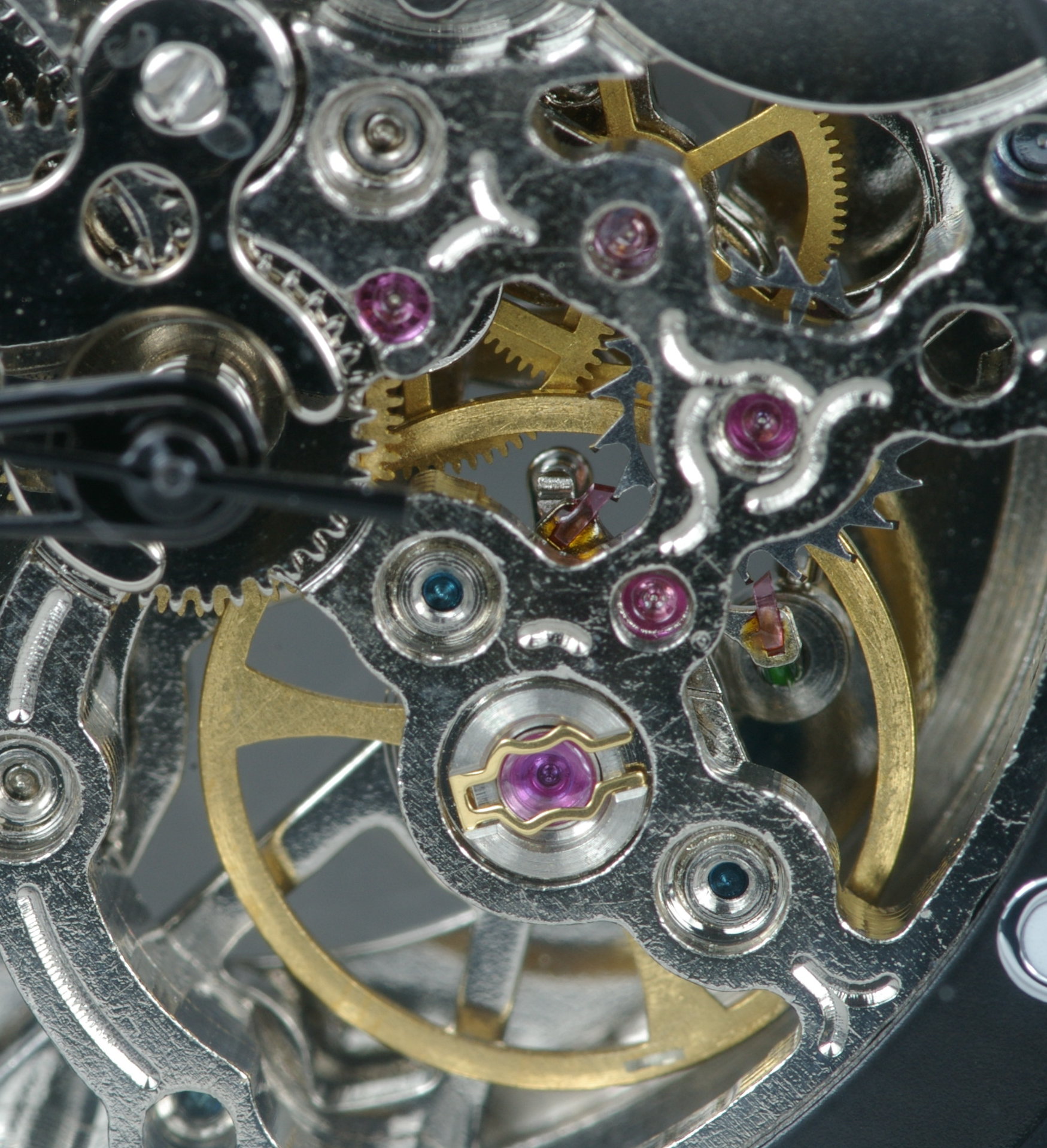
The escapement of a mechanical movement, with red jewel bearings visible at the pivot points. Photo: Wikimedia Commons, CC BY-SA 4.0.
Putting it together
Let us decode a real spec line, the kind you will see on a thousand product pages: Cal. 6R35, 24 jewels, 21,600 vph, 70-hour reserve.
Cal. 6R35: the movement is Seiko’s caliber 6R35, an automatic from their mid-range family. 24 jewels: every friction point has a ruby bearing, so it is fully jeweled, nothing more to prove. 21,600 vph: the balance wheel beats 6 times per second, which is a calm, standard rate that sips energy instead of gulping it. 70-hour reserve: that efficiency pays off, because the watch runs for nearly three days off the wrist.
Four numbers, and you now know what kind of machine you are buying: a workhorse automatic, modestly but honestly built, that will survive a long weekend in a drawer. That is the whole trick. The spec sheet was never trying to confuse you. It was just written by engineers, for people who already knew the vocabulary. Now you know the vocabulary.
Keep digging
The movement world goes deep fast, and it is full of characters. These three Reference pages pick up where this lesson leaves off.
Why it matters
Learning to read a movement spec is the moment you stop shopping by vibes. Marketing can dress up any watch in heritage and candlelight, but the caliber line does not lie about what is inside the case. Two watches at wildly different prices can share a movement, and now you will spot it. A beginner who can decode a spec sheet will make better buying decisions than a collector with ten years of experience who never bothered. That beginner can be you, starting now.
Thanks for reading this.
Course Index | Previous: What makes it tick? | Next: Beyond telling time

