
Every watch has an inside and an outside. The inside is the movement, the tiny engine covered in the first lessons. The outside is everything you touch and see: the metal shell that protects the engine, the glass you read the time through, the little knob on the side, and the numbers stamped on the back that say whether it can survive a swim. The outside is also the part you actually live with. It gets knocked on doorframes, rained on in parking lots, and stared at across diner tables. This lesson covers what it is made of and what actually matters when you handle one.

A crown up close. It sets the time, winds the movement, and on many watches it screws down for water resistance. Photo: Wikimedia Commons, CC BY-SA 4.0.
The case is the bodyguard
The case is the metal housing that holds the movement, dial, and hands, and its parts have names worth knowing. The bezel is the ring around the crystal; on some watches it rotates to time things, on most it just sits there looking nice. The lugs are the little legs at the top and bottom where the strap or bracelet attaches. The caseback is the rear cover: solid steel on many watches, or an exhibition back, a window of glass that lets you watch the movement work.
Three numbers describe a case, and they matter more than any photo. Diameter is measured across the face, not counting the crown; 40 millimeters is the classic middle. Thickness is measured top to bottom; a thin watch slides under a shirt cuff and a thick one does not. Lug to lug is measured from the tip of the top lugs to the tip of the bottom ones, and this is the number that decides whether a watch fits your wrist. A 40mm watch with short lugs can wear smaller than a 38mm watch with long ones. When you pick up a watch, check these numbers instead of guessing from pictures.
Crystal, crown, and the bits you touch
The crystal is the transparent cover over the dial, and it comes in three common types. Acrylic is plastic, found on vintage watches; it scratches easily, but a little polish buffs the scratches right out. Mineral glass is ordinary hardened glass, the standard on affordable watches; tougher than acrylic and cheaper than the good stuff. Sapphire crystal is grown synthetic sapphire, extremely scratch resistant and the default on serious watches; its weakness is that a hard, sharp knock can crack it where acrylic would just bounce.
The crown is the little knob sticking out of the side, usually at 3 o’clock. Pull it out to set the time and date; on a manual-wind watch, turning it winds the movement. A screw-down crown threads into the case like a jar lid, and it is one of the main reasons a watch can claim real water resistance. If your watch has one, unscrew it to set the time, then screw it back in snug when you are done. Forgetting that last step is the classic beginner mistake, and it is an expensive one if the watch goes swimming afterward.
Materials, without the sales pitch
Cases come in a short list of materials, each with honest tradeoffs. Stainless steel is the default for a reason: tough, affordable, and easy for a watchmaker to polish when it picks up scratches. Which it will. Scratches on steel are normal wear, not damage.
Gold is heavy, soft, and expensive. It scratches more easily than steel and mostly exists because it looks like gold and costs like gold. Titanium is the interesting one: much lighter than steel, dark grey, very strong, and usually finished matte. If a steel watch feels like a brick on your wrist, titanium is the answer. Bronze is the romantic choice: it reacts with air and skin and develops a patina, a dark, lived-in coating that keeps changing. Some people love that their watch looks different every month; others find it unsettling. Ceramic is the modern lab material: nearly impossible to scratch, light, and usually black or white; its downside is brittleness, since a hard drop can crack it where steel would dent. For a first watch, steel is the sensible answer to every question on this list.
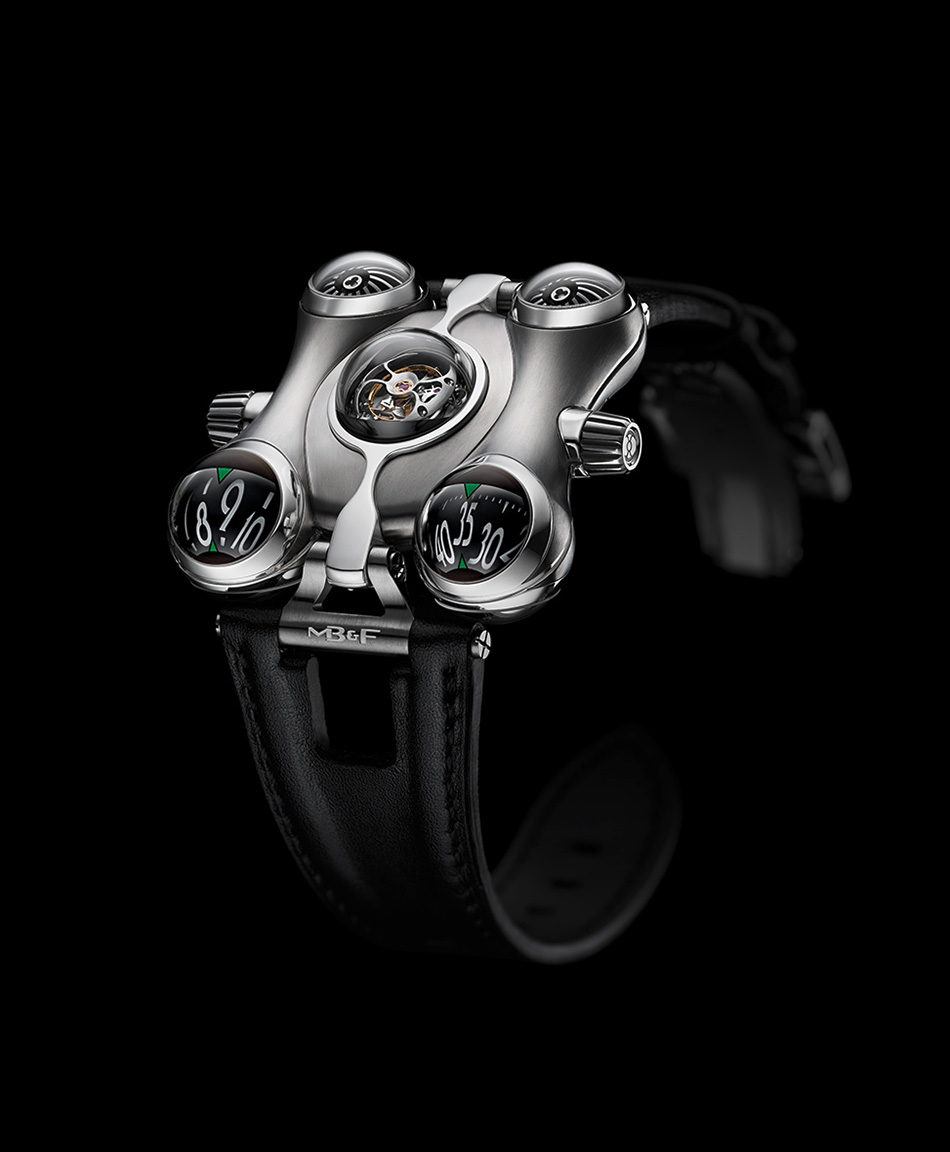
Titanium: dark, light, and matte. This is the MB&F HM6, an extreme example of the material. Photo: Wikimedia Commons, CC BY-SA 4.0.
Water resistance numbers, translated
Water resistance is written in meters or ATM (atmospheres; one ATM is roughly 10 meters), and the numbers confuse everyone at first because they do not mean what they say. Thirty meters does not mean you can dive 30 meters down. It means the watch survived a lab pressure test, and in real life 30m means rain and splashes, not swimming. Fifty meters handles a casual swim. One hundred meters is fine for swimming and snorkeling. Two hundred meters and up means substantial water resistance, but that alone does not make a watch a professional dive watch, which has to meet additional requirements like those in ISO 6425. Screw-down crowns, sealed casebacks, and rubber gaskets are common ways of getting there, but the construction varies.
Two things beginners should know. First, gaskets age: the rubber seals dry out over the years, so a ten-year-old 200m watch is not a 200m watch until a watchmaker pressure-tests it. Second, heat and soap are the enemies; hot tubs and long hot showers wear seals out faster than cold pool water. When in doubt, treat the watch as one step less resistant than its rating, and do not push a chronograph’s buttons underwater unless the manufacturer specifically says you can.
Keep digging
The Reference wiki goes deeper on every part of the outside. These three articles pick up exactly where this lesson stops.
Why it matters
You handle the outside of a watch a hundred times a day and the inside never. Knowing what the case, crystal, crown, and materials do turns every watch you pick up, in a store or on a friend’s wrist, from a pretty object into something you can read. You will spot the screw-down crown, guess the crystal, and know what the depth rating actually promises. That is the whole point of this course: to make watches legible.
Thanks for reading this.
Course Index | Previous: Beyond telling time | Next: Who makes watches?

