
The mainplate is the foundation of a mechanical watch movement: a single shaped plate, usually brass, that every other part bolts onto or sits inside. Turn a movement over and the broad decorated surface you see is the mainplate, with the bridges screwed down on top of it. Every wheel pivot has a seat machined into it, every jewel a setting, every screw a tapped hole. Without the mainplate, a movement is just an expensive box of loose parts.
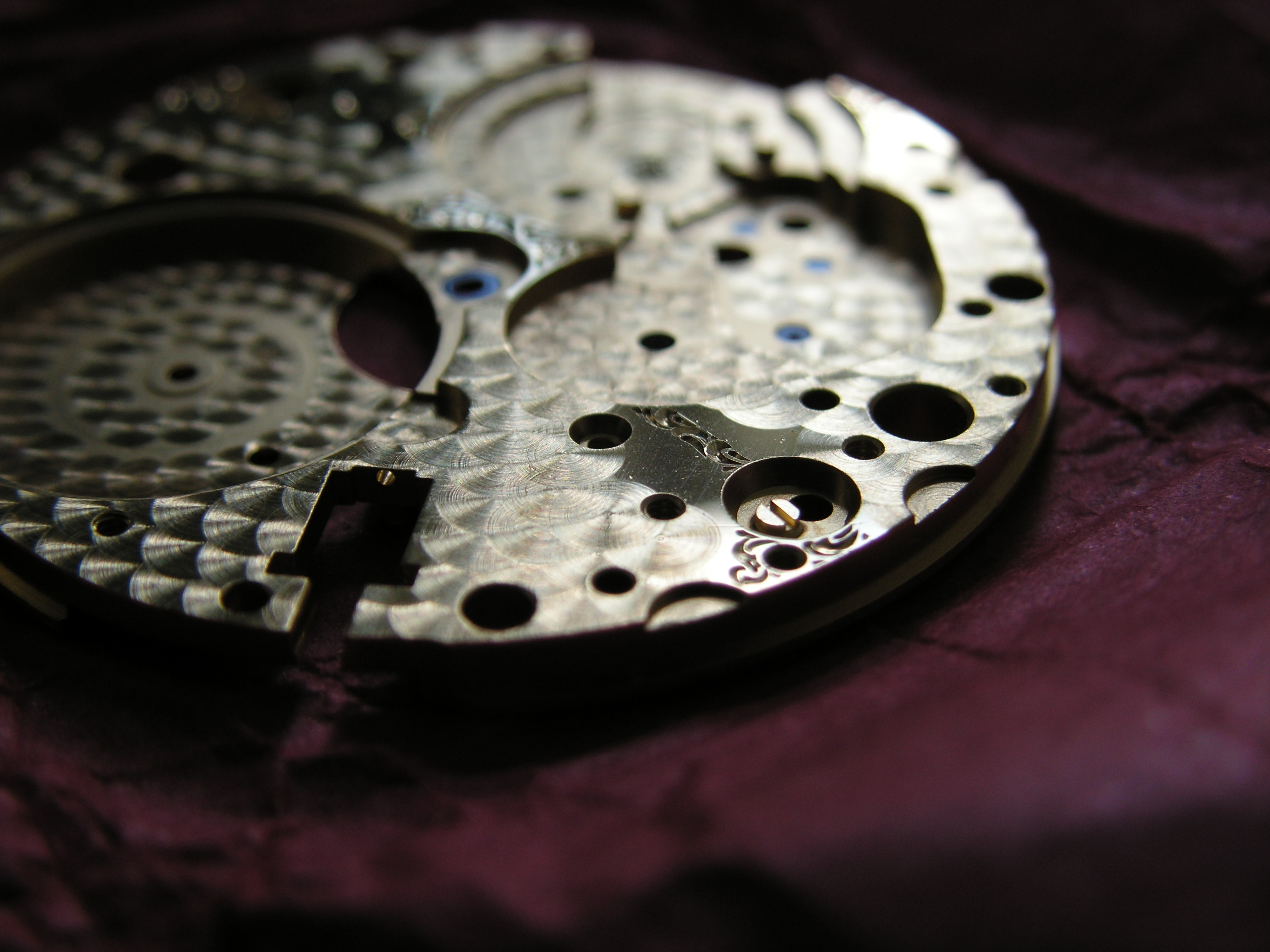
Perlage, the circular graining traditionally applied to mainplates. Photo: Wikimedia Commons, public domain.
What it is and what it holds
Think of the mainplate as the chassis. The lower pivots of every wheel in the gear train run in jewels set into it, the barrel sits in a recess machined for it, and pillars rise from its surface to support the bridges above. The dial feet, the little posts that locate the dial, are fixed to its top side. When a watchmaker takes a movement apart, the mainplate is the last thing left on the bench, with everything else removed. It is also the part that determines a movement’s diameter and basic layout: round, shaped, or skeletonized, it all starts here.
Brass, German silver, and decoration
Most mainplates are brass, chosen because it machines cleanly and does not rust. At the high end you will find German silver, also called maillechort, a nickel-copper-zinc alloy with a warm champagne color that takes a beautiful finish; A. Lange & Söhne’s untreated German silver plates, which develop a soft patina over decades, are the famous example. Decoration follows tradition: perlage, the overlapping circular graining in the photo above, is the classic mainplate finish, while Geneva stripes (côtes de Genève) usually live on the bridges. None of this is visible when the watch is assembled, which is exactly the point. Finishing the hidden parts is how a maker signals that the work was done properly everywhere, not just where the customer looks.
How they are made
Historically, mainplates were cut, drilled, and finished by hand, which is why vintage movements each have tiny individual quirks. Today the rough work is done by CNC milling machines cutting to tolerances measured in microns, and the hand work survives in the finishing: beveling edges, graining surfaces, and polishing sinks by hand at the top end. The irony is that the machine-made plate is technically more perfect than the hand-made one, and collectors still pay a premium for the hand-made one. Craft has its own economy, and it does not always follow logic.

A watch movement taken apart for servicing, with the plates separated from the wheels. Photo: Wikimedia Commons, CC BY-SA 3.0.
Why it matters
The mainplate is the reason a movement has architecture at all instead of being a pile of gears in a tin. Its layout decides where everything goes, its material decides how the movement ages, and its finishing decides whether the maker cared. Skeleton watches, which carve the plates away to show the mechanism, are really just the mainplate stepping aside to let you admire what it normally holds together. Every mechanical watch you will ever handle is built on one of these, doing its quiet structural job underneath all the decoration.
Thanks for reading this.

