
The barrel is the fuel tank of a mechanical watch: a toothed drum that houses the coiled mainspring. Wind the watch and you tighten the spring inside it; the barrel’s outer teeth then drive the gear train as the spring unwinds. Everything downstream, every wheel and every tick, runs on what the barrel delivers.
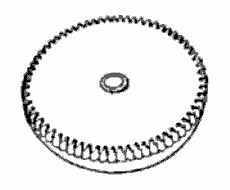
Diagram of a mainspring barrel: drum, arbor, and toothed outer wall. Photo: Wikimedia Commons, public domain.
How it works
The barrel has three essential parts. The drum is the toothed outer wall that meshes with the first wheel of the gear train. The arbor is the central axle, fixed in place, around which the spring coils. The cover closes the top so the spring stays put. Winding turns the arbor (via the ratchet wheel), tightening the spring; as the spring unwinds, it drags the drum around with it, and the drum’s teeth push the train. This arrangement, where the spring drives the train directly through the barrel wall, is called the going barrel. It replaced the older fusee-and-chain system in the 1800s and has been standard ever since, because it is simpler, thinner, and has fewer parts to wear out.
One barrel or two
A single barrel typically stores enough energy for 36 to 72 hours of running, which is why most watches ask for a daily wind. Watches advertising longer power reserves get there by changing the barrel equation: a bigger barrel, a longer spring, or two barrels instead of one. Twin barrels can be arranged to pool their energy for very long reserves, eight days in some designs. There is no free lunch, though. More stored energy means more torque to manage, and the spring still shoves hardest when fully wound and weakest when nearly spent, which is the eternal headache of mechanical timekeeping.

A going barrel, the direct-drive arrangement used in nearly all modern watches. Photo: Wikimedia Commons, public domain.
The barrel in automatic watches
In an automatic watch the barrel never stops being wound, so it needs a way to avoid overwinding. That job falls to the slipping bridle, a springy tail on the outer end of the mainspring that grips the barrel wall while winding and slides once the spring is fully wound. The barrel wall has shallow notches for the bridle to catch in, a small detail with a big job. It is one of those invisible mechanisms that works for decades without anyone thinking about it, which is the highest compliment a watch part can earn.
Why it matters
The barrel is the boundary between stored energy and moving machinery, and every compromise in a mechanical watch’s power supply lives inside it: how long the reserve is, how evenly the power comes out, whether the watch can be an automatic. It is a drum with a spring in it, doing a job that sounds simple until you try to make it run evenly for a week. Respect the barrel.
Thanks for reading this.

