
The gear train, also called the going train, is the set of wheels that carries power from the barrel to the escapement, trading the barrel’s slow, strong turn for the fast, delicate beats the escapement needs. Four wheels do nearly all of it: the center wheel, the third wheel, the fourth wheel, and the escape wheel. Each step multiplies speed and divides force, like a bicycle’s gears run in reverse.
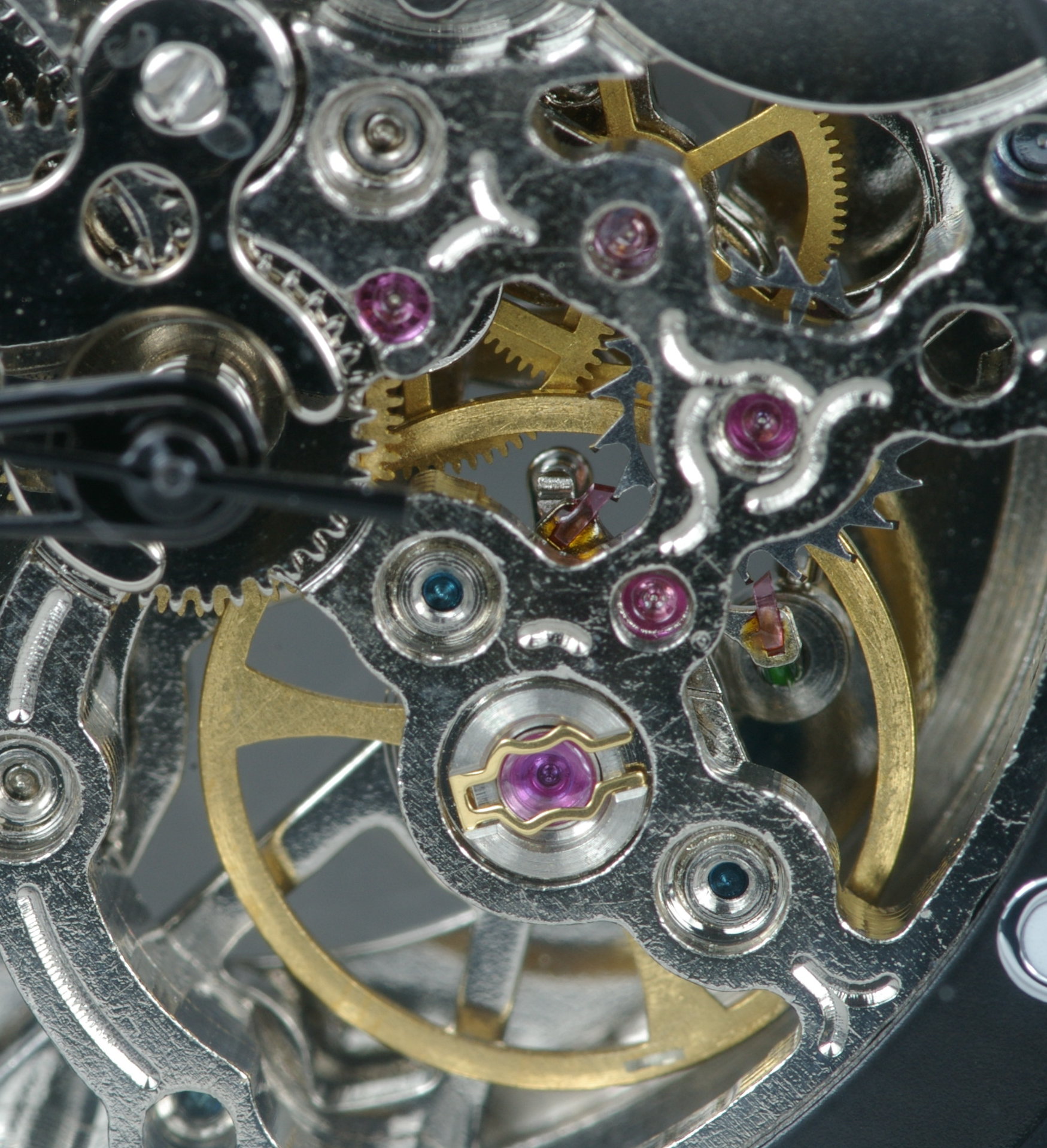
The wheels and jewel bearings of a simple movement, the whole going train on display. Photo: Wikimedia Commons, CC BY-SA 3.0.
The wheels in order
Power flows in one direction. The barrel’s teeth drive the center wheel, which turns once per hour and, through the motion work, carries the minute hand. The center wheel drives the third wheel, a pure intermediary that bridges the distance. The third wheel drives the fourth wheel, which turns once per minute and usually carries the seconds hand. The fourth wheel drives the escape wheel, which spins fastest of all and feeds the escapement its rapid little pushes. The ratios multiply at each step: by the time the barrel’s stately rotation reaches the escape wheel, it has been geared up enormously, which is exactly what the escapement wants.
Why step it up
The barrel turns slowly and strongly; the escapement needs to move quickly and lightly. A balance wheel oscillating at 28,800 beats per hour cannot be driven directly by a drum that takes hours to turn once. The gear train is the translator between those two worlds, converting torque into speed one meshing at a time. Get the ratios wrong and the watch runs fast, slow, or not at all, which is why wheel teeth are cut to exact profiles and why a bent tooth is a serious problem. There is no slack in this system. Every wheel has to hand off its energy cleanly to the next.
Friction, jewels, and finishing
All that meshing creates friction, and friction is the enemy. Each wheel’s pivots run in synthetic ruby jewels, which are harder and smoother than any metal bearing, and the whole train is oiled with tiny drops of specialized lubricant. The wheels themselves are usually brass, light and easy to cut, with carefully shaped teeth. High-end makers finish the wheels too: chamfered spokes, polished surfaces, the works. It is invisible inside the case, but like all movement finishing, it signals that the maker did not cut corners where you cannot see.
Why it matters
The gear train is the least glamorous part of a mechanical watch and one of the most exacting. It does pure transmission, no decoration, no romance, just ratios, and if any wheel is off, the whole watch is off. The escapement gets the poetry and the mainspring gets the credit, but the four quiet wheels in between are what make the connection work. Every mechanical watch is, at bottom, a gear train with ambitions.
Thanks for reading this.

