
The escapement is the mechanism that meters the mainspring’s energy to the balance wheel in exact little beats. It does two jobs at once: it keeps the balance swinging, and it counts those swings to advance the hands. Nearly every mechanical watch ever made uses a version of the Swiss lever escapement, a design old enough to predate the United States.
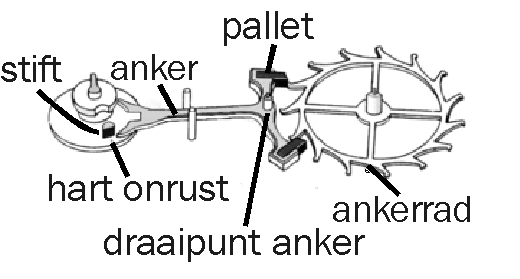
Diagram of a Swiss lever escapement: escape wheel, pallets, and fork. Photo: Wikimedia Commons, public domain.
The Swiss lever
The lever escapement has three main parts: the escape wheel, the pallet fork with its two ruby pallet jewels, and the balance wheel it serves. The escape wheel pushes against one pallet, the fork rocks over, gives the balance a nudge, and locks the wheel until the balance swings back to unlock it. The clever part is that the balance swings free almost the entire time, touching the mechanism only to receive its push and unlock the wheel. Less contact means less friction and better accuracy. Thomas Mudge invented it around 1755, and the full story of what came before it, the verge, the cylinder, the duplex, lives in our Historical Movement Types article. The lever won so completely that everything since has been a refinement of it.
The co-axial challenger
The one serious alternative came from the English watchmaker George Daniels, who invented the co-axial escapement in the 1970s. Instead of the lever’s sliding friction, where pallet jewels scrape across the escape wheel teeth, the co-axial uses a three-tiered escape wheel that pushes the pallets with radial force, nearly eliminating sliding friction. Less friction means less wear and less need for lubrication, the traditional weak point of the lever. Daniels spent years trying to sell the idea to the Swiss industry, which mostly shrugged, until Omega adopted it and put the first co-axial caliber into production in 1999. Omega has used it ever since, and it remains the only mass-produced alternative to the Swiss lever.

The co-axial escapement in motion, George Daniels’ low-friction alternative to the lever. Photo: Wikimedia Commons, CC BY-SA 4.0.
Modern variants
Recent decades have brought new materials to the old geometry. Silicon pallet forks and escape wheels, etched rather than machined, run with so little friction that some need no lubrication at all, and they are immune to magnetism into the bargain. Various brands have experimented with constant-force escapements and other exotic geometries, mostly at the high end. None has displaced the lever. Two and a half centuries after Mudge, the detached lever remains the default answer, which tells you how thoroughly he solved the problem.
Why it matters
The escapement is the ticking heart of the watch in the most literal sense: it is the part that divides time into beats and the part you hear. Everything else in the movement exists to serve it, delivering smooth power to the balance and carrying its count to the hands. When you hold a mechanical watch to your ear, the sound you hear is the escapement doing the only job that ultimately counts.
Thanks for reading this.

