

You have $1,000 and you want three watches instead of one. Fine. Here is how I would spend it: $675 on a Hamilton Khaki Field Mechanical, $240 on an Orient Bambino 38, and $65 on a Casio G-Shock. That comes to $979.91. The Hamilton gets most of the money because it does most of the work.
The short answer
Hamilton Khaki Field Mechanical ($675) for every day. Orient Bambino 38 in green ($240) for anything with a dress code. Casio G-Shock DW5600E ($65) for everything you should not wear a mechanical watch to do. Total: $979.91.
The three at a glance
| Hamilton Khaki Field Mechanical | Orient Bambino 38 | Casio G-Shock DW5600E-1V | |
|---|---|---|---|
| Reference | H69439931 | RA-BB0001E | DW5600E-1V |
| Movement | Hamilton H-50, manual wind, 80-hour reserve | Orient F6524 automatic, 40-hour reserve | Casio quartz, module 3229 |
| Case | 38mm x 9.5mm, 47.3mm lug to lug | 38.4mm x 12.5mm, 44mm lug to lug | 48.9 x 42.8mm resin |
| Crystal | Sapphire | Domed mineral | Mineral glass |
| Water resistance | 50m | 30m | 200m |
| Price | $675 | $239.99 | $64.92 |
Hamilton Khaki Field Mechanical (H69439931): $675
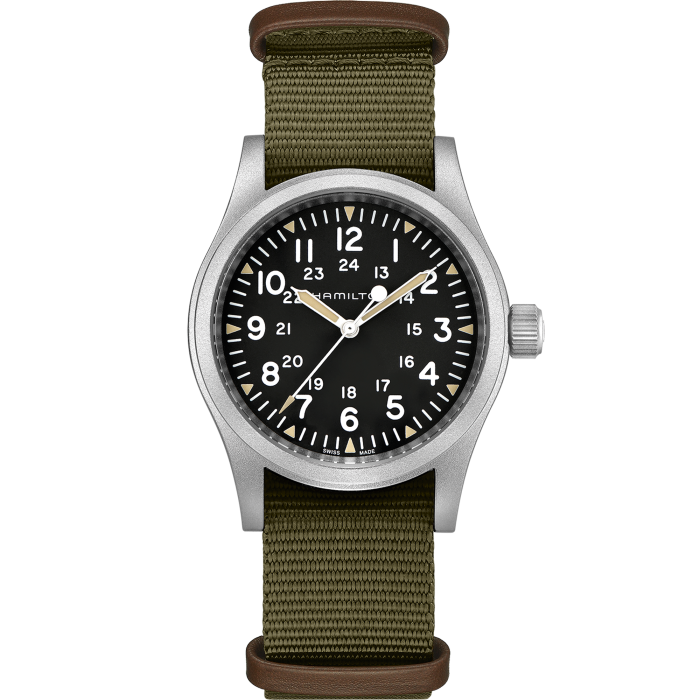
The Hamilton Khaki Field Mechanical. Photo: Hamilton.
What it is good at: being the watch you wear almost every day. Thirty-eight millimeters, black dial, big numerals you can actually read, sapphire crystal, and an 80-hour power reserve, so you can leave it alone all weekend and it is still running Monday morning. It descends from the military field watches Hamilton actually made, and it looks the part. Nobody outside the hobby will notice it. That is the point.
The catch: you wind it yourself, every couple of days, for as long as you own it. Some people enjoy that. Some people resent it by week three. Know which one you are before you buy. The 50 meters of water resistance covers rain and hand-washing and nothing more ambitious. The green NATO it ships on is fine, but you will replace it within a month.
Would I buy it? Yes. Best value on this list, and the only one I would call essential. If the collection had to be one watch, it would be this one.
Orient Bambino 38 (RA-BB0001E): $239.99
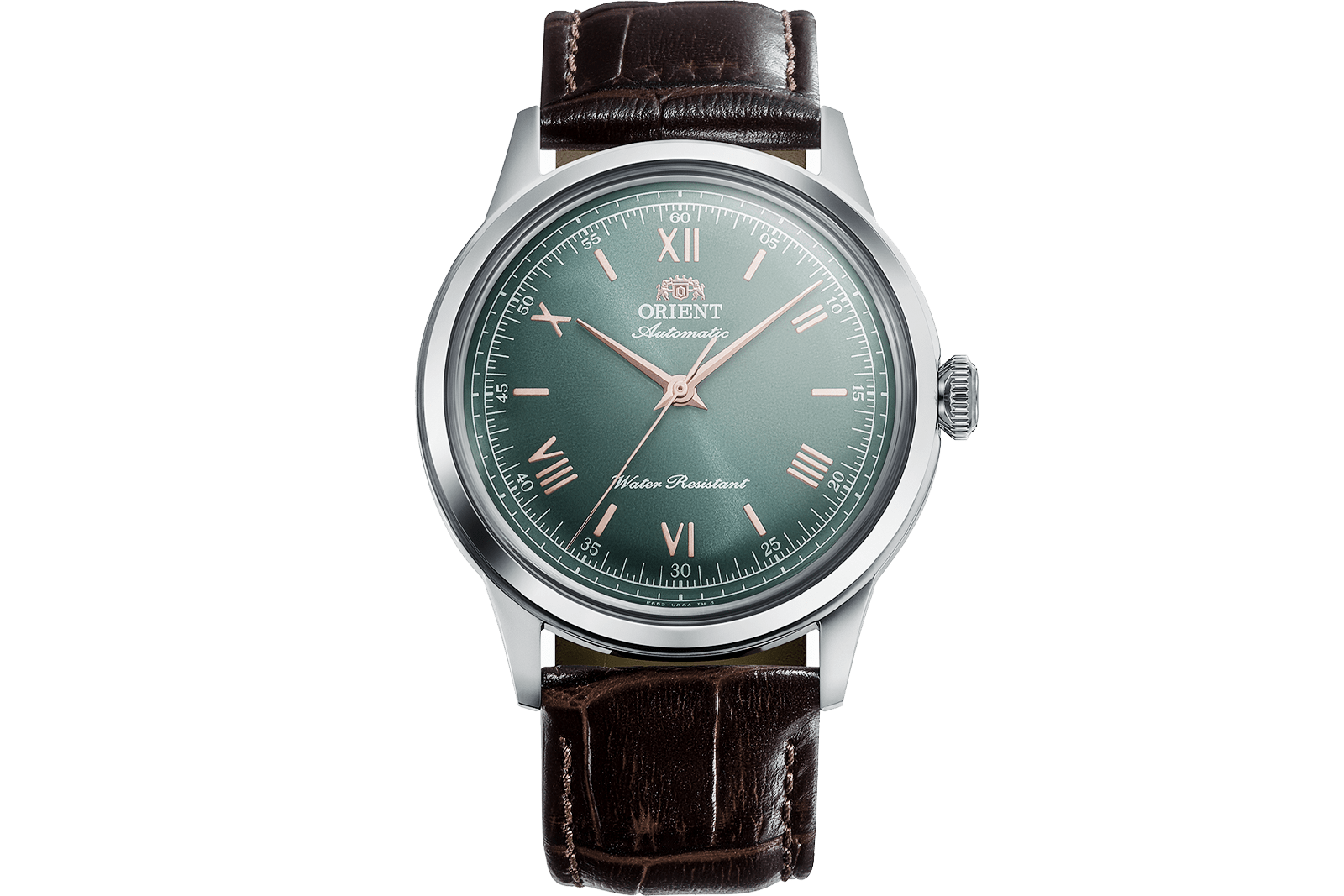
The Orient Bambino 38 in green. Photo: Orient.
What it is good at: looking like it costs three times the price at any event where someone might take a photograph of you. Green sunburst dial, rose gold Roman numerals, no date window breaking the symmetry, a domed crystal, and an exhibition caseback showing an in-house automatic with hacking and hand-winding. For $240, that combination is a genuinely good deal, and the Bambino is a genuinely good watch. It is well made and it will do its job for years. I will not do the forum routine of pretending it embarrasses watches costing ten times more. It doesn’t, and it doesn’t have to. A good cheap watch needs no apology and no hype.
The catch: 30 meters of water resistance is a suggestion, not a promise. Keep it away from water. The mineral crystal will pick up scratches the way the Hamilton’s sapphire won’t. At 12.5mm thick it is chunky for a dress watch, so tight cuffs are a negotiation. And green is a commitment. A beautiful one, but not the versatile white or black dial you will reach for first.
Would I buy it? Yes, in this green. It is the only watch here that makes getting dressed up feel like an occasion instead of an obligation.
Casio G-Shock DW5600E-1V: $64.92
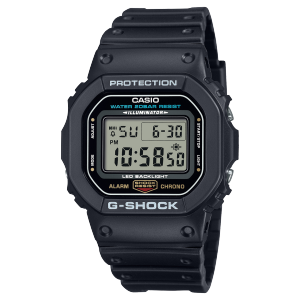
The Casio G-Shock DW5600E. Photo: Casio.
What it is good at: not dying. Two hundred meters of water resistance. It shrugs off drops, the lawn mower, the lake, and toddlers. It has been in production in basically this form since 1996, which means every flaw was found and fixed decades ago. It costs about sixty-five dollars.
The catch: it is a black resin rectangle. It will never be beautiful and it is not trying to be. The 48.9mm lug to lug wears big on smaller wrists. Setting anything beyond the time takes the manual and some patience. You will set it once and never touch those buttons again.
Would I buy it? Everybody needs one beater. This is the beater, perfected a long time ago. Yes.
The movements, up close
Three watches, three completely different answers to what should power a watch. Worth slowing down for.
Hamilton H-50
The H-50 is Hamilton’s reworking of the ETA 2801-2, the hand-wound workhorse that has powered field watches for decades. Seventeen jewels, 21,600 vibrations per hour, hacking seconds, and an 80-hour power reserve. The reserve comes from the straightforward approach: the beat rate drops from the 2801-2’s 28,800 to 21,600 vibrations per hour, so the movement uses its mainspring energy more slowly. Hamilton also fits a Nivachron balance spring, Swatch Group’s anti-magnetic alloy, a quiet upgrade for a watch meant to be worn daily.
There is no decoration to discuss. The Khaki Field Mechanical has a solid caseback, so this is a tool you will never see. Now the part I actually care about. The H-50 has no regulator. It belongs to ETA’s C07 family, the Powermatic 80 group that also includes Hamilton’s H-10, H-30, and H-40, and like all of them it is laser-regulated at the factory. Your watchmaker cannot regulate it. If it drifts, it goes back to Swatch Group. I make one exception to my rule here: a fixed adjuster is fine when the hairspring is silicon, because silicon barely drifts. The H-50 runs a Nivachron spring, not silicon, so this counts as a genuine mark against it. Parts and technical documents stay inside Swatch Group, and plenty of independent watchmakers will not touch these movements at all.
Good: the 80-hour reserve is the headline. A full weekend off the wrist costs nothing. Proven architecture, robust.
Bad: 21,600 vph means the seconds hand sweeps a touch less smoothly than a 28,800 movement, though on a field watch dial you will not notice unless you look for it. Hamilton publishes no accuracy rating for it, so buy the watch for the reserve and the looks, not for chronometer fantasies. And it is manual wind, which is either the point or the problem. The no-regulator issue is the one that would bother me most in long-term ownership. The service path runs through the manufacturer.
Orient F6524
Orient’s in-house automatic: 22 jewels, 21,600 vph, 40-hour reserve, with hacking seconds and hand-winding. At $240, an in-house movement with both of those features is genuinely unusual. (Note: some Orient regional sites list this watch with the F6724, but Orient’s official spec sheet for the 38mm no-date gives the F6524. The F6724 is the movement in the larger 40.5mm Bambino.)
Finish quality is basic, and it is visible through the exhibition caseback, so know what you are looking at. Machine-finished bridges, minimal decoration, a decorated rotor. Honest work, not pretty work. Nobody at Orient is pretending otherwise at this price.
Good: in-house manufacture, both convenience features, reliable. The exhibition back is a genuine pleasure on a first automatic.
Bad: 40 hours of reserve is short by modern standards. Skip wearing it for a weekend and it is stopped by Monday. Orient rates accuracy at +25/-15 seconds per day, which is an honest spec and a wide one. And the service math is rough: a $200 service on a $240 watch means most of these will never see a watchmaker.
Casio module 3229
A quartz module sealed in resin. There is no finishing to evaluate because finishing does not apply. It is an electronic component that happens to tell time. The 3229 is the current evolution of the long-running 5600 module family, with a full auto-calendar to 2099.
Good: ±15 seconds a month per Casio’s spec, which embarrasses both mechanicals. 200 meters of water resistance. A CR2016 battery about every two years and nothing else. That is the entire maintenance schedule.
Bad: it is not serviceable in any meaningful sense. When it eventually fails, the fix is a module swap, not a repair. There is no craftsmanship to admire and no relationship to maintain. Whether that is a flaw or the whole appeal depends on what you want from a watch.
Living with all three
The Hamilton needs winding every couple of days. The 80-hour reserve means a long weekend off the wrist costs nothing, but it is still a manual-wind watch, and that is either a ritual you enjoy or a chore. There is no way to know which until you live with it.
The Orient is an automatic, so it winds itself while you wear it, but the 40-hour reserve means it will be stopped by Tuesday if you only wear it on Saturdays. You will set the time every time you pick it up. Normal for a dress watch.
The G-Shock needs nothing. A battery every couple of years. It will also be the most accurate watch you own by a wide margin, because quartz does not drift the way mechanicals do.
One cost to know about: the mechanicals need servicing every five to ten years, roughly $150 to $250. On the Hamilton that is a third of the purchase price. On the Orient it is close to the whole thing. That is the math of cheap mechanical watches, and it is worth knowing before you buy rather than after. When the Hamilton needs more than a cleaning, it goes back to Swatch Group, because independent watchmakers cannot regulate the H-50. The Orient can be serviced by independents.
Price and availability
The Hamilton lists at $675 direct from Hamilton and through authorized dealers, which gets you the full manufacturer warranty. Grey market sellers go cheaper, but then the warranty gets murky, and on a watch you plan to wear daily for a decade, the warranty is worth something. The Orient is $239.99 advertised at Ashford. Ashford is a grey market dealer, so Orient’s own warranty does not come with it. Ashford covers it with their own warranty instead. For a $240 watch, that tradeoff is fine. The G-Shock is $64.92 at Walmart with the full Casio warranty. Total: $979.91 before tax and shipping. Price checked: October 4, 2026.
Verdict
Buy the Hamilton first. It is the daily watch, the travel watch, the weekend watch. Buy it knowing the service situation: no regulator, factory regulation only, back to Swatch Group when it drifts. I would still buy it.
If your life is suits five days a week, lead with the Orient instead and add the G-Shock for weekends. The Hamilton becomes optional. The collection still works.
If you will never wind a watch by hand, none of this applies. Shop automatics and quartz instead.
Further reading
- Manual Wind: how the Hamilton’s H-50 works and why the 80-hour reserve matters.
- Automatic: what the Orient’s F6524 does on your wrist while you ignore it.
- Quartz: why the $65 Casio keeps better time than both mechanicals combined.
- Water Resistance: why 30 meters does not mean 30 meters.
Thanks for reading this.

