
On Christmas Day 1969, Seiko put a watch on sale in Tokyo that was accurate to five seconds a month, ran on a battery, and cost about as much as a Toyota Corolla. The Quartz Astron was the first quartz wristwatch ever sold to the public, and within a decade its descendants nearly destroyed the Swiss watch industry. A tiny sliver of crystal vibrating 8,192 times a second replaced three hundred years of gears and springs as the state of the art. Quartz won on accuracy and price, and it did not win politely.
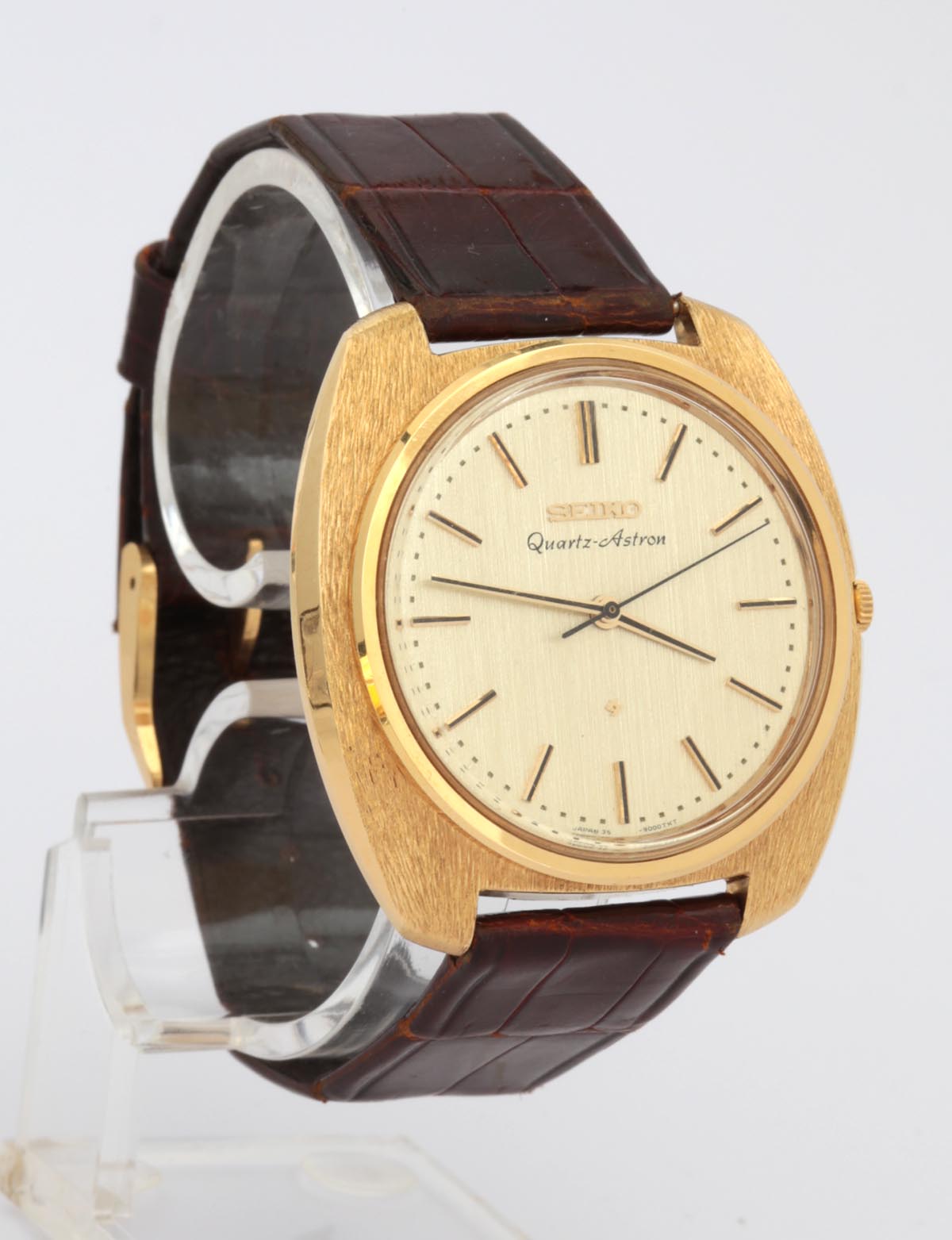
The Seiko Astron, launched on Christmas Day 1969 in an 18-karat gold case. Photo: Wikimedia Commons, CC BY-SA 4.0.
The Astron and the race to the wrist
Seiko had been working on quartz since 1959, shrinking laboratory crystal oscillators down toward the wrist, and by the late 1960s the company was in a quiet race with a Swiss consortium developing its own quartz movement, the Beta 21. Seiko got there first. The Astron, with its Caliber 35SQ, went on sale December 25, 1969, in an 18-karat gold case, priced at 450,000 yen, roughly $1,250 at the time. About a hundred sold in the first week, which is remarkable when you remember the most expensive mechanical Grand Seiko in the catalog cost less than half that. The Swiss showed the Beta 21 at the Basel fair in 1970, but the commercial moment belonged to Seiko. Then Seiko did something the Swiss never would have: it opened its quartz patents to the world, and the technology spread everywhere.
LEDs, LCDs, and the great cheapening
The first quartz watches still had hands. Then came the digitals. Hamilton’s Pulsar, launched in 1972 at $2,100, showed the time in glowing red LED numerals, but only when you pressed a button, because the display ate batteries alive. LCDs arrived a few years later: always visible, far cheaper to run, and soon far cheaper to make. American semiconductor firms like Texas Instruments and Fairchild poured into the business and drove prices through the floor. By 1982, quartz watches made up more than half of world watch production. The Astron had cost as much as a car. Thirteen years later, a quartz watch cost less than a tank of gas. That collapse in price is the whole story of the 1970s in one sentence.
How it works
A quartz watch starts with a battery and a tiny tuning-fork-shaped crystal of quartz, cut so it vibrates at an extremely stable frequency when current runs through it. Modern quartz crystals vibrate 32,768 times a second. An integrated circuit counts those vibrations and uses them to pulse a small stepping motor exactly once per second, which moves the hands. Digital versions skip the motor and just update a display. Because the crystal’s vibration barely changes with temperature or age, the result is accuracy measured in seconds per month instead of seconds per day. There is no mainspring, no escapement, no balance wheel. It is electronics doing the job mechanics used to do, and doing it about a hundred times better.

The Caliber 35A inside the Astron, the first quartz wristwatch movement ever sold. Photo: Wikimedia Commons, CC BY 3.0 de.
The quartz crisis
For Switzerland, the 1970s were a catastrophe with a name: the quartz crisis. Between 1970 and 1983, the number of Swiss watchmaking firms fell from around 1,600 to 600. Industry employment dropped from about 90,000 to 28,000. Switzerland had held more than half the world watch market in the 1960s; by 1978 it was down to a quarter, and Japan had passed it in production volume by 1980. Famous names went insolvent or vanished, and whole watchmaking towns hollowed out. The way out, ironically, was quartz itself: in 1983 the cheap, plastic, Swiss-made Swatch launched and proved the Swiss could play the new game, and the mergers that formed what became the Swatch Group consolidated the survivors. The industry that lived did so by accepting the crystal.
Where things stand
Quartz won, full stop. The overwhelming majority of watches sold on earth are quartz, and the mechanical watch survived by retreating upmarket, where it sells romance and craft instead of accuracy. Quartz kept improving at the edges: thermocompensated “super quartz” for extreme accuracy, solar charging that ends battery changes, radio and GPS time-syncing that makes setting a watch obsolete. The crystal ate the world and nobody noticed, because it ended up inside everything.
Why it matters
Quartz matters because it is the most important thing to happen to timekeeping since the pendulum, and the watch world spent decades pretending otherwise. It made accurate time cheap and universal, which is one of the genuinely democratizing things technology has ever done. It also nearly killed an entire country’s defining industry, which is worth remembering the next time someone tells you disruption is painless. Every cheap watch that runs for years on a battery is a descendant of a gold watch that cost as much as a car on Christmas Day 1969.
Thanks for reading this.

