
Every wristwatch sold before the 1920s was wound by hand, because there was no other way to do it. You turned the small crown on the side of the case, a ratchet clicked under your fingertip, and a coiled spring inside the watch tightened up to store the energy that would run it for the next day or so. Pocket watches worked the same way, except the earliest ones needed a separate key, a tiny brass thing that was exactly as easy to lose as you are imagining. The hand-wound movement is the oldest way to power a wristwatch, and despite a century of competition, it never went away.

A pocket watch movement from 1879, from the era when a separate key did the winding. Photo: Wikimedia Commons, public domain.
Keys, crowns, and the first wristwatches
For the first few centuries of the watch, winding meant a key. Pocket watches had a square post on the movement, and you carried a little key to fit it, which meant the key was always somewhere else when you needed it. In the 19th century the stem-winding crown replaced the key: a knob on the side of the case that wound the spring when you turned it and set the hands when you pulled it out. One less thing to lose, which was genuinely a big deal at the time. When the wristwatch showed up in the early 1900s, first on soldiers and then on everybody else, it inherited the crown and the daily winding ritual wholesale. For the first two decades of the wristwatch, nobody called it hand-wound. It was just what watches were.
How it works
Turning the crown tightens the mainspring, a long ribbon of spring steel coiled inside a little drum called the barrel. Let go and the spring starts unwinding, pushing a train of gears that ends at the escapement, the fussy little mechanism that meters energy out in beats, and the balance wheel that swings back and forth to keep the beat honest. Most hand-wound watches tick at 18,000 to 28,800 beats per hour and run somewhere between 36 and 72 hours on a full wind, depending on the movement. When the spring runs down, the watch stops, and you wind it again. There is no mystery to it, which is part of the appeal. I have stood in my kitchen winding a watch while the coffee brewed and felt like a person with his life together, which tells you how low the bar is.
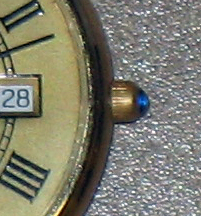
The crown, where your fingers still do the work on a hand-wound watch. Photo: Wikimedia Commons, public domain.
How long does a wind last?
That stored energy is measured as power reserve: how long the watch runs on a full wind. Most hand-wound watches manage somewhere between 36 and 72 hours, which is the whole reason the daily winding ritual exists, and squeezing out more hours is genuinely hard engineering. A longer reserve needs a longer mainspring, a stronger one, or two barrels working together, and every option makes the power delivery lumpier, because a spring shoves hardest when fully wound and weakest when nearly spent. The old mechanical fix for that was the fusee, a cone and chain that evened the torque out. The practical upshot is simple: wind it every morning and you never think about it, skip a day and it stops, and no amount of engineering changes the deal.
Where things stand
Hand-wound movements survive today for three reasons, and none of them is convenience. First, thinness: without a rotor swinging over the top, a hand-wound movement can be slimmer, which is why slim dress watches, like the 1815 line from A. Lange & Söhne, still wind by hand. Second, tradition: some brands keep hand-wound calibers because their history is hand-wound and changing it would feel like a betrayal. Third, the ritual: a vocal minority likes the daily thirty seconds of turning the crown and feeling the spring tighten, a small analog chore in a day full of screens. Automatic movements outsell hand-wound by an enormous margin. The hand-wound watch is a minority taste, and it knows it.
Why it matters
The hand-wound watch matters because it is the original deal, the unbroken line back to the first wristwatches, and it asks something of you. An automatic borrows energy from your day. A quartz watch asks for a battery every couple of years. A hand-wound watch asks for thirty seconds of your attention every morning, and in exchange it tells you the time and reminds you that it is a machine, not magic. It is a small thing, and on the right morning it is a pretty good one.
Thanks for reading this.

