


You have $6,000 and you want three watches instead of one. Fine. Here is how I would spend it: $2,330 on a Nomos Tangente, $1,840 on a Sinn 556 I in mother-of-pearl, and $1,750 on a Doxa SUB 200T Divingstar. That comes to $5,920, which leaves you $80. Buy a strap. Or lunch.
Nomos Tangente ($2,330) for the wrist time that matters. Sinn 556 I MOP ($1,840) for every day, including the days with water. Doxa SUB 200T Divingstar ($1,750) for the days you want a yellow dial and a real dive watch. Total: $5,920. The Nomos gets the most money because it has the most watchmaking in it.
The three at a glance
| Doxa SUB 200T Divingstar | Nomos Tangente 101 | Sinn 556 I MOP | |
|---|---|---|---|
| Reference | 804.10.361.31 (Iconic Yellow, rubber) | 101 | 556.0105 |
| Movement | Swiss automatic, 38-hour reserve (Doxa names no caliber; SW200-1 base) | Nomos DUW 4001, manual wind, up to 53-hour reserve | Sinn SW200-1 automatic, 38-hour reserve |
| Case | 39mm x 10.7mm, 41.5mm lug to lug | 35mm x 6.2mm, 45mm lug to lug | 38.5mm x 11mm, 45.5mm lug to lug |
| Crystal | Sapphire, AR coating | Sapphire | Sapphire front and back, AR coating |
| Water resistance | 200m | 5 atm (splash-proof) | 200m |
| Dial | Iconic Yellow | White silver-plated | Black mother-of-pearl |
| Price | $1,750 | $2,330 | $1,840 |
Doxa SUB 200T Divingstar (804.10.361.31): $1,750
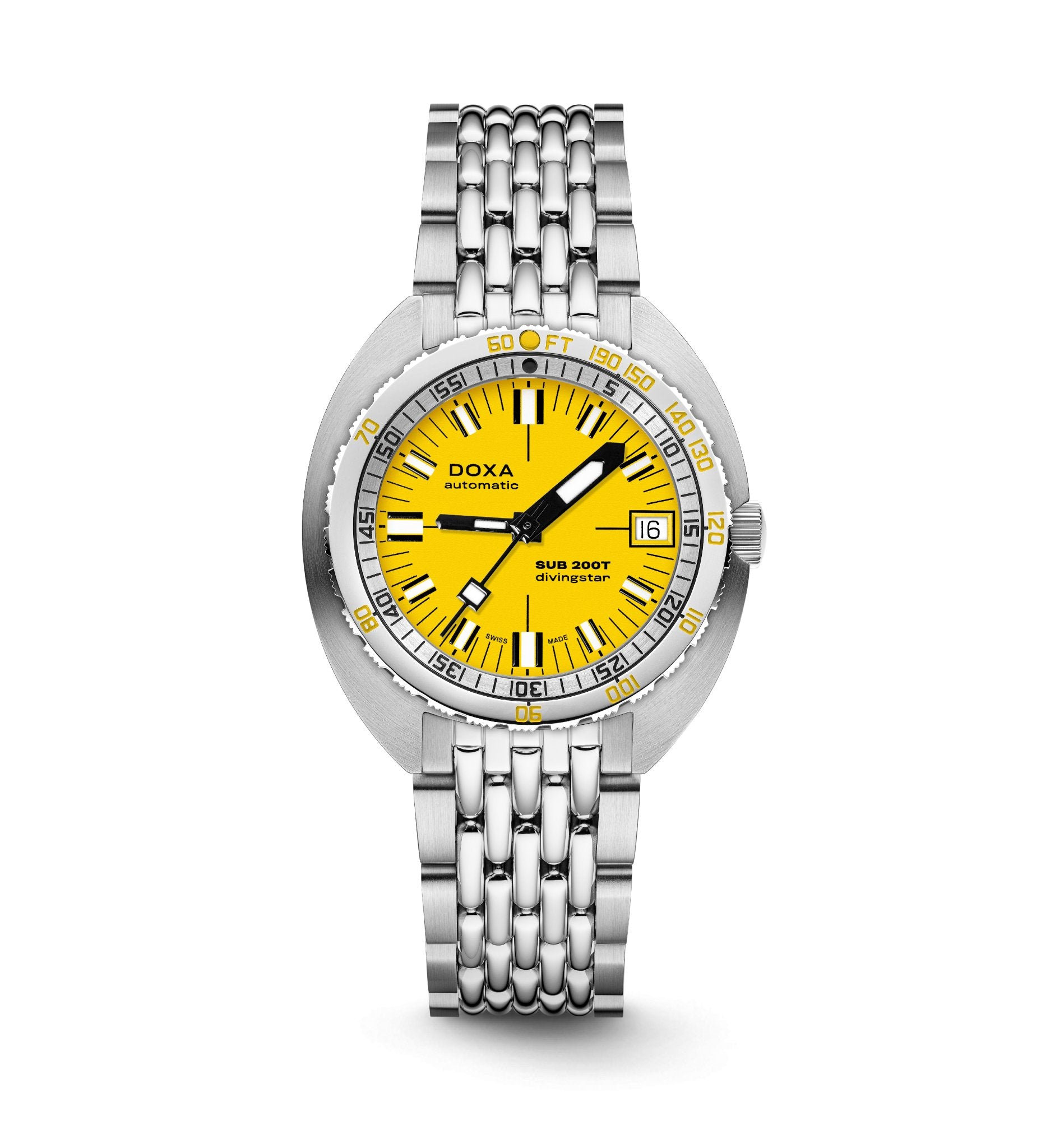
The Doxa SUB 200T Divingstar in Iconic Yellow. Photo: Doxa.
What it is good at: being a real dive watch that does not wear like a hockey puck. Thirty-nine millimeters, 10.7mm thick, 200 meters of water resistance, a screw-down crown, and Doxa’s patented unidirectional bezel with the US Navy no-decompression table baked in. The yellow dial is the most recognizable color in diving, and on the 200T it comes in the classic matte Iconic finish (a sunray version exists at the same price if you want some shine). The FKM rubber strap has a butterfly clasp with a sliding wetsuit extension, which is the correct hardware for a watch like this. Nobody outside the hobby will miss this watch. That is the point of a Doxa.
The catch: the yellow dial is a commitment, not a neutral. This is not the watch you wear when you want to disappear. The 38-hour power reserve is short; skip it for a weekend and it is stopped Monday. Doxa publishes no accuracy rating for it, so buy the watch for the dial and the case, not a number. And the movement is the industry-standard automatic (more on that below), which means the premium over a $600 watch is paying for the case, the dial, the bezel, and the name. That is a fair trade at $1,750, but know what you are buying.
Would I buy it? Yes, on the rubber, in the Iconic Yellow. The yellow is the entire point of a Doxa. Buying a Divingstar in a quiet color is like ordering a decaf espresso. Technically possible. Misses the point.
Nomos Tangente (101): $2,330
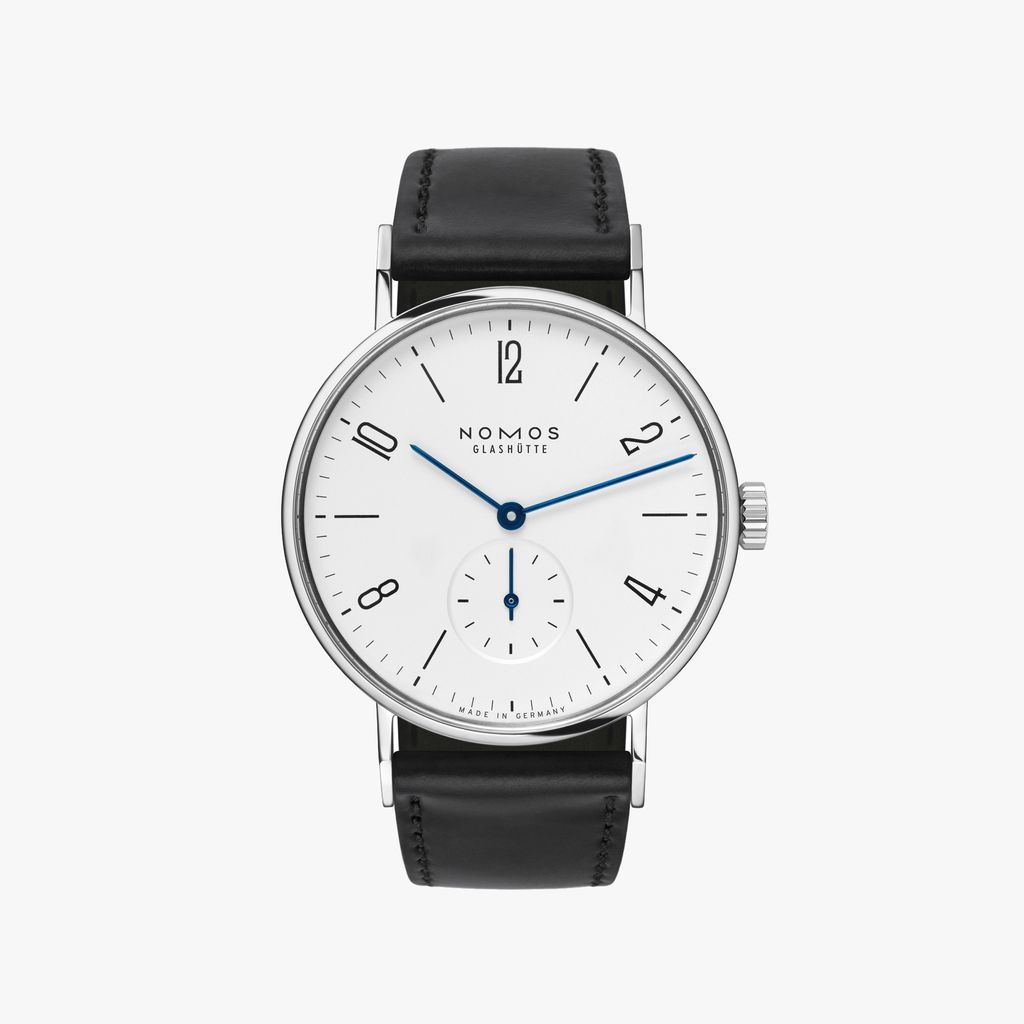
The Nomos Tangente, ref. 101. Photo: Nomos Glashutte.
What it is good at: being the best-made watch here by a clear margin. Thirty-five millimeters, 6.2mm thin, a white silver-plated dial with tempered blue steel hands, on a black Horween shell cordovan strap. The movement is genuinely in-house, finished to Glashutte standards, with a power reserve Nomos rates at up to 53 hours. People file Nomos under Bauhaus. To my eye the Tangente reads more like a 1930s Glashutte dress watch, all thin lugs and printed numerals, which is not a coincidence given the address on the dial. I own the Rosemarie version of this watch. I am a sucker for it, and I am not pretending otherwise.
The catch: 5 atmospheres is splash-proof, which means this watch stays dry. It does not swim, it does not shower, it watches the other two do those things. Thirty-five millimeters wears small if you are used to 40mm and up, and the long 45mm lug to lug only partly compensates. You wind it by hand every couple of days, forever. The solid steel caseback on the ref. 101 means the movement finishing is for your watchmaker, not for you. And when it needs service, it goes to Nomos or someone Nomos supplies. Parts and know-how live in Glashutte.
Would I buy it? I already did. The Tangente Rosemarie is in my watch box right now. Of the three watches in this article, it is the one I would save.
Sinn 556 I MOP (556.0105): $1,840
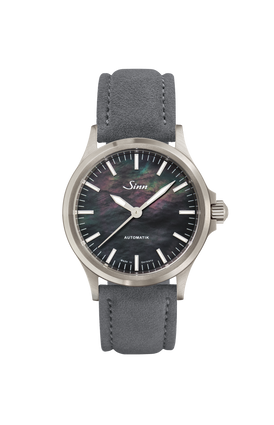
The Sinn 556 I Mother-of-Pearl. Photo: Sinn.
What it is good at: being the watch you actually wear. Thirty-eight and a half millimeters, 200 meters of water resistance, sapphire crystal front and back, anti-magnetic per DIN 8309, low-pressure resistant, and a shimmering black mother-of-pearl dial that is different without being loud. Mother-of-pearl is a natural material, so no two dials are identical, which is either a feature or a gamble depending on your temperament. The gray Alcantara strap keeps it casual. This is the least precious watch here and the one that would get the most wrist time, which counts for a lot.
The catch: the 38-hour reserve again. A weekend off the wrist means setting it Monday. The movement is the same family as the Doxa’s, so at $1,840 you are paying for Sinn’s case, dial, and engineering standards rather than the engine. Sinn publishes no accuracy rating for it either. And if you decide later that you want the quick-adjust H-link bracelet, that is another $590 on top. Budget accordingly or commit to the strap.
Would I buy it? Yes. This is the everyday watch of the three, the one that goes to work, to dinner, and in the water. Every collection needs the watch that needs nothing from you.
The movements, up close
Doxa’s unnamed automatic
Doxa does not name the caliber in the SUB 200T. Their spec sheet says Swiss self-winding mechanical movement, 38-hour power reserve, 28,800 vibrations per hour, decorated by Doxa. The base is the Sellita SW200-1, the industry-standard automatic that powers half the Swiss watches under $2,000. Twenty-six jewels, hacking seconds, hand-winding. It starts every morning and any watchmaker can fix it.
Good: any watchmaker on the planet can service it, parts will exist for decades, and 28,800 vph gives a smooth seconds sweep. Bad: 38 hours of reserve is short by modern standards. Doxa publishes no accuracy rating, so buy the watch for the dial and the case, not a number on a spec sheet. The solid steel caseback means the Doxa decoration is something you will never see, which makes it a strange thing to advertise, but here we are.
Nomos DUW 4001
This is the real thing. The DUW 4001 is Nomos’s in-house hand-wound caliber, the current form of the movement they introduced as the Alpha in 2005, developed from the old Peseux 7001 architecture. What Nomos has changed since is substantial. The caliber runs the NOMOS swing system, their own escapement, which is the difference between assembling a movement and making one. Glashutte three-quarter plate. Glashutte stopwork. The DUW regulation system. Seventeen jewels, tempered blue screws, Glashutte ribbing and NOMOS perlage, Glashutte sunburst on the ratchet and crown wheel. Nomos rates the reserve at up to 53 hours and says each caliber is adjusted in six positions. That last one is a brand claim, but it is a serious claim at $2,330.
The movement is 2.6mm thick, which is why the watch is 6.2mm thin. That thinness is the whole design. A thicker movement would mean a thicker watch, and the Tangente at 8mm would be a different, worse watch.
Good: genuinely in-house, genuinely thin, 53 hours is excellent for a hand-wound watch, and six-position adjustment is proper watchmaking at this price. Bad: manual wind only, no automatic option at this reference. The solid caseback on the ref. 101 hides all that finishing. If you want to look at it, the sapphire-back ref. 139 costs more. And service runs through Nomos in practice, since the parts and the know-how live in Glashutte.
Sinn SW200-1
Sinn, unlike Doxa, names the caliber outright: the Sellita SW200-1. Twenty-six jewels, 28,800 vibrations per hour, seconds stop, anti-magnetic per DIN 8309. Same engine family as the Doxa’s. Two watches, $1,750 and $1,840, same architecture inside. The money in both cases goes to the case, the dial, the crystal, and the name on the dial. There is nothing wrong with that. It is how the watch industry works below five figures. But it is worth knowing, because it means the choice between the Doxa and the Sinn is a choice about the watch, not the engine.
Good: an honest spec sheet that names the caliber, serviceable by any competent watchmaker, parts forever, and visible through the sapphire exhibition back if you want to look. Bad: 38 hours of reserve, same as the Doxa. Sinn publishes no accuracy rating for it. And at $1,840, you should know the movement is the same family as the one in the $1,750 Doxa and in watches costing a third of either. You are paying for Sinn’s engineering standards, the 20-bar case, and that dial. Fair, as long as it is a knowing purchase.
Living with all three
The Nomos needs winding every couple of days. The 53-hour reserve gets you through most of a weekend off the wrist, but it is still a hand-wound watch, and that is either a ritual you enjoy or a chore. There is no way to know which until you live with it. I enjoy it. Your mileage may vary.
The Doxa and the Sinn are automatics with 38-hour reserves, which means a weekend off the wrist leaves both of them stopped Monday morning. You will set the time and date on both. Normal for watches at this price, mildly annoying forever.
The Sinn is the only one you can swim with. The Doxa is the only one you should dive with. The Nomos stays dry and looks better than both of them doing it.
Service math: the two SW200-1 watches can be serviced by any competent watchmaker, a few hundred dollars every five to ten years. The Nomos goes back to Nomos or a watchmaker they supply. None of these have the no-regulator problem of some Swatch Group calibers. All three are conventionally serviceable, which is worth something at this price.
Price and availability
The Doxa lists at $1,750 on the FKM rubber strap and $1,790 on the beads-of-rice bracelet, direct from Doxa. The Nomos is $2,330 direct from Nomos. The Sinn is $1,840 on the gray Alcantara strap through WatchBuys, the US importer, which gets you the full manufacturer warranty. The quick-adjust H-link bracelet is $590 extra if you want it later. Total for the three, cheapest configurations: $5,920 before tax and shipping. Price checked: October 4, 2026.
Why these three
A three-watch collection has to cover three jobs without stepping on itself. The Nomos is the dress watch and the serious watchmaking. It cannot swim and it needs winding, but nothing else here does what it does. The Sinn is the everyday watch. It swims, it goes to dinner, it needs nothing from you. The Doxa is the fun one and the real dive watch. Yellow dial, 200 meters, zero interest in blending in.
No two of them do the same job. That is the whole test. The Nomos never touches water, the Doxa never touches a suit, and the Sinn fills in everything between them. Office, weekend, pool, wedding. $5,920 total, every watch bought for what it is good at instead of one watch asked to be everything.
Further reading
- Manual Wind: how the Nomos’s DUW 4001 works and why a 53-hour reserve matters on a hand-wound watch.
- Automatic: what the SW200-1 in the Doxa and the Sinn does on your wrist while you ignore it.
- Water Resistance: why the Sinn and Doxa swim and the Nomos watches from the shore.
Thanks for reading this.


Leave a comment