
Tudor has been around since 1926, which the brand wants you to know because this is their hundredth year, and in all that time they have never quite escaped being introduced as Rolex’s little brother. Hans Wilsdorf founded Rolex, then founded Tudor as the watch you could buy if you could not buy a Rolex, and a century later people still ask, out loud, at parties, whether a Tudor is “like a fake Rolex.” It is not a fake Rolex. It is the most successful affordable-sibling act in the history of watchmaking, it just happens to have spent decades as the punchline before spending the last fifteen years as the punchline’s comeback story.
Hans Wilsdorf’s second watch
The name was first registered in 1926 by the Genevan watch house of Veuve de Philippe Hüther, acting on behalf of Hans Wilsdorf, and Wilsdorf took it over outright in 1936. What he wanted, and he said this plainly, was a watch at a more modest price than Rolex that would still hold Rolex’s standard for dependability. The company proper, Montres Tudor SA, was founded in 1946, right after the war, with Wilsdorf at the helm. The business model was elegantly cheap: Tudor got Rolex’s cases, crowns, and bracelets, including the famous waterproof Oyster case, and powered them with off-the-shelf Swiss movements from makers like Fleurier and later ETA. So you bought a Tudor and got, essentially, Rolex’s shell with someone else’s engine, which is the kind of honest compromise that makes you either respect Wilsdorf or suspect the whole thing was a marketing scheme. Maybe it was both.
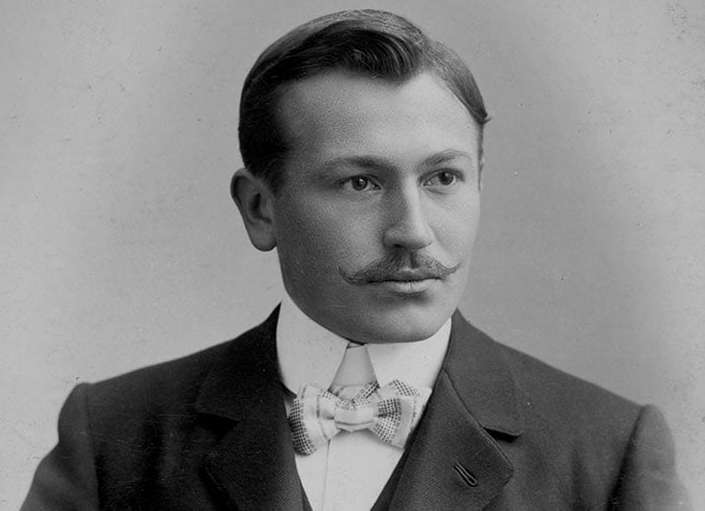
Hans Wilsdorf, founder of Rolex and Tudor. Photo: Wikimedia Commons, Public domain.
The navy years
Tudor debuted its Oyster collection in the mid-1940s, borrowing the case that had made Rolex famous, and in 1952 came the Oyster Prince, the brand’s first self-winding watch. Twenty-six Oyster Princes went along on the British North Greenland Expedition of 1952 to 1954, which is the kind of field-testing story brands still brag about seventy years later. Then came the dive watches. Tudor launched the Oyster Prince Submariner in 1954, rated to 100 meters and bumped to 200 meters by 1958, and spent the next thirty years selling tool watches to navies. From the 1960s to the mid-1980s, Tudor supplied dive watches in bulk to the French Marine Nationale, shipping them without bracelets so the divers could use their own straps. The French issued MN Subs became the backbone of the brand’s legend, and in 1969 the snowflake hands appeared on those watches, the big squared-off hour hand that looks like a magnified snowflake particle and that Tudor still builds its whole visual identity around today. There were also watches for the US Navy starting in 1964, the 1957 Advisor alarm watch, and the chunky 1970s Oysterdate chronographs collectors call the Big Block. By the time the quartz crisis hit, Tudor had a genuine heritage as a maker’s maker of dive watches, and nobody outside a handful of nerds and some French frogmen knew it.

Tudor Pelagos dive watch. Photo: Wikimedia Commons, CC BY-SA 4.0.
The wilderness years
The quartz crisis flattened the whole industry and Tudor was not spared, but the brand’s real low point came later, in its own slow, self-inflicted way. In 1996 Tudor began scrubbing Rolex’s name off its dials and cases, standing on its own feet at last, which sounds noble but also meant giving up the one thing everyone associated with the brand. By the early 2000s Tudor had pulled out of the US and UK markets entirely and spent the decade getting fatter, gaudier, and more directionless, chasing the oversized luxury fashion-watch trend that swallowed so many Swiss brands whole. This is the era people mean when they talk about Tudor’s lost years, when the watches were technically fine and emotionally inert, and when “poor man’s Rolex” stopped being a pricing strategy and started being a punchline. The company was still standing, still in Geneva, still under the Hans Wilsdorf Foundation that owns Rolex, but it had no idea who it was talking to.
Black Bay and the comeback
The turnaround started with Davide Cerrato, who ran marketing, design, and product development at Tudor from 2007 to 2015 and led the relaunch that saved the brand. In 2010 Tudor launched the Heritage Chrono, a reissue of one of its 1970s chronographs, and it woke up a whole generation of collectors who had never taken the brand seriously. Then came 2012, the year that changed everything. The Heritage Black Bay, a burgundy-bezel diver with snowflake hands and a design language pulled from Tudor’s own 1950s through 1970s back catalog, became an instant classic, and the Pelagos, Tudor’s first genuinely modern dive watch in titanium, launched the same year. Tudor re-entered the US market in 2013 to genuine excitement, which must have felt surreal to anyone who had watched the brand slink off a decade earlier. The formula was simple, which is why it worked: take the tool-watch history, lean hard into vintage styling, price it well under Rolex, and let the Born to Dare marketing do the rest. A lot of the charm of the Black Bay is that it is a tribute act to Tudor’s own history, and somehow that turned out to be the most honest thing the brand could do.

Tudor Black Bay 54. Photo: Wikimedia Commons, CC BY-SA 4.0.
Making its own engines
For nearly seventy years, Tudor’s dirty little secret was that somebody else made its movements. That ended in 2015 with the brand’s first in-house manufacture calibre, the MT5621, launched in the North Flag and the Pelagos. The MT5600 series brought 70-hour power reserves, silicon balance springs, COSC chronometer certification, and a price point that still undercut everything comparable from bigger names. In 2016 Tudor founded Kenissi, its own movement manufacture (the name comes from the Greek word for movement), and the following year entered a movement exchange with Breitling, which reads like a footnote but is really a sign of how far Tudor had come: the little brother was now supplying technology to a brand with its own proud history. Chanel bought into the Kenissi alliance in 2018. The brand had gone, in less than a decade, from selling generic movements in Rolex cases to running a movement factory that supplies the industry.
Where it stands now
Here is the honest part. Tudor lives in Rolex’s shadow and probably always will, and that is both the brand’s safety net and its ceiling. The “poor man’s Rolex” thing never really went away, it just got friendlier, and there is something faintly comic about collectors now paying four figures for the watches that once proved you could not afford a Submariner. Prices have climbed a lot since the Black Bay’s debut, some models now come with the waiting-list theater borrowed from big brother, and the vintage-nostalgia formula that saved the brand is, at this point, a carefully managed product strategy rather than an accident. None of that changes the fact that Tudor makes genuinely excellent watches for the money, with real in-house movements and build quality that embarrasses brands charging twice as much. A hundred years in, it has finally grown into Wilsdorf’s original pitch: Rolex quality at a Rolex discount, except now the discount is smaller and the quality is the brand’s own.
Why it matters
Tudor is the most interesting second act in modern watchmaking, a brand that spent fifty years as an afterthought, nearly disappeared, and came back as one of the industry’s best-run companies. It matters because it proves that heritage is worthless until somebody decides to use it on purpose, and because its in-house movement program dragged the whole affordable-luxury segment upward. It also matters as a cautionary tale: every brand that ever said “we are just like Rolex, but cheaper” should have to look at the decades when Tudor actually believed its own press releases and produced nothing worth remembering. The comeback worked because the watches got good first and the marketing followed, which is the opposite of how most brands do it.
Official site: tudorwatch.com
Thanks for reading this.

