
In 1854, a company called the Waterbury Clock Company started making clocks in Waterbury, Connecticut. By the 1890s it was making pocket watches for a man named Robert H. Ingersoll, and in 1892 they released the Ingersoll Yankee, a watch that sold for exactly one dollar and became known as the watch that made the dollar famous. That cheap little watch is the whole foundation of Timex, the American brand that would go on to make more watches than practically anyone else on earth. The Timex name itself didn’t show up until 1950, but the idea behind it was already half a century old: put a working watch on every wrist in the country, and don’t worry about whether the Swiss approve.

The first-generation Timex Ironman, released in 1986. Photo: Wikimedia Commons, CC BY-SA 4.0.
The dollar watch years
Timex traces itself back to 1854, when the Waterbury Clock Company set up shop in the Naugatuck River Valley of Connecticut, a region that was churning out so many clocks it picked up the nickname “the Switzerland of America.” The clocks were cheap and American-made, sold as the affordable alternative to fancy European pieces. That positioning, affordable for regular people, never really left the company’s DNA.
The big break came in 1892, when Waterbury entered a partnership with salesman Robert H. Ingersoll to build the Ingersoll Yankee, a pocket watch priced at one dollar. By the turn of the century the company had sold more than six million of them. Farmers checked them during harvests, train conductors relied on them, factory workers set their breaks by them. Legend has it that Mark Twain himself sent in a dollar for his own Yankee, and honestly, whether or not that’s perfectly true, the story tells you everything about what the brand was going for.
The company had its ups and downs. Waterbury went bankrupt around the turn of the century, reorganized, and eventually its plant was bought by Ingersoll himself in 1914. During World War I, the Army had the company retool the Yankee into wristwatches for soldiers, and returning veterans kept wearing them, which helped push the wristwatch into everyday civilian life in the 1920s. In 1933, Waterbury won an exclusive license from Walt Disney to make the first Mickey Mouse clocks and watches, and parents bought two million of them within a few years. That part of the story tends to get forgotten, but it’s a reminder that this company was always, first and foremost, in the business of selling enormous numbers of cheap timepieces to regular Americans.
War, Olsen, and the birth of a new company
In 1941, a Norwegian shipping man named Thomas Olsen, along with engineer Joakim Lehmkuhl, bought a controlling interest in the nearly bankrupt Waterbury Clock Company. The timing meant the company went straight into the war effort. Rather than making watches for consumers, the renamed United States Time Corporation (the shareholders voted for the new name in 1943) mass-produced mechanical time-delay fuses, precision bomb timers, and stopwatches for the military. It became the largest producer of fuse timers for precision defense products in the United States, and the War Department awarded the company the Army-Navy “E” Award for excellence in 1943.
The war years mattered for reasons that had nothing to do with the battlefield. The company developed a hard new alloy called Armalloy for military bearings, and it got very, very good at automated mass production of tiny precision parts. When the war ended and defense orders dried up, Lehmkuhl had an idea: apply the wartime tooling and automation to make an inexpensive watch that was accurate and durable. The design was simpler than a Swiss watch. Instead of expensive ruby jewels for the bearings, the movement used Armalloy. It had fewer parts. It was tougher. And it was cheap to build.
The Timex brand debuted in 1950, its name reportedly a mash-up of Time magazine and Kleenex, which is one of those origin stories that sounds made up and is somehow true. The watches were priced around seven or eight dollars, less than half of what a basic Swiss watch cost, and they worked. For a country that had just spent a decade buying one-dollar Mickey Mouse watches, a seven-dollar watch that didn’t break was an easy sell.
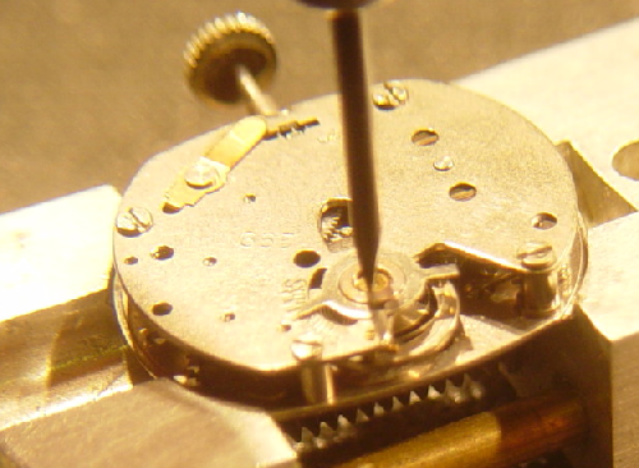
A circa-1959 Timex watch disassembled, showing the simple, jewel-free V-Conic-style movement. Photo: Wikimedia Commons, CC BY-SA 4.0.
“It takes a licking and keeps on ticking”
Timex knew exactly what it had, which was a watch that could survive abuse, so it made the abuse the entire marketing campaign. Early print ads strapped Timex watches to Mickey Mantle’s baseball bat, froze them in ice cubes, spun them inside vacuum cleaners, taped them to a lobster’s claw, and wrapped them around a turtle in a tank. Subtle it was not.
Then in 1956 the company put veteran NBC newscaster John Cameron Swayze on live television with a series of torture tests. A Timex went through paint mixers, jackhammers, washing machines, and dishwashers. One was strapped to a diver who leapt off the 87-foot La Quebrada cliffs in Acapulco. After every test, Swayze held the still-ticking watch up to the camera and delivered the line: “It takes a licking and keeps on ticking.”
The campaign was an absolute phenomenon. By 1958 Timex had sold more than five million watches, and by the end of the decade roughly one out of every three watches bought in the United States was a Timex. Thousands of viewers wrote in suggesting new torture tests for the poor watches. The campaign finally ended in 1977 with a planned gag: an elephant stomped a Timex flat, and Swayze deadpanned, “It worked in rehearsal.” You could write a whole separate article just on those ads. They were probably the most famous watch advertising in American history, and they cemented something in the public mind that no spec sheet could: a Timex might be cheap, but it would not quit.
Quartz, Ironman, and Indiglo
The 1970s nearly killed Timex. Cheap Japanese quartz movements did to the mechanical Timex what the Timex had done to everyone before it, undercut it on price and outmatched it on accuracy. The company shut down plants and shed jobs, and for a while it looked like the brand would end up as a nostalgia footnote.
It fought back with two moves that actually worked. In 1986, Timex launched the Ironman Triathlon, developed with input from triathletes, and it became a monster hit: a digital sports watch with time, stopwatch, timer, alarms, and hourly chime, aimed squarely at runners and weekend warriors. It was such a hit that Timex has now sold more watches than any other American brand in history, with total Timex sales passing one billion pieces.
Then in 1992 came Indiglo, an electroluminescent backlight that lit the whole dial in a soft blue-green glow at the push of the crown. It was a genuine innovation in the cheap-watch world, and it made the Ironman and its siblings the default choice for anyone who needed to read a watch in the dark. Other watchmakers eventually adopted similar reflective dial technology. The glow is so tied to the brand that it’s hard to picture a Timex digital without it.

A vintage Timex electronic LED watch from the 1970s, the quartz era that nearly sank the company. Photo: Wikimedia Commons, CC BY-SA 2.0.
The modern reissue boom
Today the company is Timex Group B.V., a privately held Dutch-American holding company based in Middlebury, Connecticut, owned since 2020 by the Boston investment firm Baupost Group. The group also owns or licenses brands like Guess, Nautica, and Versace, but Timex the watch brand is the heart of it, still headquartered in the same Connecticut town where all of this started.
And something funny happened in the last decade: Timex became cool. Or at least, the parts of Timex that collectors could project their affection onto became cool. The brand started digging through its own archives and reissuing old designs, and the watch internet ate it up. The Marlin, a 1960s dress watch, came back in 2017 as a 34mm hand-wound reissue, and it sold out almost immediately. The Q Timex, a 1979 quartz diver-style model, got a faithful reissue in 2019. The MK1, a military-inspired piece, followed the same formula. Suddenly you could buy a genuinely charming, historically honest watch for under two hundred bucks, and people who would never look twice at a full-price Ironman were lining up.
The company also gave itself a design credibility boost with the Giorgio Galli Design Lab, an Italian design studio in Milan (acquired in 2007) that now designs across the Timex range. Between the reissues and Galli’s cleaner, more modern pieces, Timex has managed something unusual: it stayed cheap, and it got interesting. Not every attempt lands, and the modern catalog still has plenty of generic quartz fill, but the willingness to raid the archives instead of pretending to be something they’re not is one of the smartest things any American watch company has done in years.
Why it matters
Let’s be honest about what Timex is. It’s a mass-market brand that sells enormous volumes of inexpensive watches, many with thoroughly mediocre movements, and a good chunk of its modern identity is nostalgia farming aimed at people who fondly remember a watch they got as a kid. The dollar watch era was brilliant and democratic, but the company also spent decades making basically disposable product, and some of its trend-chasing collaborations and licensed fashion watches are the kind of thing that makes collectors roll their eyes. Timex is not making fine watches, and it doesn’t pretend otherwise. Good.
Here’s the thing, though: Timex might be the most honest company in the watch business. It never asks you to worship it. It doesn’t write tortured prose about heritage or sell you a story about a manufacture in the mountains. It sells you a watch for forty dollars and it tells the truth about what it is. The Yankee dollar watch genuinely put timekeeping in the hands of ordinary Americans in a way nothing else did. Indiglo was a real, clever piece of technology. The Ironman genuinely owned the sports watch category for a decade. And the modern reissues, for all that they’re selling nostalgia, are genuinely well-judged watches at genuinely fair prices, which is more than you can say for a lot of luxury brands charging fifty times as much for the same trick.
There is also something quietly admirable about a 170-year-old company that started out selling watches to factory workers and still sells watches to regular people, through drugstores and big-box stores, at prices a teenager can afford. Most of the watch industry spent the last thirty years running uphill toward luxury, convinced that dignity lives at a higher price point. Timex stayed down here with the rest of us. It takes a licking, as they say, and it keeps on ticking. The slogan was never really about the watches.
Official site: timex.com
Thanks for reading this.

