
TAG Heuer is a Swiss watch company founded in 1860 by Édouard Heuer in Saint-Imier, a small town in the Jura mountains where the clocks mattered more than anything else in town. For its first century it was simply called Heuer, and it built its reputation on chronographs and stopwatches, the kind of instruments that timed races and airplanes and Olympic events before anybody had figured out how to put “Swiss Made” on a marketing slide. In 1985 the company was bought by Techniques d’Avant Garde, becoming TAG Heuer, and in 1999 it was absorbed into LVMH. It is one of those brands that everybody has heard of, which is either a compliment or a warning depending on how you look at it.
The Heuer years, 1860 to the 1970s
Édouard Heuer set up his workshop in 1860 and immediately started patenting things, because that is what 19th-century watchmakers did instead of posting on forums. His big one came in 1887: the oscillating pinion, a little component that let a chronograph engage and disengage without the whole mechanism throwing a fit. It is still used in mechanical chronographs today, which is a genuinely impressive shelf life for an invention, like a kitchen appliance from the 1800s that your grandmother still uses. Heuer spent the next few decades timing everything that moved: dashboard chronographs for cars and planes in 1911, and in 1916 the Mikrograph, a stopwatch accurate to 1/100th of a second, which at the time must have felt like science fiction. The brand was the official timekeeper for the Olympics at Antwerp, Paris, and Amsterdam in the 1920s. This was a serious instrument company, not a fashion house. People who wore Heuers were usually holding a steering wheel or standing next to a runway.
Jack Heuer and the racing era
In the 1960s, the founder’s great-grandson Jack Heuer was running the company, and he understood something that most Swiss watchmakers of the era did not: racing was about to become the most glamorous thing on the planet, and the wrist was the place to be. In 1964 he launched the Carrera, named after the Carrera Panamericana, a Mexican road race so dangerous it makes modern motorsport look like a church picnic. The Carrera had a clean, readable dial with no clutter, designed so a driver could glance at it at 150 miles an hour without dying. It worked. Then in 1969 came the big one-two punch. First, the Calibre 11, one of the first automatic chronograph movements in the world, developed jointly with Breitling, Hamilton-Buren, and the movement specialists Dubois Dépraz (a group called Project 99, because even watch nerds like code names). Second, the Monaco, a square blue-dialed chronograph housing that new movement, the first square water-resistant automatic chronograph ever made. Jack named it after the Monaco Grand Prix, his favorite race.
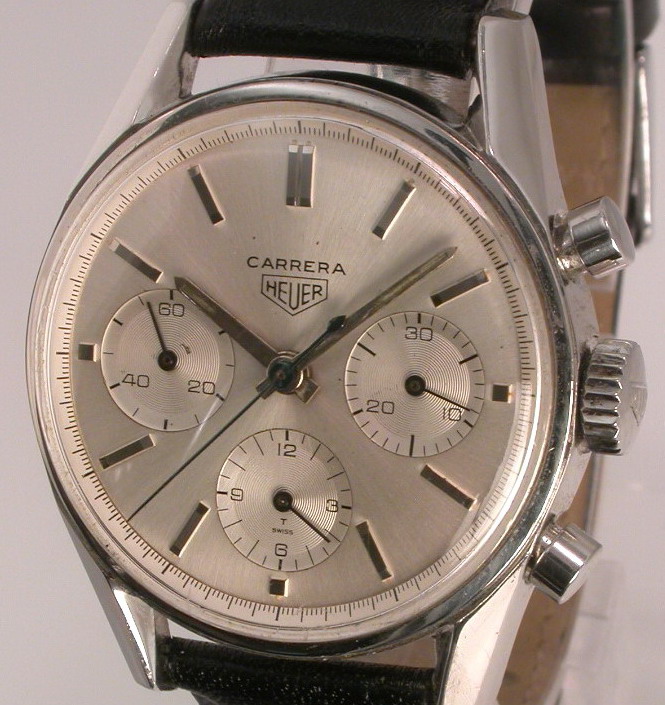
An original 1964 Heuer Carrera. Photo: Wikimedia Commons, public domain.
And then Steve McQueen happened. Filming Le Mans in 1971, McQueen was playing a race car driver and needed a watch, and somebody on the wardrobe team handed him the Monaco. He wore it through the whole film. That one decision, by a guy who mostly just wanted to drive fast, turned the Monaco into arguably the most famous square watch ever made. Meanwhile Heuer was the official timekeeper for Ferrari’s Formula 1 team through most of the 1970s, and Jack Heuer personally timed the drivers, standing around pit lanes with a stopwatch while history happened. This is the era the entire brand still lives off, and honestly, it earned it.
The quartz crisis and the TAG takeover
The 1970s ended badly for almost every Swiss watch company, and Heuer was no exception. Quartz watches, cheap and accurate and battery-powered, gutted the mechanical industry, and by the early 1980s Heuer was in serious trouble, the kind of trouble where people start having meetings about selling the building. What saved it was a rich man with a taste for racing: Mansour Ojjeh, whose company Techniques d’Avant Garde (TAG) bought a majority stake in 1985. That is when Heuer became TAG Heuer, and the brand changed direction completely. The new playbook was fashion, not instruments. In 1986 they launched the TAG Heuer Formula 1, a line of brightly colored plastic quartz watches that were cheap, fun, and sold in enormous numbers. Watch snobs turned their noses up, but those plastic watches paid the bills and kept the lights on in La Chaux-de-Fonds. Say what you want about them, they were the right product at the right time, which is more than most of the Swiss industry managed in the 1980s.
LVMH and the modern era
In 1999, LVMH bought TAG Heuer, and the brand entered its luxury-group era, with all the polish and all the price increases that implies. The racing connections kept getting bigger: official timekeeper of Formula 1 from 1992 to 2003, and a long-running partnership with McLaren that is still going. In 2015, under CEO Jean-Claude Biver, TAG Heuer did something no Swiss luxury brand had done and launched the Connected, a $1,500 smartwatch built with Intel and Google that ran Android Wear. People laughed, and then people bought it, because it turns out there were wealthy men who wanted their texts on their wrist but wanted the bezel to say TAG Heuer. It even came with a trade-in deal: after a year, you could swap it for a mechanical watch, which tells you everything about how the Swiss watch industry felt about smartwatches. Today the company is led by Béatrice Goasglas, who took over as CEO in May 2026 after rising through the company since 2018, and the Formula 1 partnership is still the centerpiece, with TAG Heuer even becoming a title partner for the British Grand Prix in 2027.
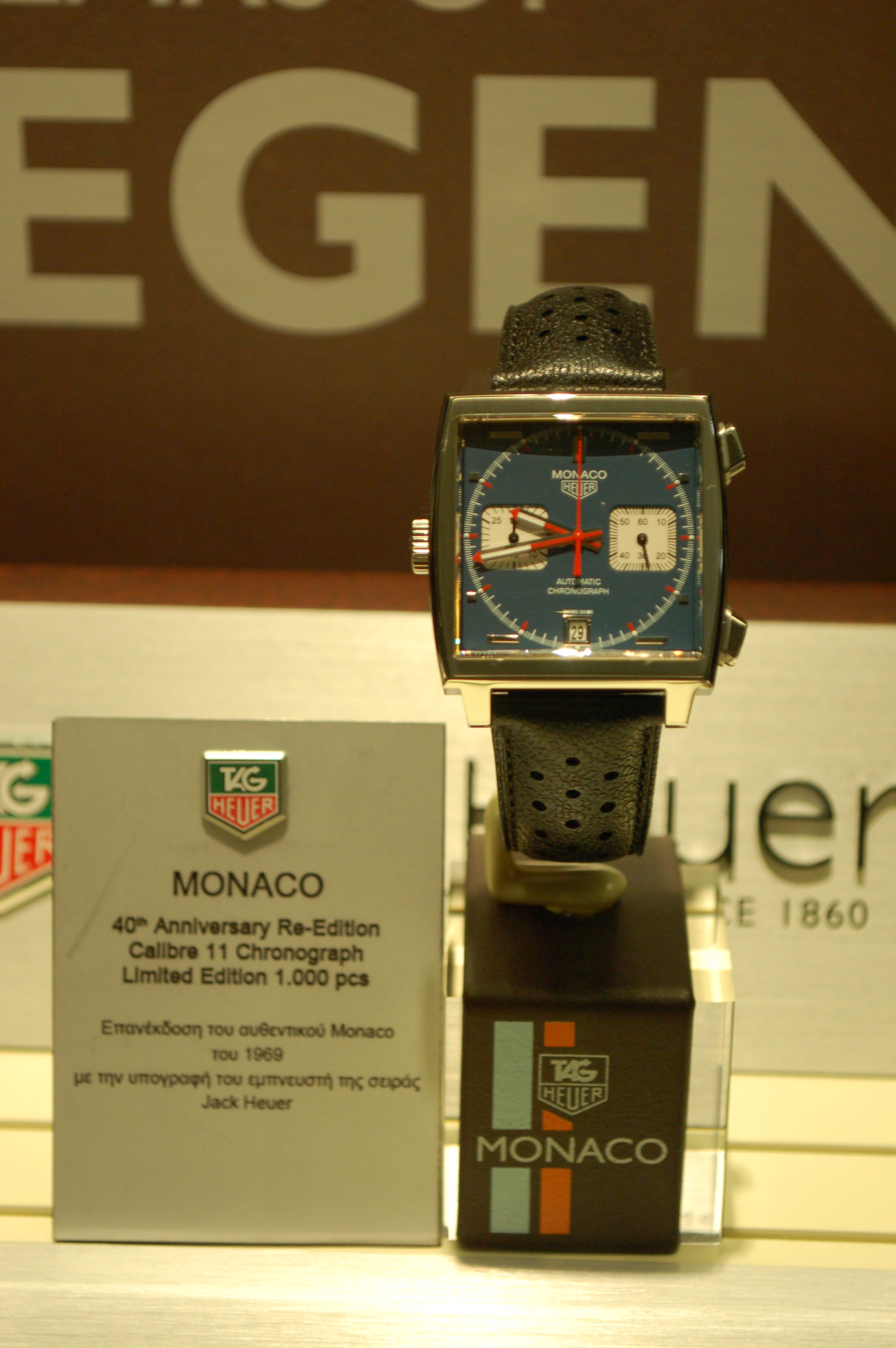
A TAG Heuer Monaco 40th Anniversary re-edition, keeping the 1969 look alive. Photo: Wikimedia Commons, CC BY-SA 3.0.
The watches today
The modern catalog is big, maybe too big, but the important stuff is easy to find. The Carrera is still the flagship chronograph, and the modern Carrera Chronograph with its in-house movement is a genuinely good watch, clean dial, honest proportions, everything the 1964 original was trying to be. The Monaco is still square, still blue, still trading on Steve McQueen, and they have released approximately nine thousand limited editions of it, which is fine, the watch can take it. Below those sit the Aquaracer and the Formula 1 lines, which are the volume sellers, quartz-heavy, aggressively priced, and aimed squarely at the guy buying his first “nice watch” at the airport. There is nothing wrong with that customer existing, somebody has to keep the Swiss industry solvent, but it is worth knowing where you are in the food chain when you walk into the boutique.

A modern TAG Heuer Monaco, the square case that refuses to quit. Photo: Wikimedia Commons, CC BY-SA 4.0.
Why it matters
Here is the honest version. TAG Heuer has one of the great origin stories in watches: a real instrument maker, a real inventor in Édouard Heuer, a real visionary in Jack Heuer, and two of the most iconic watch designs ever made in the Carrera and the Monaco. None of that is marketing, it all actually happened. The problem is that the modern company spends a lot of its energy renting out that history while selling a lineup that is mostly quartz fashion watches, celebrity ambassadors, and LVMH pricing that has drifted well past what a lot of collectors think the watches are worth. There is a genuine identity split between the Heuer that timed Ferrari pit stops and the TAG Heuer that sells you a smartwatch, and the brand has never quite resolved it. But give credit where it is due: the Carrera Chronograph and the Monaco, at the right price, are legitimately good watches with real heritage behind them, not costume jewelry. And Jack Heuer built a racing legacy that most brands would kill for. You just have to look past the noise to find the parts of the catalog that earned it.
Official site: tagheuer.com
Thanks for reading this.

