
Seiko started in 1881, when a twenty-one-year-old named Kintaro Hattori opened a watch shop in Ginza, Tokyo. He was not born into watchmaking and he did not train in Switzerland; he was a kid who sold and repaired clocks and pocket watches in a country that barely had a watch industry. By 1892 he had built his own factory, Seikosha. In 1913 that factory made the Laurel, the first wristwatch produced in Japan. The word Seiko first appeared on a dial in 1924. Nearly a century and a half later, the company he started has done more to change what a watch fundamentally is than anyone else in history, and it did it from the losing position of a country with no tradition, no supply chain, and no reason to be taken seriously. That is the short version. The long version involves earthquakes, quartz, and the Swiss nearly getting wiped off the map.
The shop in Ginza
Kintaro Hattori was twenty-one when he opened for business in 1881, and his first move was the unglamorous one: he sold imported watches and clocks, and he repaired them. Repairing things teaches you how they fail, and Hattori turned that education into manufacturing. In 1892 he founded Seikosha, literally the house of exquisite workmanship, to make clocks in Japan rather than importing them. The factory made wall clocks and alarm clocks, and the business grew through the 1900s until, in 1913, Seikosha produced the Laurel, Japan’s first domestically made wristwatch.
Then came the disaster. The Great Kanto Earthquake of 1923 flattened the Seikosha factory and the Hattori shop, and wiped out the company’s stock. Most businesses would have folded. Hattori rebuilt, and the following year, 1924, the name Seiko appeared on a dial for the first time. (The word is generally taken to mean exquisite, fine, or success, which is a conveniently lucky name to have picked.) Hattori’s company was renamed K. Hattori & Co. in 1917 and later became Seiko Holdings, and the family has stayed in the picture ever since.
The people
Every era of Seiko traces back to the Hattoris, and unlike most heritage brands, the family is still in the building. Kintaro founded it. His son Genzo ran manufacturing and established the second factory, Daini Seikosha, which eventually became Seiko Instruments, the company behind many of Seiko’s quartz and electronic movements. Four generations on, Shinji Hattori, Kintaro’s great-grandson, sits as chairman of the group. You can argue about whether dynasties are good corporate governance, but it is hard to argue with the results.
The working president of Seiko Watch Corporation is Akio Naito, who took the job in 2021 after roughly four decades inside the company, starting in the legal department in 1984 and running Seiko Australia before building Grand Seiko’s American operation from scratch. He is not a watchmaker and he does not pretend to be one; he is the guy who figured out how to sell a prestige Japanese brand to Americans, and it worked. The engineers deserve a line too, particularly the ones at Suwa Seikosha, the Nagano factory that became Seiko Epson, who spent the 1960s miniaturizing quartz timekeeping from a room-sized clock down to a wristwatch. They did it faster than anyone in Switzerland thought possible, which turned out to be the whole story.
Who owns what (it is a little confusing)
At the top sits Seiko Group Corporation, the holding company. Under it are several companies that operate independently of each other, and sometimes compete with each other, which confuses people and occasionally confuses Seiko’s own marketing. Seiko Watch Corporation handles watches: the Seiko brand itself, plus Grand Seiko and Credor. Seiko Instruments makes movements, electronic components, and industrial equipment. Seiko Epson, the company most people know for printers, grew out of Suwa Seikosha and still manufactures watches and movements, including Grand Seiko’s Spring Drive calibres and high-end quartz.
Grand Seiko deserves its own note here. It launched in 1960 as the best watch Seiko knew how to make, lived for decades as a top tier within the Seiko brand, and was spun out as a fully independent brand in 2017 at Baselworld, with its own boutiques, its own marketing, and its own identity. The parent company is the same. The watches moved upmarket and the storytelling followed.
The eras: ambition, then the end of the world
For its first eighty years Seiko’s story was pure mechanical ambition. Grand Seiko arrived in 1960, aimed directly at the Swiss chronometer standard, with finishing and regulation that asked to be judged against the best of Geneva. King Seiko followed in 1961 as the internal rival, made at a different factory, which is the kind of family competition you only get inside a Japanese conglomerate. In May 1969 Seiko released the 6139, one of the world’s first automatic chronographs, launched the same year as Zenith’s El Primero and the Heuer and Breitling consortium’s calibre 11, and it was the first of the three to actually reach the market. All through the late 1960s, Seiko’s mechanical movements were climbing the results tables at the Neuchatel chronometer trials, beating Swiss entries at a game the Swiss had invented. The Swiss noticed.
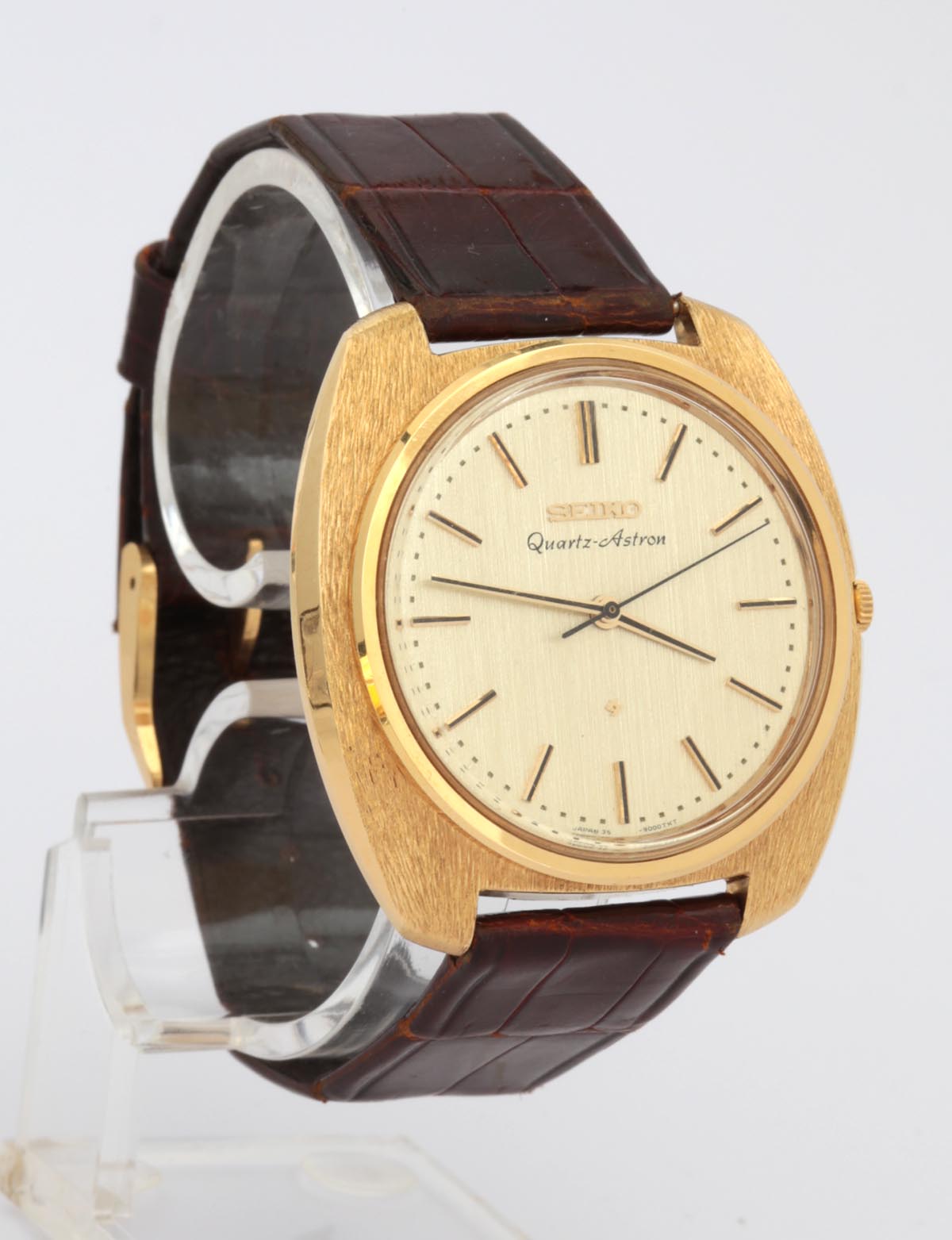
Then came Christmas. On December 25, 1969, Seiko put the Quartz Astron on sale in Tokyo: one hundred watches in 18-karat gold cases, priced at 450,000 yen, roughly the price of a Toyota Corolla at the time. It was accurate to about five seconds a month, roughly a hundred times better than a good mechanical watch, and it ran on a battery and asked nothing of you. The queue outside the store that morning understood something the rest of the industry would take a decade to accept. The Astron was the first quartz wristwatch ever sold to the public, and it detonated the mechanical watch industry. Within fifteen years, the Swiss watch industry had lost most of its companies and most of its jobs, and the survivors were the ones who learned to sell mechanical watches as luxury objects rather than timekeeping instruments. Seiko had fired the gun.
The original Quartz Astron, calibre 35A, from Christmas 1969. Photo: Wikimedia Commons, CC BY-SA 4.0.
Here is the part people skip: the quartz crisis hit Seiko too. The company got rich on quartz, and in doing so spent the seventies and eighties training the world to think of the name Seiko as cheap digital watches sold at department stores. The prestige the company had built with Grand Seiko in the sixties got buried under a mountain of LCDs. Seiko spent the next forty years digging back out, and the excavation tools were mechanical. Spring Drive arrived in 1999, after nearly thirty years of development: a mechanical mainspring driving the watch, with a quartz crystal regulating it through an electromagnetic brake, producing the famous smooth glide of the seconds hand. It is a genuine third way between mechanical and quartz, it is real engineering, and nobody else has anything like it. The company kept building from there, revived King Seiko in 2021, and gave the Astron name to its GPS solar watches in 2012, which is either a nice tribute or marketing doing marketing things, depending on your mood.
The watches
Seiko 5, launched in 1963, is the line that introduced more people to mechanical watches than anything else in history: automatic winding, day-date display, water resistance, a recessed crown, and a tough case, for the price of a dinner out. Generations of collectors started with a Seiko 5 bought on a whim, and a lot of them never really left. The 6139 automatic chronograph from 1969, nicknamed the Pogue after the astronaut who wore one in space, is the vintage Seiko people chase. The 6105 diver from 1970, the watch Martin Sheen wore in Apocalypse Now, became the template for the SKX line of affordable divers that dominated the entry-level market for decades, including the bright orange SKX781 Monster below, a watch that has no business being as beloved as it is and is beloved anyway.

Dial detail of the 1976 Speed-Timer Bullhead, calibre 6138, a pushers-on-top chronograph from Seiko’s wild seventies. Photo: Wikimedia Commons, CC BY-SA 3.0.
Today the brand is organized into collections that mostly make sense. Prospex covers the sport and dive watches, the spiritual home of the SKX and the Marine Masters. Presage covers dressier mechanical watches with genuinely beautiful dials, including the Cocktail Time line that punches far above its price. King Seiko is back as a mid-tier dress line. The Astron name now belongs to GPS solar watches that set themselves by satellite, which is the kind of feature that sounds like a gimmick until you travel and your watch just knows. And the 1970s chronographs, like the Bullhead above, remain some of the strangest and most characterful watches any major brand ever mass-produced.

The SKX781 Orange Monster, with Seiko’s famously unsubtle approach to dive watch design. Photo: Wikimedia Commons, CC BY-SA 4.0.
Why it matters
Seiko matters because it made accurate time cheap and, in 1969, made everyone else’s accuracy irrelevant. The Astron is the single most consequential watch ever sold: it ended the mechanical era, nearly killed the Swiss industry, and forced watchmaking to become what it is now. Spring Drive is proof the company did not just get lucky once; it is a serious, original piece of horological engineering that nobody has copied because nobody can. Grand Seiko’s finishing, the zaratsu polishing, the dial work, is legitimately among the best in the world at any price, and it comes out of a company that also sells you a five for the cost of groceries.
Now the honest part. Seiko’s mid-tier mechanical movements, the 4R and 6R families and the old 7S workhorses, are tough and reliable and regulated at the factory with what can only be described as a shrug. Buy two of the same watch and they will keep different time, and the chapter ring on one of them will be crooked; this is a running joke on the forums because it keeps being true. The Seiko 5 naming system has become a tangle of reference numbers that reads like a password generator. Plenty of Seiko designs borrow heavily from Swiss icons, and the prices have been climbing for years while the quality control has not always kept up, which is a combination that tests people’s patience. The online debates about whether Grand Seiko beats the Swiss are inflated on both sides, mostly by people who have already decided the answer.
None of that changes the core fact. Seiko built a watch industry in a country that did not have one, beat the Swiss at their own accuracy game, invented the quartz watch, survived the crisis it caused, and came out the other side making some of the best watches on earth. Outside this hobby nobody cares about any of that, which is fine. The rest of the world just buys the cheap quartz ones and they keep excellent time, which was the whole point all along.
Official site: seiko.co.jp
Thanks for reading this.

