
Rolex was founded in London in 1905, which is the kind of fact that sounds wrong the first time you hear it. A German named Hans Wilsdorf, orphaned at twelve and working in the watch trade, went into business with his brother-in-law Alfred Davis importing Swiss movements into England, casing them up, and selling them to jewelers. At the time, serious men carried pocket watches and the wristwatch was dismissed as jewelry. Wilsdorf bet everything on the wristwatch being the future. He spent the next fifty-five years being right about that.
The London years
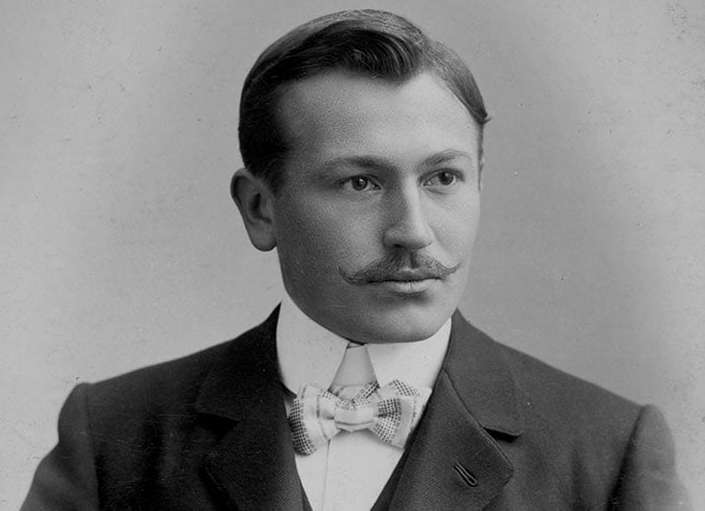
Wilsdorf was born in 1881 in Kulmbach, Bavaria, lost both parents by the age of twelve, and went to work for a watch exporter in La Chaux-de-Fonds before landing in London. In 1905 he and Davis set up Wilsdorf & Davis, with Davis supplying the capital and Wilsdorf supplying the obsession. They did not make movements. They bought them from Switzerland, put them in cases, and sold the finished watches to jewelers who stamped their own names on the dials. In 1908 Wilsdorf registered a word of his own: Rolex. Nobody agrees on what it means (the favorite theory is that it sounds like a watch being wound), and that was the point. It was short, it worked in every language, and it carried no national origin, which meant it could be sold anywhere on earth. Then Wilsdorf did the thing he would do for the rest of his life: he picked the most respectable test available and won it in public. In 1910 a Rolex wristwatch became the first wristwatch to earn a Swiss Certificate of Chronometric Precision from the rating center in Bienne. In 1914 one earned a Class A certificate from Kew Observatory in London, an honor previously reserved for marine chronometers. In 1915 the firm became the Rolex Watch Co. Ltd., and after the First World War, when British duties and taxes made London untenable, Wilsdorf moved the operation to Geneva. In 1920 he registered Montres Rolex SA, and the company has been Swiss ever since.
Hans Wilsdorf, who founded Rolex in London in 1905 and eventually left every share of it to a foundation instead of an heir. Photo: Wikimedia Commons, public domain.
The company nobody owns
Wilsdorf married Florence Frances May Crotty, a New Zealand-born woman, in 1911. They had no children, and when Florence died in 1944, Wilsdorf faced the question every founder eventually faces, except his version had no good answer. There were no heirs. On August 1, 1945 he established the Hans Wilsdorf Foundation in Geneva, a private charitable trust under Swiss law, and he wrote its purpose with unusual bluntness: the foundation’s job was the preservation and development of Rolex itself, and the philanthropy, which is real and substantial and mostly stays in Geneva, was what the money did afterwards. When Wilsdorf died on July 6, 1960, every share of Rolex passed to the foundation, and there it has sat ever since. There are no shareholders, no published accounts, and no realistic way for anyone to buy the company. Every revenue figure you have ever seen for Rolex is an analyst’s estimate (around 1.24 million watches and roughly CHF 10.1 billion in 2023, if you trust the estimates), because Rolex is under no obligation to tell anyone anything. After Wilsdorf came the Heiniger dynasty. André J. Heiniger joined the company in 1948 and ran it from 1963 to 1992, the man who turned a watchmaker into a luxury icon. Then his son Patrick, CEO from 1992 to 2008, pushed the company into full vertical integration and set its governing philosophy: evolution, not revolution, which Rolex has followed like scripture ever since. The Heinigers held the company for forty-five years. Since then the tenures have been shorter (Bruno Meier, then Gian Riccardo Marini), and since 2015 the CEO has been Jean-Frédéric Dufour, hired away from Zenith. In 2023 Rolex agreed to buy Bucherer, its longtime retail partner, which is the sort of move only a company with no shareholders to ask could pull off quietly. Rolex also runs Tudor, its sister brand, out of the same Geneva orbit.
The watches that built the crown
The early innovations were real and they were enormous. In 1926 came the Oyster, the first waterproof wristwatch, and Wilsdorf being Wilsdorf, he proved it with a stunt: the swimmer Mercedes Gleitze crossed the English Channel wearing one, and the watch kept ticking. In 1931 came the Perpetual rotor, the first self-winding mechanism with a freely rotating central rotor, which is now the industry standard for automatic watches and was invented here. The Datejust arrived in 1945 for the company’s fortieth anniversary, the first automatic wristwatch that changed the date at midnight. Then came the run that made the crown. The Submariner in 1953 was the first watch rated waterproof to 100 meters (modern ones go to 300) and invented the dive watch template that every brand on earth now copies, usually with less shame than they should feel. The GMT-Master in 1954 was built for Pan Am pilots, with a 24-hour hand and a rotating bezel so you could read two time zones at once. The Day-Date in 1956 was the first watch to spell out the day of the week in full on the dial, made only in precious metals, eventually nicknamed the President after Lyndon B. Johnson made it famous. And the Cosmograph Daytona in 1963, a racing chronograph, became the most collectible steel watch in the world. In 1960, the year Wilsdorf died, an experimental Deep Sea Special was strapped to the hull of the bathyscaphe Trieste for the descent to the bottom of the Mariana Trench, 10,911 meters down, and it was still running when the vessel surfaced.

A Rolex Submariner, the dive watch that has been copied by everyone since 1953. Photo: Wikimedia Commons, public domain.

A Rolex Cosmograph Daytona, the chronograph that became the most collectible steel watch in the world. Photo: Wikimedia Commons, CC BY-SA 3.0.
The waiting list
Here is the honest part. Rolex makes well over a million watches a year, more than Patek Philippe and Audemars Piguet combined, and yet for the better part of a decade the steel models have been nearly impossible to buy at retail. There is a waiting list of sorts. In practice it works as an allocation database: your relationship with the dealer matters more than the date you signed up. On the secondary market, steel sports models trade at premiums of twenty to forty percent over retail or more; at the peak of the shortage in 2021 and 2022, a steel Daytona was changing hands for roughly two and a half times its sticker price. Rolex could make more watches, and everyone knows it. Scarcity is the product strategy. Meanwhile the watches themselves change slowly, by design. Nobody in Geneva is trying to invent a new complication. The innovation budget goes into materials and manufacturing (scratch-resistant ceramic bezels, the Parachrom hairspring, proprietary gold alloys like Everose) and into movements that are genuinely excellent: Rolex’s Superlative Chronometer standard means the finished, cased watch runs within plus or minus two seconds a day, which beats the Swiss chronometer standard it already passed. Since around 2002 the crown logo has been laser-etched microscopically onto the crystal, because Rolex is one of the most counterfeited brands in the world, which is what happens when you build the most recognizable watch on earth. The company has responded to the secondary market it helped create by launching its own certified pre-owned program, which is either vertical integration taken to its logical conclusion or the crown selling you back your own watch, depending on your mood. (I am too impressionable to have a firm take.)
Why it matters
Rolex matters for two reasons, and both of them are real even if neither is romantic. First, the technical record: Wilsdorf’s company proved the wristwatch could be a precision instrument when everyone serious laughed at it, invented the waterproof case and the modern self-winding rotor, and wrote the template for the dive watch, the pilot’s watch, and the luxury date watch that the entire industry still works from. Second, the business record: it built the most valuable name in watches without going public, without being bought, and without ever explaining itself, which is a kind of freedom no other watch brand has. The catch is that the same machine that protects the brand also frustrates the people who love it. The waiting lists, the premiums, the dealer theater: that is the price of a company that answers to a foundation instead of customers. I say this as someone who will probably never get the call from an authorized dealer. The watches are genuinely good, the mystique is mostly manufactured, and you can hold both of those ideas at once.
Official site: rolex.com
Thanks for reading this.

