
Roger Dubuis is a Swiss watchmaker founded in Geneva in 1995 by the watchmaker Roger Dubuis and the designer Carlos Dias. It makes some of the most technically ambitious and visually loud watches in the industry, all in-house, with nearly every one carrying the Poinçon de Genève (the Geneva Seal). Richemont bought a controlling stake in 2008 and took full ownership in 2016, and the brand now lives in the Richemont stable alongside Cartier, IWC, and Jaeger-LeCoultre. Which is funny, because the brand started out making restrained classical watches that looked like they were trying to out-Patek Patek.
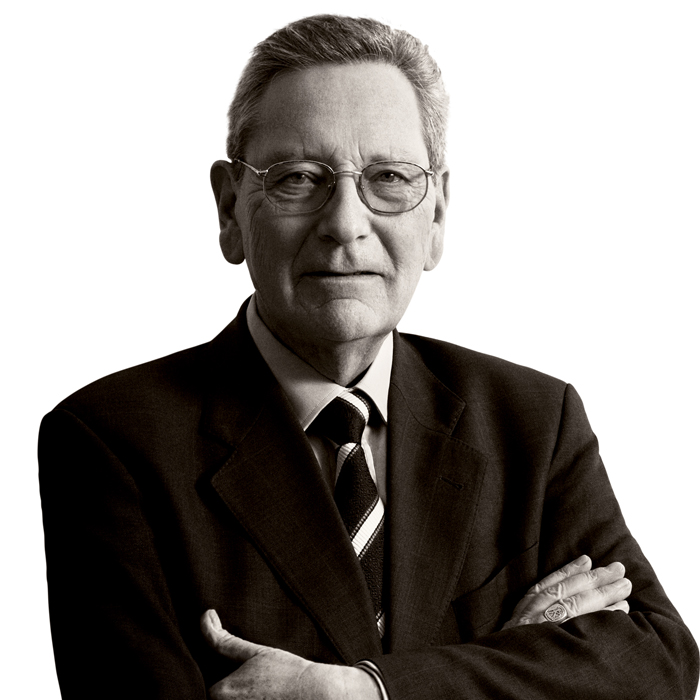
Roger Dubuis, the founder. Photo: Wikimedia Commons, CC BY-SA 3.0.
A watchmaker and a designer
Roger Dubuis was born in 1938 and spent most of his adult life doing the hardest kind of watchmaking quietly. He started at Longines in Saint-Imier in the late 1950s, in after-sales, which mostly meant repairing chronographs, and then spent about fourteen years at Patek Philippe in the complications workshop. He left in 1980, opened his own workshop, and took on the kind of work other brands outsourced: antique restorations, complication modules, the unglamorous stuff. His one headline credit from that era was a perpetual calendar with a double retrograde display that he developed with watchmaker Jean-Marc Wiederrecht for Harry Winston, presented at Baselworld in 1989. It was the first bi-retrograde display fitted to a wristwatch, and that little trick, hands that sweep across an arc and snap back to zero, became the brand’s signature move.
Carlos Dias was the other half. A Portuguese-born businessman and designer who had worked for Franck Muller, Dias had the visual flair and the commercial nerve, and he was the one who decided in the summer of 1995 that the two of them should found a company. They called it SOGEM SA, the Société Genevoise des Montres, and stamped the watches “Roger Dubuis Horloger Genevois.” The name changed to Manufacture Roger Dubuis SA in 1999. From the start they offered two lines: the Sympathie, with a cushion-shaped case that often carried the bi-retrograde display, and the Hommage, a round-cased tribute to past watchmakers with a look borrowed from 1950s Patek Philippe chronographs. The earliest watches got the Geneva Seal and were tested as chronometers at the Besançon Observatory, which was an enormous statement for a brand nobody had heard of. I will be honest: I find it charming, a 57-year-old watchmaker launching a startup the way a 25-year-old launches an app.
Becoming a manufacture
The company earned the right to call itself a manufacture the hard way. Its first in-house movements arrived in 1999, all Geneva Seal certified, making it at the time the youngest brand ever to produce a Geneva Seal movement. In 2001 it built its integrated manufacture in Meyrin, on the outskirts of Geneva, inaugurated in 2002, and by 2006 it claimed 28 proprietary calibres, every one of them Geneva Seal certified. That is a genuinely ridiculous output rate for a company a decade old, and the watch nerds noticed. Around the turn of the millennium the collections got bigger and weirder: Too Much, Much More, Follow Me, Golden Square, collections with large cases and unusual shapes that signaled the classical phase was ending.
Then came 2005, the year the brand as we know it was born. Roger Dubuis launched the Excalibur collection and its first skeleton calibre, the RD01SQ, a skeletonized double flying tourbillon with a differential that was presented as a world first, alongside the RD08 minute-repeater tourbillon. The Excalibur name, according to the company, came from a medieval sword given to Carlos Dias. Skeletons, big cases, medieval cosplay. The template was set.

An Excalibur Automatic Skeleton in carbon, the brand’s modern face. Photo: Wikimedia Commons, CC BY-SA 4.0.
The Richemont years
By the mid-2000s the brand had grown fast, maybe too fast. Before the 2008 financial crisis it employed about 450 people and was making roughly 25,000 watches a year, with revenue over 100 million Swiss francs. When the crisis hit, output collapsed, and in 2008 Richemont took a controlling interest. Richemont acquired full ownership in 2016. The founder himself had stepped back from day-to-day operations in the early 2000s but remained a brand ambassador until his death in October 2017, at 79. So the man whose name is on the dial had already handed the keys to someone else years before he died, which is worth knowing when you see his signature on a modern carbon skeleton watch he had nothing to do with. That is just how the watch industry works.
The Richemont era reshaped everything. Production settled at around 5,000 watches a year by the late 2010s, a fraction of the pre-crisis peak, and the identity hardened into what the brand now calls “expressive high watchmaking.” The 2010s brought feminine and sporting lines: La Monégasque in 2011, Velvet and Pulsion in 2012, and the Knights of the Round Table in 2013, a métiers d’art line with hand-sculpted miniature knights as hour markers. 2013 also saw the Excalibur Quatuor with the RD101 calibre, the first movement with four sprung balances linked by five differentials, an attempt to average out gravity’s effects that came with three patents. Then came the motorsport partnerships: Lamborghini Squadra Corse and Pirelli, plus the design studio Italdesign, and ambassadors like boxer Canelo Álvarez and artists Hajime Sorayama and Dr. Woo. The CEO chair turned over too: Nicola Andreatta left in 2023, Emmanuel Perrin served as interim, and David Chaumet, who had been with the brand since 2008 and later ran Baume & Mercier, took over in June 2024.

The manufacture in Meyrin, near Geneva. Photo: Wikimedia Commons, CC BY-SA 4.0.
The watches now
The modern lineup is built around the Excalibur, redesigned in 2020 with cleaner lines and sold in monotourbillon, double-tourbillon, and monobalancier versions, with the sporting Excalibur Spider series and the Lamborghini collaborations hanging off it. The Knights of the Round Table continues as the artisanal showpiece line. For the brand’s thirtieth anniversary in 2025 it leaned into a “return to its roots” narrative, releasing the Excalibur Grande Complication, limited to eight pieces and combining a flying tourbillon, minute repeater, and bi-retrograde perpetual calendar, plus a 40mm pink-gold Excalibur Biretrograde Calendar. At Dubai Watch Week it also showed the Hommage La Placide, a 38mm watch with a bi-retrograde display and perpetual calendar, which was a quiet nod to where it all started. For 2026 the theme is “Movements of the Sky,” eight models built around perpetual and retrograde calendars, including a bi-retrograde perpetual calendar driven by the new RD850 calibre, plus a feminine line called Lady of the Lake.
Now the honest part. These are not subtle watches. They are large, busy, skeletonized, often brightly colored, and the triple-lug case design is instantly recognizable and instantly divisive. If you want a watch that disappears under a cuff, look elsewhere, preferably at the brand’s own 1990s output. The supercar partnerships read to some collectors as marketing gloss over real watchmaking, and it is fair to ask how much of the current identity traces back to the founder versus the Richemont marketing department. The fair answer is that the watchmaking underneath is genuinely serious. Only flying tourbillons, in-house everything, hand finishing, Geneva Seal on nearly every piece, more than 40 exclusive calibres developed since the founding. The decoration is loud, but the engineering is real. You can find the whole thing exhausting and still respect the work. I do.
Why it matters
Roger Dubuis matters because it is the closest thing the modern industry has to a proof of concept for a young manufacture. In about a decade, a 57-year-old founder and a designer went from two classical collections to 28 in-house Geneva Seal calibres and their own factory. That had never been done that fast, and nobody has done it since. The brand also represents the great fork in the road that the whole luxury watch industry faced after 2008: go classical and heritage-heavy, like everyone else, or go loud, contemporary, and unapologetic. Roger Dubuis picked loud. Whether that was brilliance or survival instinct probably depends on the day you ask, but it kept the name alive, the manufacture in Meyrin busy, and the founder’s bi-retrograde trick in production. Thirty years on, that counts for something.
Official site: rogerdubuis.com
Thanks for reading this.

