
Raketa is a Russian watch brand made at the Petrodvorets Watch Factory outside Saint Petersburg, and the factory has been in business since 1721, which is not a typo and not a marketing department fantasy. It was founded by Peter the Great as the Peterhof Lapidary Works, and it spent its first two centuries carving stone for palaces and cathedrals, including the ruby stars on the Kremlin, before anyone there thought about gears. The brand name itself is younger, dating to 1961, when the factory christened its watch line Raketa, the Russian word for rocket, in honor of Yuri Gagarin. A rocket named after a space launch, made by a factory that used to polish rocks for tsars, and it all somehow still exists.
Stones before gears
The Peterhof Lapidary Works opened in 1721 on a decree of Peter I, cutting and polishing hardstone for the imperial court. After the 1917 revolution the factory was retooled to make precision industrial stones for the military, because that is what revolutions do to your business plan, and after World War II it was rebuilt and turned toward watchmaking. It produced Pobeda (Victory) watches in the late 1940s and was given its current name, the Petrodvorets Watch Factory, in 1954. From that point on it was a full Soviet watch enterprise, and by the 1970s it was turning out around five million mechanical watches a year for the Red Army, the Soviet Navy, polar expeditions, and ordinary citizens standing in ordinary lines.
Rocket, meet watch
On April 12, 1961, Yuri Gagarin made the first manned spaceflight aboard Vostok 1, and the factory answered with a new brand: Raketa, Russian for rocket. The timing was perfect for Soviet pride and less than perfect for Western marketing, since at the height of the Cold War the word Raketa made foreign buyers think of the R-16 intercontinental ballistic missile more than the cosmos. It became one of the most produced watch brands in the world anyway, and it is one of the few survivors that still makes its movements from start to finish, hundreds of parts produced in-house in Peterhof.

A Soviet-era Raketa. Photo: Wikimedia Commons, CC BY-SA 4.0.
The Big Zero and the Copernicus
Raketa’s two most famous designs both date to the 1980s, and both are stranger than anything the Swiss were doing at the time. The Big Zero appeared in 1984 or 1985, commissioned by the All-Soviet Society of the Blind as a high-legibility watch for the visually impaired, with a white dial, oversized numerals, and a giant zero sitting at twelve where the other numbers feared to go. Production was nearly over by 1986 when a group of Italian businessmen visited the factory, took one look at the giant zero, and declared it the perfect symbol of perestroika, Gorbachev starting everything from zero. They placed a huge order, and the zero went from assistive device to political fashion statement.
There is also the famous story that Gorbachev himself wore a Big Zero on a 1985 trip to Italy, and when a journalist asked him what perestroika meant, he pointed at the dial and said the Soviet people were starting from zero. It is a great story. It is also the kind of story that gets better every time it is told, and Raketa itself was still promoting it in a 2003 video, so take it the way you take any legend that serves everybody involved. The less mythologized icon is the Copernicus, launched in the mid-1980s with no ordinary hands at all: a gold disc for the sun and a large ring for the moon, eclipsing once an hour against an off-center earth. Collectors love it now, though the originals were, by every honest account, typical Soviet-era pieces in terms of fit and finish.
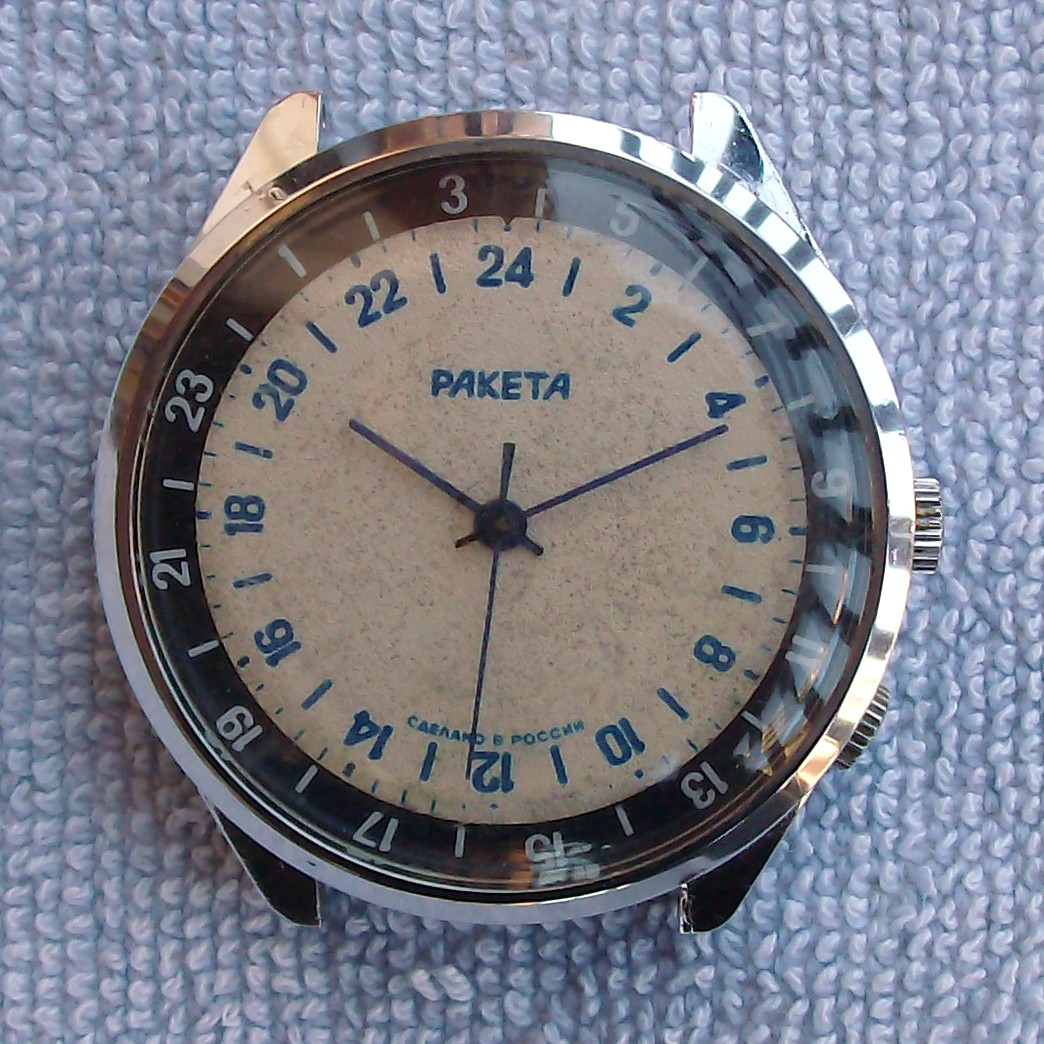
Raketa’s 24-hour dial, the format made for polar expeditions where the sun never sets. Photo: Wikimedia Commons, CC BY 3.0.
The Brit who bought a factory
The Soviet Union collapsed in 1991, the factory was converted into a joint stock company in 1992, and the years that followed were rough in the specific way that post-Soviet industry was rough. A plant that once employed some 7,000 people and made millions of watches a year shrank to a skeleton crew of watchmakers huddling in winter coats over vintage equipment, and much of the complex was turned into a shopping mall. Then, in 2010, a British former lawyer named David Henderson-Stewart, who had moved to Russia years earlier and knew nothing about watches, bought the factory with his French partner Jacques von Polier, funded by money from friends and relatives because no bank or investor would touch it.
To his credit, Henderson-Stewart did the unglamorous work instead of just slapping the name on imported parts. He opened a watchmaking school on the factory premises, hired Swiss specialists including Jean-Claude Quenet, the former head of escapements at Rolex, who joined in 2012, and brought Prince Rostislav Romanov, a descendant of Peter the Great himself, onto the board in 2013. Supermodel Natalia Vodianova designed a Raketa model in 2011 with proceeds going to her Naked Heart Foundation. The revival pitch was honest in its oddness: a British lawyer who did not wear a watch until he owned a watch factory, rebuilding a Soviet one.
Where Raketa stands now
Modern Raketa makes its movements in-house in Peterhof, still one of the few brands anywhere that can say that, with a workforce back over 200 people. The lineup runs roughly $700 to $3,500, a long way from the $60 a beat-up vintage Kopernik costs on eBay, and the fit and finish of the new pieces genuinely is better than the Soviet originals. The watches trade on Russian identity hard, which has only intensified since 2022: Western sanctions shuttered foreign luxury stores in Russia and domestic demand for a made-in-Russia mechanical watch rose, while the brand kept selling to Europe and the Middle East. It is worth noting, since nobody else will, that Vladimir Putin has been photographed wearing a watch from the factory’s bespoke Imperial Peterhof Factory offshoot, which tells you something about the brand’s place in modern Russia whether you want to hear it or not.

A Soviet-era Raketa military watch. Photo: Wikimedia Commons, CC BY-SA 4.0.
Why it matters
Raketa matters because it is one of the very few watch brands with an unbroken line back through the Soviet era, made in the same factory town, still building its own calibers, and because it was revived by outsiders who believed in it rather than a marketing firm that purchased its corpse. The honest version includes the drawbacks. Soviet-era Raketas vary wildly in quality, so buy vintage carefully and expect to service it. The modern watches cost Swiss money in some cases, which is a bold ask when your heritage pitch rests on a factory that spent 200 years polishing stones before making its first watch. And the brand leans on its story harder than its movements in every brochure, which is fair, since the story is the best thing they have. But few factories on earth have survived what this one has, from tsarist lapidary works to Soviet mass production to near death to a British lawyer’s second career, and the watches are still ticking in Peterhof.
Official site: raketa.com
Thanks for reading this.

