
Panerai is the Florentine watchmaker whose entire identity is a 47mm wristwatch built for frogmen. Founded in 1860 as a watch shop and instrument supplier to the Italian navy, it spent most of its life as a tiny, obscure military contractor whose early wristwatches were mostly built by Rolex. Then, in the late 1990s, it was bought by the Vendôme Luxury Group (now Richemont), given to a former Cartier salesman named Angelo Bonati, and turned into the brand that basically invented the big-watch trend. Today it is a Swiss-manufactured luxury brand that still trades on its Florentine, salt-water soul.
The shop on the bridge
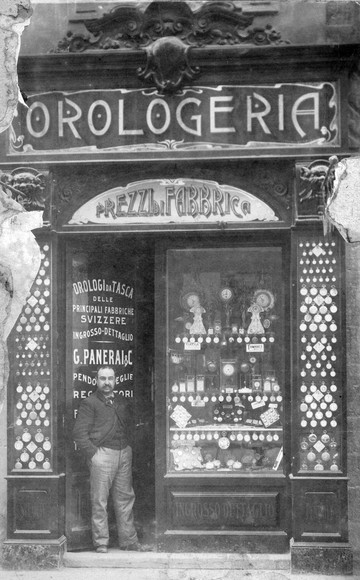
Giovanni Panerai in front of his Florence shop, 1860. Photo: Wikimedia Commons, public domain.
Giovanni Panerai (1825-1897) opened his shop in Florence in 1860, on the Ponte alle Grazie. It was a store, a workshop, and reportedly the city’s first watchmaking school, which tells you something about how the whole operation worked: they fixed watches, sold watches, and taught other people how to fix watches, the way you might run a diner that also trains short-order cooks. The family business grew under Giovanni’s grandson Guido Panerai (1873-1934), who moved the shop in the early 1900s to the Palazzo Arcivescovile in Piazza San Giovanni, where the Panerai boutique still sits across from the Duomo. Sometime around 1890 the firm became an official supplier of precision instruments to the Royal Italian Navy, and that contract is the whole reason we are still talking about them: ship’s clocks, compasses, depth gauges, gun sights, and a radium-based luminous compound Guido patented in 1916 called Radiomir, from “radio mire,” Italian for radium sights.
Here is the part the marketing sometimes skips past: for decades, Panerai did not really make watches the way you think of a watch brand making watches. They made instruments and dials. The watches themselves, cases, crowns, and movements, came from Rolex, using Swiss Cortébert pocket-watch calibres. Rolex did the movement and case engineering, and Panerai supplied the dials and the ideas. Vintage models are sometimes catalogued under Rolex at auction, and everyone involved has always been up front about it. Panerai’s genius was the luminous dial and the overall package, not the gears inside.
Frogmen and Rolex

In 1935 the Italian navy’s Submariner Group asked for a wristwatch its combat divers could actually read underwater at night. Panerai delivered the prototype in 1936: a 47mm cushion-shaped case (huge even by today’s standards, enormous then), welded wire lugs, a long strap meant to fasten over a diving suit, and a dial glowing with that Radiomir radium compound. Ten were ordered, tested day and night at sea, and used in maneuvers to excellent results. After some refinement, the watch went into fuller production around 1938, and it became the wrist instrument of the navy’s Decima MAS frogmen, the guys who rode manned torpedoes called maiali (pigs) under enemy ships. That is a genuinely cool origin story, and it is real, though it is worth knowing the scale: between 1935 and 1970, Panerai delivered roughly 1,600 watches total, most of them to the Italian navy. This was a cottage operation with a cool client list, not an industry.
The design kept evolving through the 1940s. The dial became a “sandwich” (a dark upper plate cut out to reveal the luminous compound on the plate beneath), the lugs were integrated into the case, the crown screwed down, and a lever-operated bridge device was invented to lock the crown against the case, the famous crown guard. In 1943 Panerai built its first chronograph prototype, the Mare Nostrum, for deck officers. Then came the name change that confuses everyone: in 1949 the company patented Luminor, a tritium-based luminous compound, to replace the dangerously radioactive radium. The Luminor watch followed in 1950 with that locking crown guard, which became the brand’s visual trademark. In 1956 Panerai built the “Egiziano” for the Egyptian navy, a 60mm monster with a rotating dive bezel and an 8-day movement derived from an Angelus pocket-watch calibre, which was the largest wristwatch in the world at the time and suggests the big-watch thing was always in the company’s DNA.
Giuseppe Panerai died in 1972, and management passed to an engineer named Dino Zei, who created the “Officine Panerai” trademark. The navy contract continued under military secrecy, but the commercial story went quiet. By the 1990s Panerai was essentially a small workshop making instruments and replacement parts, unknown to anyone outside a handful of vintage military watch nerds. Then Sylvester Stallone saw one in the Florence boutique window, bought a few for friends, wore them in films, and started talking the brand up in America. You can say what you want about Stallone as a tastemaker, but for Panerai he was the whole marketing department, and he worked for free.
The rescue
In 1993, before any buyout, Panerai’s management tested the waters with its first commercial collection: three limited editions inspired by the wartime commando watches (the Luminor, the Luminor Marina, and the Mare Nostrum). Then, in 1997, the Vendôme Luxury Group, which would later become Richemont, bought the company outright. Richemont put a former Cartier Italy sales executive named Angelo Bonati in charge, and Bonati, who ran the brand from 1997 to 2018 and died in May 2025 at 75, did one of the great brand-building jobs in modern watchmaking. He created the PAM reference system collectors still use, leaned into numbered limited editions, got Panerai into the SIHH fair in Geneva, and, whether he meant to or not, made the oversized watch a worldwide fashion, which the rest of the industry then copied for a decade.
He also made Panerai a real watch manufacturer instead of a marketing operation with a cool logo. A manufacture was opened in Neuchâtel, Switzerland, in 2002, and in 2005 the company launched its first fully in-house movement, the P.2002, a hand-wound 8-day GMT calibre inspired by those 1940s Angelus movements. More calibres followed, including tourbillons, and Panerai could finally call itself a genuine haute-horlogerie player. Not everything worked. The 2005-2010 Ferrari partnership produced a line of co-branded watches that sold poorly and was quietly dropped. But the net result of the Bonati era is not really debatable: he took a curiosity and made it one of the most recognizable names in sports watchmaking.
The watches now

A modern Luminor Marina. Photo: Wikimedia Commons, CC BY 2.0.
Jean-Marc Pontroué, formerly CEO of Roger Dubuis, took over in 2018 and streamlined the catalog into four families: the Radiomir (the cushion-case original, now offered in smaller sizes, which was a smart correction), the Luminor (the crown-guard icon), the Luminor Due (a thinner, dressier take for people who like the look but not the anchor), and the Submersible, which became a standalone collection at SIHH 2019 instead of a Luminor sub-line. The current collection mixes heritage reissues with a lot of materials science: Carbotech (a carbon-fibre composite), recycled eSteel, and the Lab-ID line, including a 2017 model Panerai guaranteed for fifty years without a service, which is a fun thing to promise on a mechanical watch.
Pontroué also introduced the “experiences” concept, where special-edition Submersibles come with things like a training session with the Italian navy’s commando divers or a freediving trip in French Polynesia. Whether that is marketing genius or just a nice vacation with a watch attached depends on your mood, but it fits the brand’s action-movie image. Panerai sits around the high teens of the top 20 Swiss watch brands by sales, its biggest market is still the United States (thanks, Sly), and it has been trimming its boutique network lately after years of expansion, which suggests the era of unstoppable growth has settled into something more like steady-state.
Why it matters
Panerai matters because almost every design element in its catalog was invented for a real reason. The cushion case, the sandwich dial, the crown guard, the oversized everything: these were solutions to legibility and water resistance, worked out for frogmen in the 1930s and 40s, and they happen to look fantastic. Plenty of brands invent a heritage story; Panerai’s is mostly true, which is rare enough to be worth saying out loud.
But the honest version includes the caveats. The famous watches were engineered by Rolex and assembled around Panerai’s dials, so the “Florentine manufacture” story has always been more about Florence than manufacture (the manufacture is in Neuchâtel, like everyone else’s). There is a forty-year gap, roughly the 1950s through the early 90s, where the brand was essentially a small navy workshop, so the deep bench of history is really one shop, one navy contract, and about 1,600 watches. And the big-watch boom Bonati rode eventually became a hangover: when fashion moved on from dinner-plate wristwear, Panerai had to learn to sell smaller watches and subtler designs, which it is doing now, with mixed results depending on who you ask.
None of that erases the genuine achievement. Bonati’s revival was real work, the in-house movements are real, and a Luminor is still one of the most immediately recognizable watches on the planet, which counts for a lot in watchmaking, where most designs blur together. Just know what you are buying: a Richemont-owned luxury brand with an Italian accent and a Swiss engine, built on a very real naval story that was, for most of its life, somebody else’s movements in Panerai’s very good cases. There are worse origin stories. Most of them, actually.
Official site: panerai.com
Thanks for reading this.

