
Oris is a Swiss watch company from Hölstein, a village in the canton of Basel-Landschaft, and it has been making watches there since 1904. It is one of the rare Swiss watch brands that is still genuinely independent, not owned by Swatch, Richemont, or LVMH. The watches are mostly priced between a couple thousand and a few thousand dollars, which puts Oris in the strange middle ground of mechanical watchmaking: real Swiss movements, real quality, but prices that do not require refinancing the house. And unlike most brands at this price, Oris makes nothing but mechanical watches, which is a quirk that deserves a longer story than it sounds like.
The founding
Paul Cattin and Georges Christian, two watchmakers from Le Locle, bought a recently closed watch factory in Hölstein in 1904. On June 1st of that year they signed a contract with the town’s mayor, took on 67 workers, and started making pocket watches. They named the company after a small brook that runs nearby, which is the kind of origin story that would sound made up if a marketing department invented it, but it happened before anyone needed marketing departments. The business grew fast. By 1911 Oris was the biggest employer in Hölstein with over 300 workers, and the company built housing for its watchmakers to keep them from leaving. Oris also converted pocket watches into wristwatches by fitting them with bracelet attachments, one of the earliest versions of an idea that would eventually take over the entire industry.
The Herzog era
Georges Christian died in 1927, and his brother-in-law Oscar Herzog took over as general manager the following year. Herzog ran the company for 43 years, which is longer than most watch companies’ entire lifespans. His tenure had a real obstacle: the Swiss Watch Statute of 1934, a law that essentially froze watch technology in place to protect the industry. Oris had been using pin-lever (Roskopf) escapements, and the statute made it illegal to introduce newer technology without permission, so the company spent decades as a maker of honest, inexpensive movements while better-equipped rivals moved ahead. Once the statute was reversed in 1966, Oris caught up fast. Its Calibre 652 earned full chronometer certification from the Observatoire Astronomique et Chronométrique in 1968. By 1969 Oris ranked among the top ten watch companies in the world, employed 800 people, and produced 1.2 million watches and clocks a year. Then the floor dropped out.
The dark decade
The 1970s nearly killed the company. In 1970, Oris joined ASUAG, the holding group that would eventually become part of the Swatch Group. The timing was brutal: the Quartz Crisis was beginning, and under the new ownership Oris was slotted in as a maker of cheap watches. Production collapsed, staff fell from around 900 to a few dozen, and by 1981 the company had stopped making its own movements entirely. This is the part of the story that Oris’s own history page covers with admirable frankness, because there is no way to spin a fall from the world’s top ten to a few dozen employees. Plenty of brands would just skip those years. Oris does not.
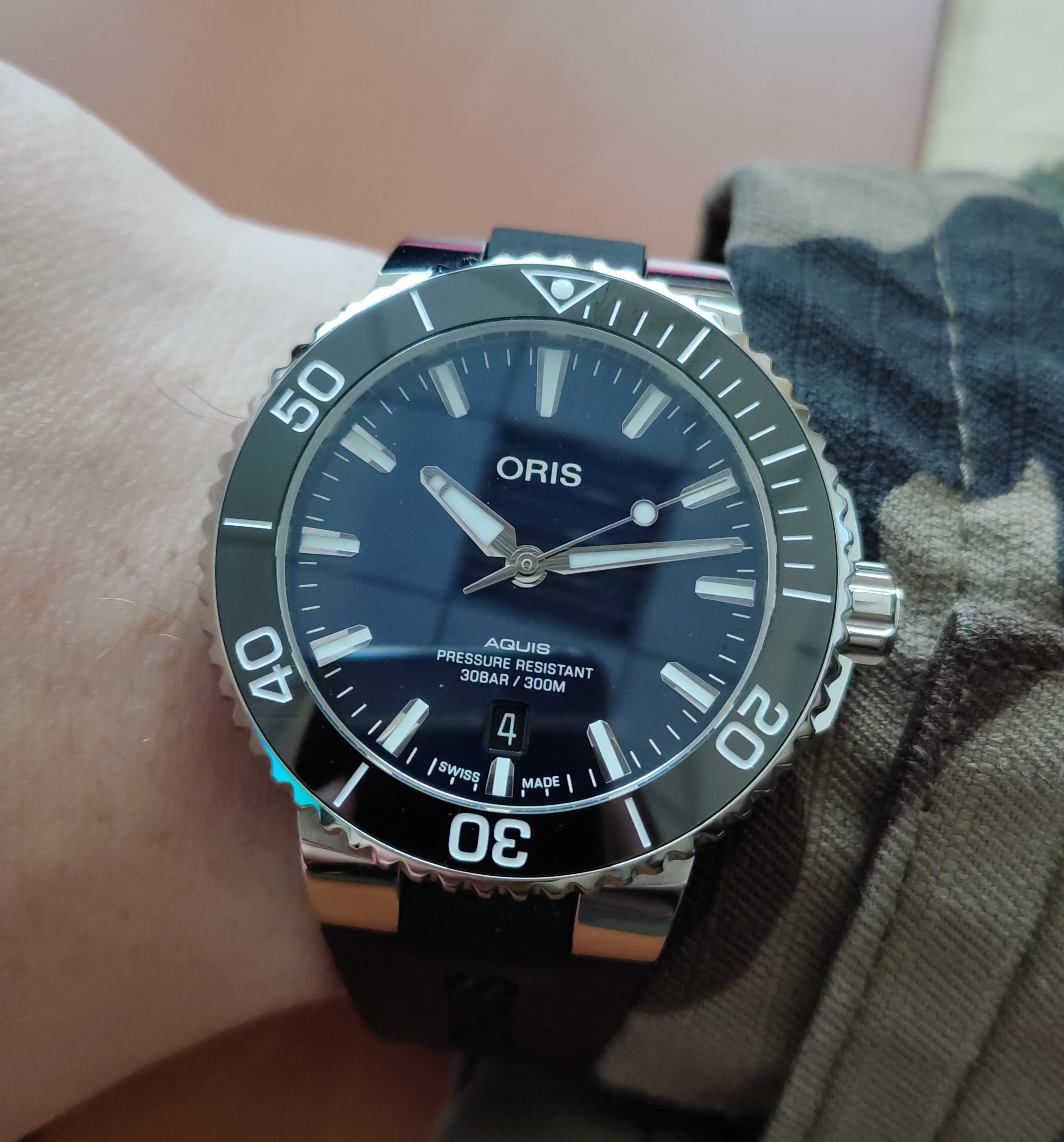
An Oris Aquis dive watch. Photo: Wikimedia Commons, CC BY-SA 4.0.
The 1982 buyout
With Oris on the verge of disappearing, Dr. Rolf Portmann and Ulrich W. Herzog bought the company back in a management buyout in 1982 and restored its independence. Then they did something people thought was insane: they abandoned quartz and committed Oris to making only mechanical watches. In the early 1980s, when everyone else was racing to sell you a battery, two men looked at a nearly dead company and bet the farm on ticking. It worked, partly because Herzog had spent time in Japan and noticed young people there rediscovering mechanical watches, and partly because mid-priced mechanical watches turned out to be exactly the gap the market wanted. The 1984 reintroduction of the Big Crown’s pointer calendar became the company’s signature complication, and by the 1990s Oris was growing again on the strength of watches like the 1991 Calibre 581, a moon-phase that was the most complicated movement the company had built to that point.
The watches
The Big Crown is the oldest name still in the catalog. The original 1938 pilot’s watch had an oversized crown so pilots could wind it with gloves on, plus the pointer calendar that still defines the line. The Chronoris of 1970 was the company’s first chronograph and the start of a motorsport thread that later ran through a Williams F1 partnership. The Aquis arrived in 2011 as the modern dive watch: 300 meters of water resistance, screw-down crown, and a design that looks distinct from the usual diver formula without being weird about it. In 2015, Oris brought back a 1965 diver as the Divers Sixty-Five, a 40mm vintage-styled watch that was an instant hit and grew to more than 50 references within five years. The ProPilot line carries the aviation side of the brand, including the 2014 Altimeter, the first watch to combine an automatic movement with a mechanical altimeter.

Now the honest part about the insides. The red rotor, the little red winding weight you see through the caseback, has been Oris’s signature since 2002, but it sits on movements based on third-party ETA and Sellita calibres. Most of the lineup still runs on those, and there is nothing wrong with a well-regulated Sellita, but it is worth knowing that the base of the catalog is sourced, not built in Hölstein. The in-house stuff is reserved for the top of the range. The hand-wound Calibre 110 arrived in 2014 with a ten-day power reserve, the first fully in-house movement in 35 years. Then in 2020 came the Calibre 400, an automatic with a five-day power reserve, strong anti-magnetism, and a ten-year warranty, with small-seconds (401), pointer-date (403), and power-reserve (473) variants following. The Calibre 400 models are consistently the bestselling references in every collection they appear in, which suggests the watch-buying public noticed the same thing I did.
The Oris Aquis Depth Gauge, part of the brand’s conservation-linked lineup. Photo: Wikimedia Commons, CC BY-SA 3.0 de.

Oris in-house movement Calibre 110, introduced in 2014 with a ten-day power reserve. Photo: Wikimedia Commons, CC BY 3.0.
Where Oris stands now
Oris is still independent, still in Hölstein, and still making only mechanical watches. The company also keeps its head down and does work that has nothing to do with selling: long-running ocean conservation partnerships (the Aquis Depth Gauge, pictured above, is part of that thread), a jazz festival partnership dating back to 1996, and a climate-neutral certification from 2021. On the business side, the company restructured its leadership in 2026, with longtime co-CEO Rolf Studer becoming sole CEO and Claudine Gertiser moving to CFO, while Ulrich W. Herzog remains chairman. If there is a weakness to name, it is that the catalog can feel like a lot of very similar dive watches in different colors, and the Divers Sixty-Five’s success owes something to the heritage trend that every brand was riding at the same time. But the core proposition has held for four decades now: a real mechanical watch, Swiss made, at a price a normal person can actually consider.
Why it matters
Oris matters because it is the proof that independence and honesty can be a business model. It was bought, broken, nearly shut down, and then bought back by two people who decided the future of a Swiss watch company was a technology the industry had just declared dead. Forty years later the company is still standing, still making ticking things in a village most watch buyers could not find on a map, and still refusing to sell you a quartz watch. In an industry full of conglomerate-owned heritage theater, that is worth something.
Official site: oris.ch
Thanks for reading this.

