
Jaquet Droz claims to have been founded in 1738, and that part is true. The part where a watch company survives nearly three centuries of history is less true. The original Jaquet-Droz firm, founded by Pierre Jaquet-Droz in La Chaux-de-Fonds, built some of the most astonishing machines of the eighteenth century, including three humanoid automata that still work today, and then died a completely ordinary business death in the 1790s. The Jaquet Droz you can buy a watch from is a Swatch Group brand relaunched in 2000, built on a genuinely incredible origin story and a two-century gap in the middle. It is just how the modern luxury watch business works, and you should know it going in.
The original guy
Pierre Jaquet-Droz was born in 1721 in La Chaux-de-Fonds, into a family of watchmakers and farmers. He studied mathematics and physics under Daniel Bernoulli at the University of Basel, briefly considered a career in the church, and then dropped theology to become a watchmaker, which turned out to be the right call. In 1738 he opened his first workshop on a farm called Sur Le Pont and spent the next decade making increasingly sophisticated longcase clocks. His big break came in 1758, when he traveled to Spain and presented six clocks to King Ferdinand VI. The king bought all six for the royal palaces of Madrid and Villaviciosa. That is the eighteenth-century equivalent of landing a national TV ad, and after it Jaquet-Droz went all in on automata, the clockwork figures that made him famous across Europe.
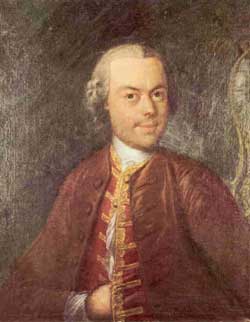
Pierre Jaquet-Droz, painted in 1758. Photo: Wikimedia Commons, Public domain.
The three robots
In the early 1770s, Jaquet-Droz, his son Henri-Louis, and their neighbor Jean-Frédéric Leschot built the three machines that made the family name immortal: the Writer, the Draughtsman, and the Musician. The Writer is the famous one. It is a boy, roughly the size of a toddler, who dips a goose quill in ink and writes out sentences of up to forty characters, and you can program what it writes. It is an eighteenth-century robot, and it still works. The Draughtsman draws pictures. The Musician plays an organ. These machines toured the courts of France, England, Holland, and Russia, and legend has it that at some point Jaquet-Droz was suspected of witchcraft, which is the kind of thing you would expect people to think about a man whose dolls write sentences. The originals are still running at the Museum of Art and History in Neuchâtel, and if you are ever in Switzerland they are worth the trip in a way most watches are not.

The Writer, built by Pierre Jaquet-Droz, his son Henri-Louis, and Jean-Frédéric Leschot. Photo: Wikimedia Commons, CC BY-SA 4.0.

The Musician, one of the three great automata. Photo: Wikimedia Commons, CC BY-SA 4.0.
Dead for two hundred years
Pierre Jaquet-Droz died in 1790. Henri-Louis died in 1791. Leschot tried to keep the business going, but the Napoleonic Wars and the Continental Blockade of 1806 crushed the luxury trade, and that was that. The brand was dead, and it stayed dead for the entire nineteenth and twentieth centuries. In the 1970s and 80s the name got used as a white-label maker, which is the watch industry’s polite term for anonymous OEM production. There were short-lived relaunches in the 1990s backed by investment firms (Investcorp in the early nineties, then Cupola Venture Partners in 1999) that had no real connection to the original concern, and in 1995 the rights were bought by two former Breguet men, François Bodet and Yves Scherrer. None of it stuck. When people talk about Jaquet Droz as a 288-year-old brand, they are describing Pierre’s workshop and a marketing department’s continuity planning. The founder’s machines are real. The lineage between them and the modern company is not.
Swatch Group takes over
In April 2000 the Swatch Group bought the Jaquet Droz name, and did something unusual: instead of turning it into another dress-watch brand with a famous name on the dial, it leaned hard into the automata heritage. The Grande Seconde launched in 2003, a design drawn from a 1785 Jaquet-Droz pocket watch, with off-center hours and minutes at twelve and a large seconds dial at six, the two circles forming the figure eight that became the brand’s signature. In 2010 the brand moved into a new haute horlogerie atelier in La Chaux-de-Fonds. In 2012 came the Bird Repeater, a sixteen-piece minute repeater with an automaton bird. And in 2013 came the Charming Bird, the first wristwatch with a singing bird automaton: a 47mm case, a little bird that flaps its wings and sings on demand, a half-million-dollar price tag, twenty-eight pieces. It won the Grand Prix d’Horlogerie de Genève in the Mechanical Exception category in 2015. The current collection rests on three pillars: the Grande Seconde, the Petite Heure Minute line with its elaborate enamel dials from the Ateliers d’Art, and the automata watches. Today the brand sits in Swatch Group’s Prestige and Luxury range, still in La Chaux-de-Fonds, making low-volume artistic pieces under a strategy called “JD 8.0,” much of it bespoke one-off work for collectors.
Why it matters
Jaquet Droz matters for the oldest reason in watchmaking: the founder’s actual work is that good. The Writer is one of the most important machines ever built, and the fact that it still runs is a better argument for mechanical watchmaking than anything said on a stage in Geneva. The modern brand’s work is genuinely good too. The Grande Seconde is a beautiful, quiet dress watch. The enamel work from the Ateliers d’Art is first rate. The Charming Bird is one of those pieces that reminds you the industry can still build something just because it can. The honest caveats: this is a revived name, not a continuous company, so read the heritage claims accordingly. The watches are expensive, the automata watches are toys, and nobody outside the watch world has heard of the brand, which is either a selling point or a warning depending on your personality. But as revived brands go, and this category is full of cynical exercises, this is one of the honest ones. The connection to Pierre Jaquet-Droz is real in spirit, and the work being done in his name is excellent. A friend’s take: buy it for the automata and the enamel, not for the founding date.
Official site: jaquet-droz.com
Thanks for reading this.

