
IWC Schaffhausen started life as the International Watch Company, founded in 1868 by an American, Florentine Ariosto Jones, who crossed the Atlantic to set up Switzerland’s first centralized watch factory. The company has been making mechanical watches in the same town on the Rhine ever since, through bankruptcies, two world wars, family ownership, corporate takeovers, and the quartz crisis. It is best known for pilot’s watches, the Portugieser line, and a famous perpetual calendar you can set with a single crown. Since 2000 it has belonged to the Richemont luxury group.
An American factory on the Rhine
Jones was a Boston engineer who had worked at the E. Howard Watch & Clock Company, and he came to Switzerland with a simple, audacious idea: make watch movements on an industrial scale, in one factory, using machinery instead of a cottage industry of scattered artisans. The Rhine Falls near Schaffhausen supplied hydropower for the machines, and Schaffhausen sat conveniently close to the German border for exports. It was the first centralized watch factory in Switzerland, which is remarkable if you think about it, since Switzerland was already famous for watches made mostly the old way.
The early years were rough. Jones never got the capital he needed, and the company went through several bankruptcies and ownership changes. In 1880, Johannes Rauschenbach, a Schaffhausen industrialist who made farm machinery, bought the whole thing for 260,000 Swiss francs, about half its estimated value. Jones left. The American experiment was over, but the factory he started was just getting going.

The main entrance of the IWC manufacture in Schaffhausen. Photo: Wikimedia Commons, public domain.
The family years
Rauschenbach’s purchase began nearly a century of family ownership. After his death in 1905, the company passed to his heirs, and through marriage it came under the Homberger family. Ernst Jakob Homberger took charge and steered IWC through the turbulence of the early 20th century. One of Rauschenbach’s sons-in-law deserves a mention purely because of how strange history is: Carl Jung, the psychologist, became a shareholder of the company when he married Emma Rauschenbach in 1902. So yes, the man who gave the world the collective unconscious briefly co-owned a watch factory.
Hans Ernst Homberger, the third generation, ran IWC as sole proprietor from 1955 and kept investing in machinery and people. Under family ownership, the company’s whole identity was formed. Every one of its five classic model lines was launched before the family era ended: the pilot’s watches in 1936, the Portugieser in 1939, the Ingenieur in 1955, and the Aquatimer and Da Vinci in the late 1960s.
The pilot’s watch house
IWC’s first aviator watch arrived in 1936, the Mark IX, a rugged piece for pilots that established the template: legible dial, generous hands, built for actual use. The big one came in 1940, the Big Pilot’s Watch, a 55mm giant supplied to the German Luftwaffe, worn over a flight jacket. Then in 1948, the British Royal Air Force asked for something completely different: a precise, antimagnetic wristwatch for navigators. The answer was the Mark XI, a 36mm watch with the in-house calibre 89, and it became one of the most respected military watches ever made, issued until the 1980s.
The Mark series carried the name forward after civilian buyers took over: Mark XII in 1993, Mark XV in 1999, Mark XVI in 2006, Mark XVII in 2012, Mark XVIII in 2016, and the Mark XX in 2022. The modern ones are fine watches, but here is the honest part: the original Mark XI was 36mm and ran an in-house movement built for the British military. The Big Pilot’s Watch grew to 46mm, and the Top Gun line turned the whole pilot identity into something closer to an action movie franchise. The marketing leaned hard on military cosplay, and meanwhile the actual pilot’s watches kept getting bigger, glossier, and further from what a navigator would ever wear. They still make good ones. The Mark XX is genuinely solid. But some of us miss the modesty.
Quartz, Germany, and the man who saved the calendar
The family sold up in 1978, when the quartz crisis and a collapsed dollar had pushed IWC close to bankruptcy. The buyer was VDO Adolf Schindling AG, a German auto parts company, for a sum that by watch industry standards was pocket change. VDO became part of Mannesmann in 1994, and in 1991 IWC’s director Günter Blümlein had founded the LMH holding (Les Manufactures Horlogères) around IWC, Jaeger-LeCoultre, and A. Lange & Söhne. When Vodafone bought Mannesmann in 2000 for the mobile phone business, it had no interest in watches, so Richemont bought the three brands for CHF 2.8 billion in July 2000. IWC has been a Richemont brand since.
The quiet hero of this era was Kurt Klaus, an IWC watchmaker who spent his spare time in the 1970s designing a perpetual calendar for a pocket watch movement. When management asked for a wristwatch version, he built one with just 81 parts that could be set entirely with the crown, no tools, no pushers. It debuted in the Da Vinci Perpetual Calendar Chronograph at Basel in 1985, ref. 3750, and the basic design has barely changed since. This was during the darkest years of the quartz crisis, when almost nobody thought a complicated mechanical watch could matter. Klaus proved otherwise, and IWC has been coasting on that credibility ever since. Which is fine. It earned it.
Key watches
The Portugieser came first: in the late 1930s, two Portuguese dealers named Rodrigues and Teixeira asked for a wristwatch with the precision of a pocket watch. IWC put a hunter pocket watch calibre in a 41.5mm case, and the ref. 325 of 1939 became the brand’s defining dress watch. The name was revived in the 1990s and the line has carried the company’s dress watch identity ever since, including the 2024 Portugieser Eternal Calendar, which won the Aiguille d’Or at the Grand Prix d’Horlogerie de Genève.
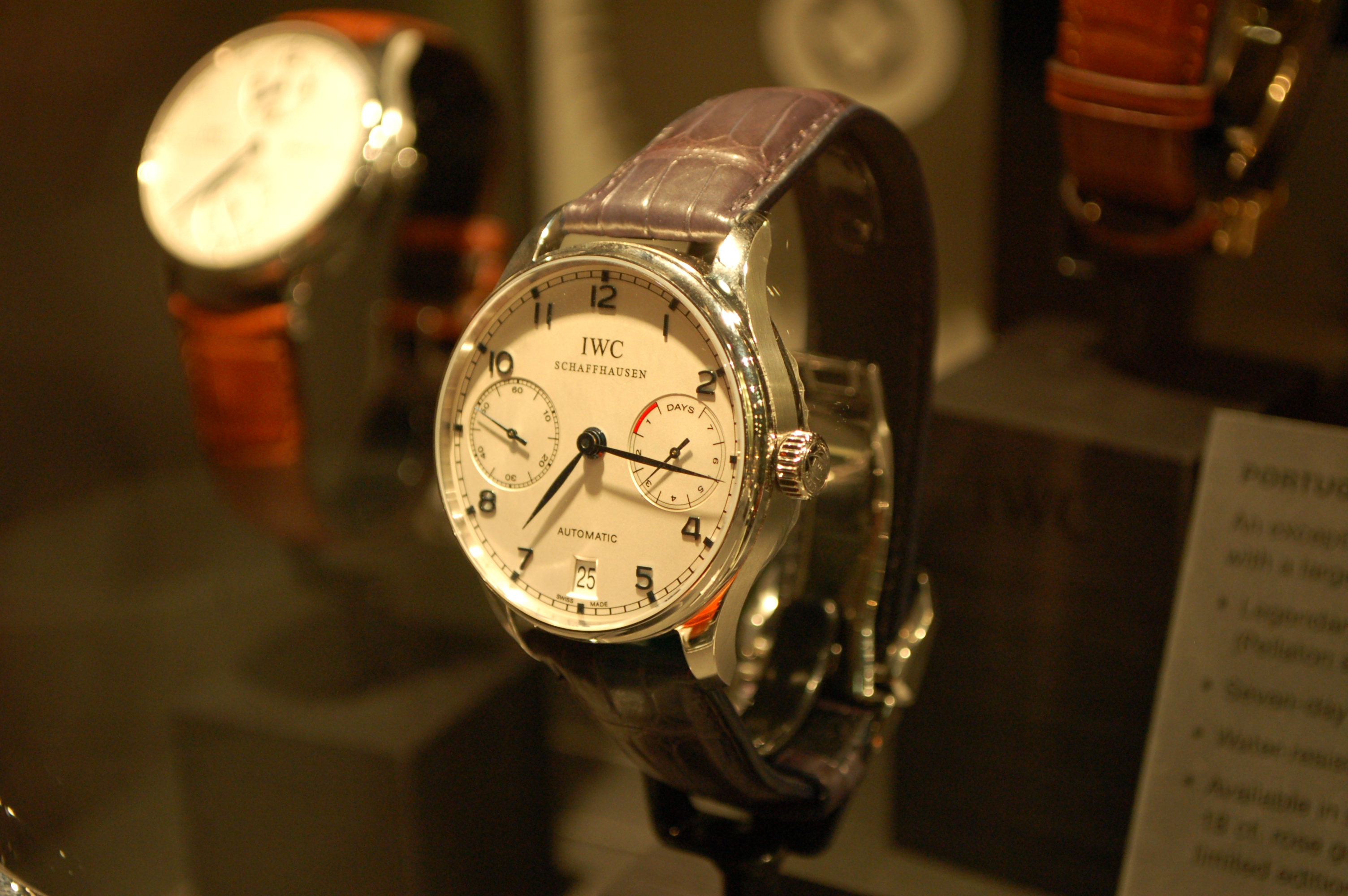
The IWC Portuguese Automatic. Photo: Wikimedia Commons, CC BY-SA 3.0.
The Ingenieur of 1955 was the world’s first antimagnetic watch for civilian use, built for engineers (hence the name), with a soft iron inner case protecting the movement. Gérald Genta redesigned it in 1976 as the Ingenieur SL ref. 1832, an integrated-bracelet sports watch in the same family as his Royal Oak. The Aquatimer, the company’s dive watch, arrived in the late 1960s with an internal rotating bezel. The Da Vinci line began in 1969 with the Beta 21 quartz movement, of all things, and then became the home of Klaus’s perpetual calendar in 1985. The elegant Portofino dress line joined in the 1980s. And the 1980s Porsche Design partnership produced some genuinely radical watches, including the first titanium bracelets in watchmaking and the Ocean 2000 diver.

Detail of an IWC Aquatimer. Photo: Wikimedia Commons, CC BY 2.0.
Current status
IWC has been led by CEO Christoph Grainger-Herr since 2017, following Georges Kern’s tenure from 2001 to 2017. It operates with a high degree of autonomy inside Richemont, building seven different in-house movements at its Schaffhausen manufacture plus a newer manufacturing center outside the city. The brand now runs six collections: Pilot’s Watches, Portugieser, Ingenieur, Aquatimer, Da Vinci, and Portofino. Marketing has leaned into Formula 1 partnerships and celebrity ambassadors like Lewis Hamilton and Gisele Bündchen, which sells watches but does not do much for the sober engineering reputation the brand spent 150 years building.
Why it matters
IWC is proof that watchmaking can be an industrial craft rather than just luxury theater. Jones’s idea was factories and machines, not cottages and mystique, and the company still keeps that engineering DNA: antimagnetic cases, the single-crown perpetual calendar, titanium bracelets before anyone else thought of it. It made real tools for real professions, navigators and divers and engineers, and the Mark XI and the early Portugieser remain genuinely great watches. The fair criticism is that the Richemont era sometimes confuses bigger with better, and the marketing department occasionally forgets that engineers are not supposed to wear flight jackets. But the factory is still in Schaffhausen, the archives still go back to 1885, and they will still service your watch from a century ago. That counts for a lot in watchmaking.
Official site: iwc.com
Thanks for reading this.

