
Hublot is a Swiss luxury watch brand founded in 1980 by Carlo Crocco, an Italian from the family behind the Binda Group, the company that made Breil watches. The name is the French word for porthole, which sounds like an odd choice for a watch company until you see the case: round, chunky, and ringed with screws like a ship’s window. Crocco’s founding idea was a gold watch on a rubber strap, which nobody had done, because it sounded like a joke. In 2004 he handed the company to Jean-Claude Biver, who turned it into the Big Bang, the official timekeeper of football World Cups, and the loudest thing in Swiss watchmaking. LVMH bought Hublot in 2008, and watch people have been arguing about it ever since.
The gold watch on a rubber strap
Carlo Crocco left his family’s company in 1976, moved to Switzerland, and formed MDM Genève with the idea of a luxury watch you could actually wear on a boat, which was one of his favorite pastimes. He spent three years developing a natural rubber strap that would hold up to daily wear, because pairing precious metal with rubber was unheard of in 1980. When he showed the first Hublot at the 1980 Basel Watch Fair, the story goes that he failed to attract a single customer on the first day. Even allowing for legend inflation, he was a strange pitch. It worked anyway: more than $2 million in sales in the first year, with members of European royal families among the early buyers. The porthole case with its ring of exposed screws became the brand’s signature, and the rubber strap, which half the industry now treats as obvious, started here. (I have spent an embarrassing amount of time on watch forums, and every argument about rubber straps eventually comes back to this watch.)

A MDM-era Hublot chronograph, from the years before the Big Bang. Photo: Wikimedia Commons, CC BY-SA 3.0.
Jean-Claude Biver and the Big Bang
By the early 2000s the brand had gone quiet, and in 2004 Crocco handed the keys to Jean-Claude Biver, who had already resurrected Blancpain and revived Omega. Biver gave Hublot a slogan, the Art of Fusion, and a watch to embody it: the Big Bang, launched in 2005. It was big, layered, and skeletonized, mixing rubber, titanium, carbon, and gold in a single case. The watch press split down the middle. It sold out anyway, winning the 2005 Design Prize at the Geneva Watchmaking Grand Prix, and by the end of 2006 Hublot’s sales were closing in on CHF 100 million. Biver followed it with the All Black in 2006, a watch so black on black it was genuinely hard to read, which was apparently the point. He then launched the sponsorship blitz that became the brand’s signature: football World Cups, Ferrari, Jay-Z, sprinters, and a logo on Floyd Mayweather’s shorts. In 2010 he even turned Bernie Ecclestone’s bruised face, after the former F1 boss was mugged, into an ad reading “See what people will do for a Hublot.” Subtle it was not. Effective it was.
The LVMH years
In April 2008, LVMH bought Hublot outright, acquiring it from Crocco and a company controlled by Biver, at a price reported at roughly twice the brand’s CHF 250 million turnover. Biver stayed on, then passed the CEO role to Ricardo Guadalupe in 2012. Guadalupe ran the brand for twelve years, and the era had real substance underneath the noise: the UNICO in-house flyback chronograph movement debuted in 2010, the Classic Fusion brought the design down to a slimmer size in 2008, the tonneau-cased Spirit of Big Bang arrived in 2014, and the MP Masterpiece line pushed into wild concept watches with tourbillons and 50-day power reserves. The company also built a proper manufacture at Nyon. In September 2024, LVMH moved Guadalupe to honorary chairman and put Julien Tornare, formerly of Zenith and TAG Heuer, in charge. Revenue was reported around CHF 670 million in 2023, which makes Hublot the loud, profitable middle child of the LVMH watch stable.
The honest part
Collectors tend to dislike Hublot, and the main reason deserves a straight answer: for years, a lot of the watches used off-the-shelf ETA and Sellita base movements inside five-figure cases, and people who care about what is inside a watch find that hard to forgive. The designs are deliberately aggressive, the marketing volume is enormous, and plenty of models exist mainly to be photographed. None of that criticism is unfair. But the dismissals skip over real achievements. The UNICO is a genuine in-house column-wheel flyback chronograph, designed and built by Hublot’s own engineers. The materials work, from scratch-resistant gold alloys to sapphire cases and colored composites, is genuinely inventive. And the founding idea, the gold watch on a rubber strap, is so standard now that people forget it had to be invented, by this company, when everyone said it was a joke.
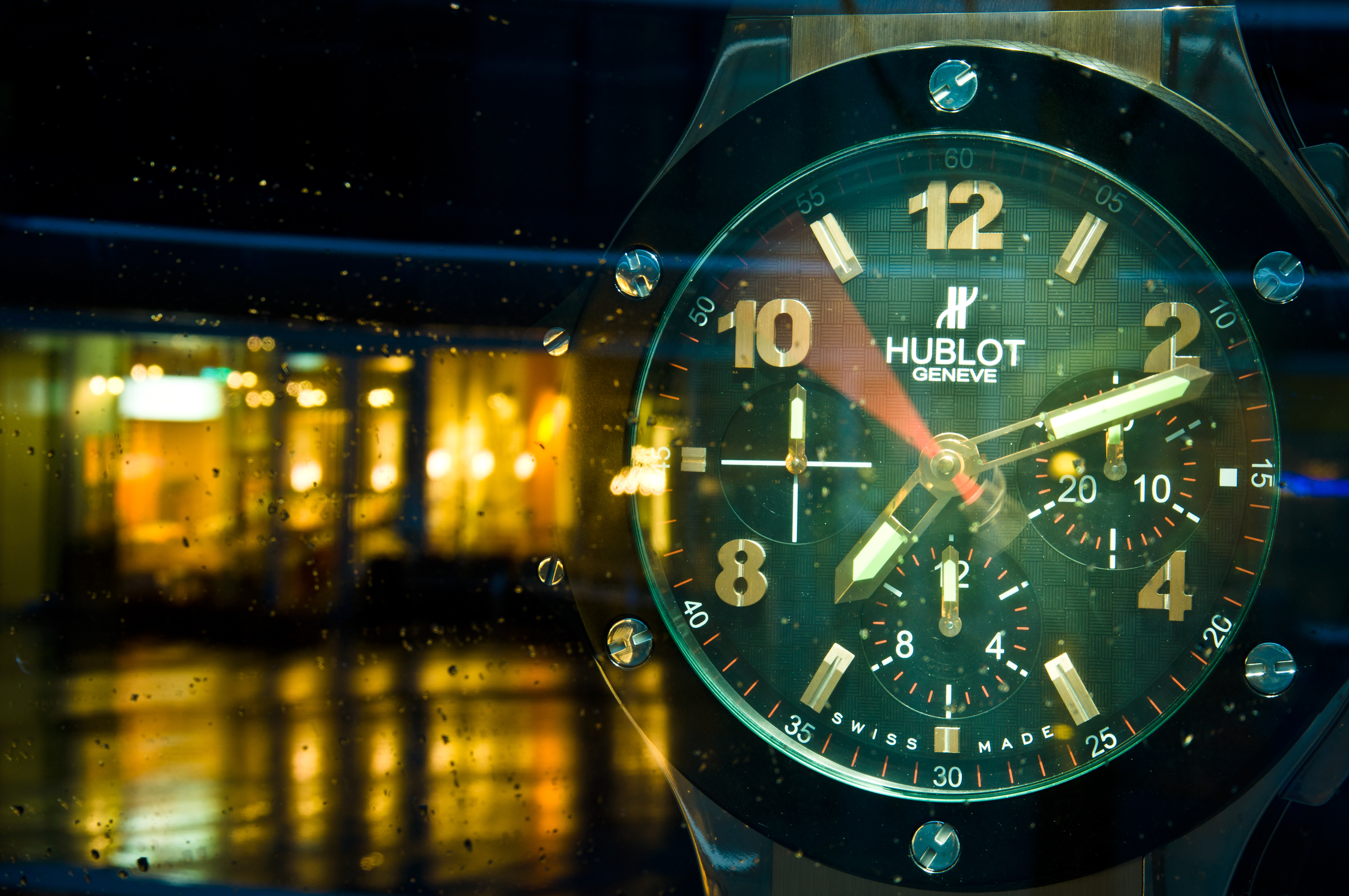
An oversized Hublot display in a Warsaw boutique window. Photo: Wikimedia Commons, CC BY-SA 3.0.
Why it matters
Hublot matters because it proved a Swiss luxury brand could be built almost entirely on attitude, and that marketing, if you back it with actual products, is a strategy rather than a dirty word. Biver took a brand people had forgotten and made it impossible to ignore, which is a genuine skill, however you feel about the watches. And the original 1980 idea still holds up: every brand now sells sport watches on rubber straps, and Hublot was doing it when it got them laughed out of Basel. Whether you love the Big Bang or would never wear one, the industry spent forty years catching up to a gold watch on rubber.
Official site: hublot.com
Thanks for reading this.

