
Hamilton was founded in 1892 in Lancaster, Pennsylvania, and for most of the twentieth century it was about as American as a watch company could get: railroad pocket watches, more than a million watches for American troops in World War II, the first electric wristwatch in 1957, and the first LED digital watch in 1970. Then, in 1969, the company closed its Lancaster factory and ended American manufacturing for good. The Hamilton you can buy today is a Swiss-made Swatch Group brand headquartered in Bienne. The name is American. The watches are Swiss. The heritage is genuine, but it belongs to a company that no longer exists.

A Hamilton Grade 992 railroad pocket watch, circa 1918. Photo: Wikimedia Commons, CC BY-SA 2.0.
Born from a bankruptcy
Lancaster had already burned through several watch companies before Hamilton came along: Adams & Perry, the Lancaster Watch Company, and finally the Keystone Standard Watch Company, started by Abram Bitner in 1886, which went bankrupt in 1891. A group of local investors bought the Keystone factory and merged it with the struggling Aurora Watch Company of Illinois, hauling Aurora’s machinery to Lancaster along with its superintendent, Henry Cain, who had also put his own money into the venture and wanted to build watches the railroads could trust. The new company was almost called “Columbian,” but the Waterbury Watch Company had already trademarked that name, so at a stockholders meeting in November 1892 they settled on Hamilton, after Andrew Hamilton, the Scottish-born lawyer who had laid out Lancaster County and once owned the ground the factory stood on. The first watch made under the Hamilton name came out in 1893: an 18-size, 17-jewel pocket watch.
The railroad years
Hamilton existed because of the railroads. The 1891 wreck at Tipton, Ohio, blamed on a railroader’s inaccurate pocket watch, had forced the railroads to adopt strict accuracy standards, and Hamilton aimed squarely at that demand. Its first series of pocket watches, the Broadway Limited, was marketed as “The Watch of Railroad Accuracy,” and at its peak Hamilton held over 56 percent of the railroad watch market. The Grade 992 and its descendants became the stuff of legend; in its first 65 years the company made nearly 2.8 million railroad-grade pocket watches. Wristwatches came late and reluctantly. Hamilton didn’t make its first wristwatch until 1917, aimed at men heading into World War I, and in 1928 it bought the Illinois Watch Company for over $5 million, which strengthened its American production and added stylish Art Deco dress watches like the Piping Rock and the Spur.
Two world wars
World War I pulled Hamilton into wristwatches. World War II turned the whole company into a war supplier. Hamilton stopped making consumer watches entirely and gave the Lancaster factory to the military: more than a million watches were shipped overseas to American forces. It also solved a problem no American company had cracked before, mass-producing marine chronometers for the Navy. The Model 21, built in the thousands for the Navy and the merchant marine, was good enough that the Navy kept some in service as navigation backups into the late 1980s, when GPS finally displaced them. Hamilton’s wartime output earned the Army-Navy E Award for manufacturing excellence in 1943.
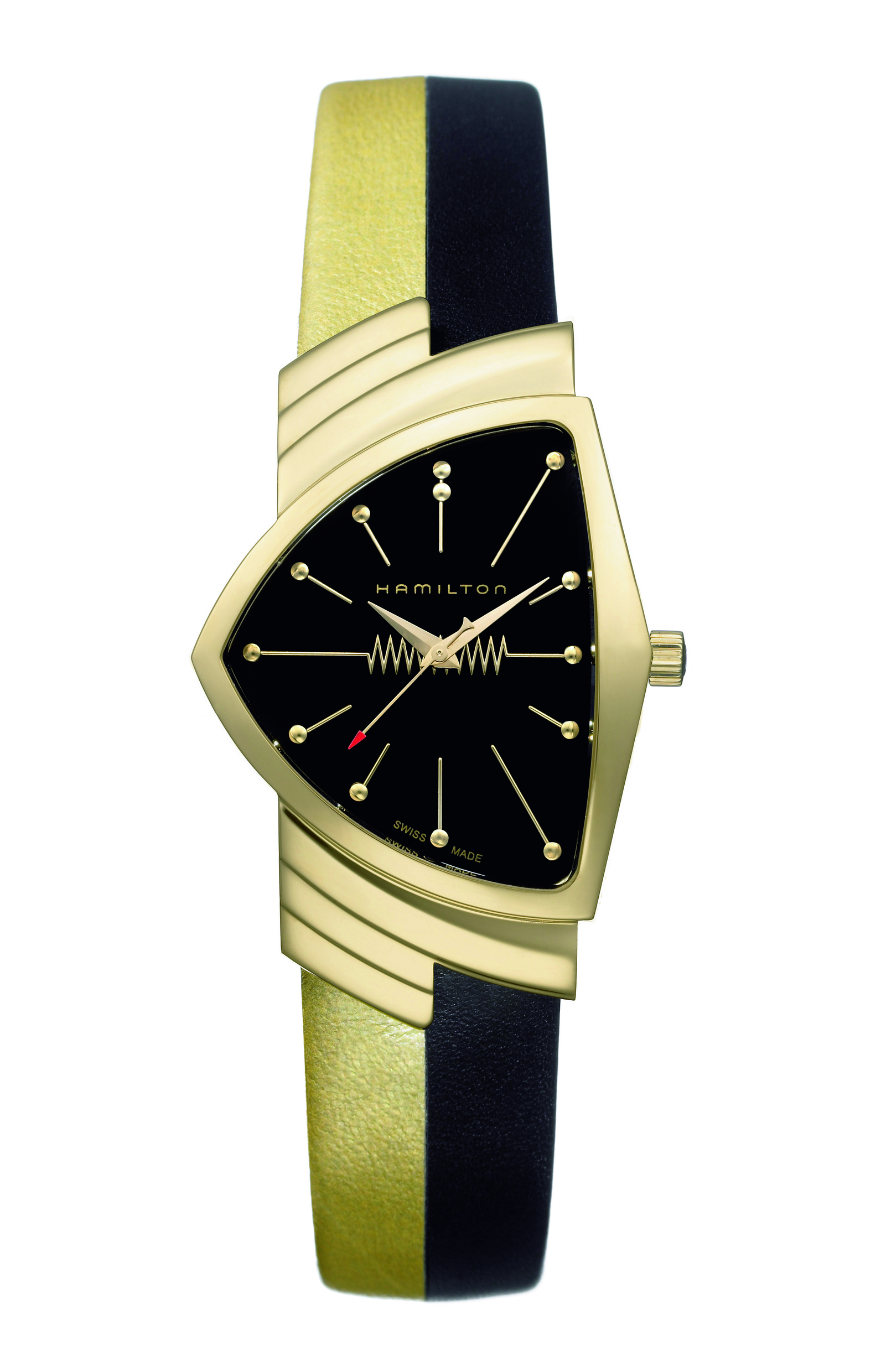
The Hamilton Ventura, the world’s first electric wristwatch, introduced in 1957. Photo: Wikimedia Commons, CC BY-SA 3.0.
The last American decade
The 1950s were Hamilton’s strangest and most creative period, and its last as a genuinely American manufacturer. The company fought off a hostile takeover bid by Benrus in 1951, and the fallout became a landmark federal antitrust case. Then, in 1957, Hamilton introduced the world’s first electric watch, the Electric 500, in a series of wild asymmetrical cases designed by industrial designer Richard Arbib. The most famous of them, the Ventura, ended up on Elvis Presley’s wrist in the 1961 film Blue Hawaii, and it has never really left the catalog. Hamilton also tried a joint venture with Japan’s Ricoh in 1962 to build electric watches for the Japanese market; demand was weak, Seiko loomed over everything, and the partnership folded in 1965. Then in 1970, a team led by Hamilton engineer John Bergey launched the Pulsar, the first LED digital watch, announced with a full-page ad in the New York Times. It was a sensation for about three years, until cheaper LCD watches and quartz analogs with longer battery life made it obsolete.

The Hamilton Pulsar Time Computer, the first LED digital watch, introduced in 1970. Photo: Wikimedia Commons, CC BY-SA 4.0.
Becoming Swiss
This is the part the advertisements tend to glide past. In 1966 Hamilton bought the Swiss Büren Watch Company and began shifting production across the Atlantic. In 1969 it closed the Lancaster factory entirely, ending American manufacturing for good. In the early 1970s the watch business was sold to SSIH, the holding company behind Omega and Tissot (Hamilton’s own company history dates this to 1974), and Hamilton became a Swatch Group brand through the merger of SSIH and ASUAG. The headquarters officially moved from the United States to Switzerland in 2003, and since then every Hamilton watch has carried the Swiss Made label. So the continuity the marketing implies deserves a careful read. The Lancaster company that built the railroad watches and the wartime chronometers is gone. Today’s Hamilton is a Swiss subsidiary, sitting near the entry level of the Swatch Group price ladder, trading on the name and the greatest hits.
What Hamilton is now
Modern Hamilton is one of the strongest value plays in watches, and I mean that as a compliment. The lineup mines the back catalog: Khaki Field and Khaki Aviation for the military and pilot look, Khaki Navy for divers, Jazzmaster for dressier pieces, and the Ventura still in production nearly seventy years after its debut. Movements come from the Swatch Group parts bin, including the 80-hour H-10 and hand-wound H-50, which means solid specs and servicing any watchmaker can handle. Hamilton also has the best film career in the business, with the brand claiming more than 500 screen appearances, from 2001: A Space Odyssey to Interstellar, whose prop “Murph” watch became a genuine retail hit. Nothing in the catalog is cutting edge anymore, and some of the heritage talk leans hard on a past the current company never lived through. But the watches are honest, well made, and fairly priced, which is rarer than it should be.
Why it matters
Hamilton matters because it did three things that genuinely changed watches: it helped define railroad-grade timekeeping in America, it made the first electric wristwatch, and it made the first LED digital watch. It also matters as a lesson about what happened to American watchmaking. The industry that once held 56 percent of the railroad market is gone, and the name survives as a Swiss brand making affordable watches with American-flavored designs. That is worth knowing before you buy, not because it makes a Khaki Field Mechanical a bad watch (it is one of the best values going), but because the story on the website is smoother than the real one. Most watch brand stories are. Hamilton’s is just easier to check, because the real one is so good they barely need to embellish it.
Official site: hamiltonwatch.com
Thanks for reading this.

