
Every watch that leaves Schaffhausen with the H. Moser & Cie name on the paperwork traces its origin story to 1828, when a twenty-three-year-old Swiss watchmaker named Heinrich Moser set up shop in St. Petersburg and started selling timepieces to Russian aristocrats. What happened in between then and now is the interesting part. Moser died in 1874, his Russian business was seized in the 1918 revolution, and the Swiss remnant limped along until the quartz crisis finished it off in the late 1970s. So the company making watches under that name today is not, strictly speaking, the company Heinrich Moser founded. It is a 2005 revival, put together by a hairspring engineer and the founder’s great-grandson, that acquired a nearly two-hundred-year-old name and then, to its credit, proceeded to make some of the most interesting watches in Switzerland.
The man who sold watches to the Tsars
Heinrich Moser was born in Schaffhausen in 1805, did the usual watchmaker’s apprenticeship, and then did something unusual: he went to Russia. In 1828 he established H. Moser & Cie in St. Petersburg, building his own watches and supplying movements to firms including Fabergé, and his clients included Russian princes and members of the Imperial Court. Decades later, a Moser pocket watch even ended up on the wrist of Vladimir Lenin, which is the kind of historical trivia that is impossible to verify from the wrist but which museums have confirmed from the paperwork.
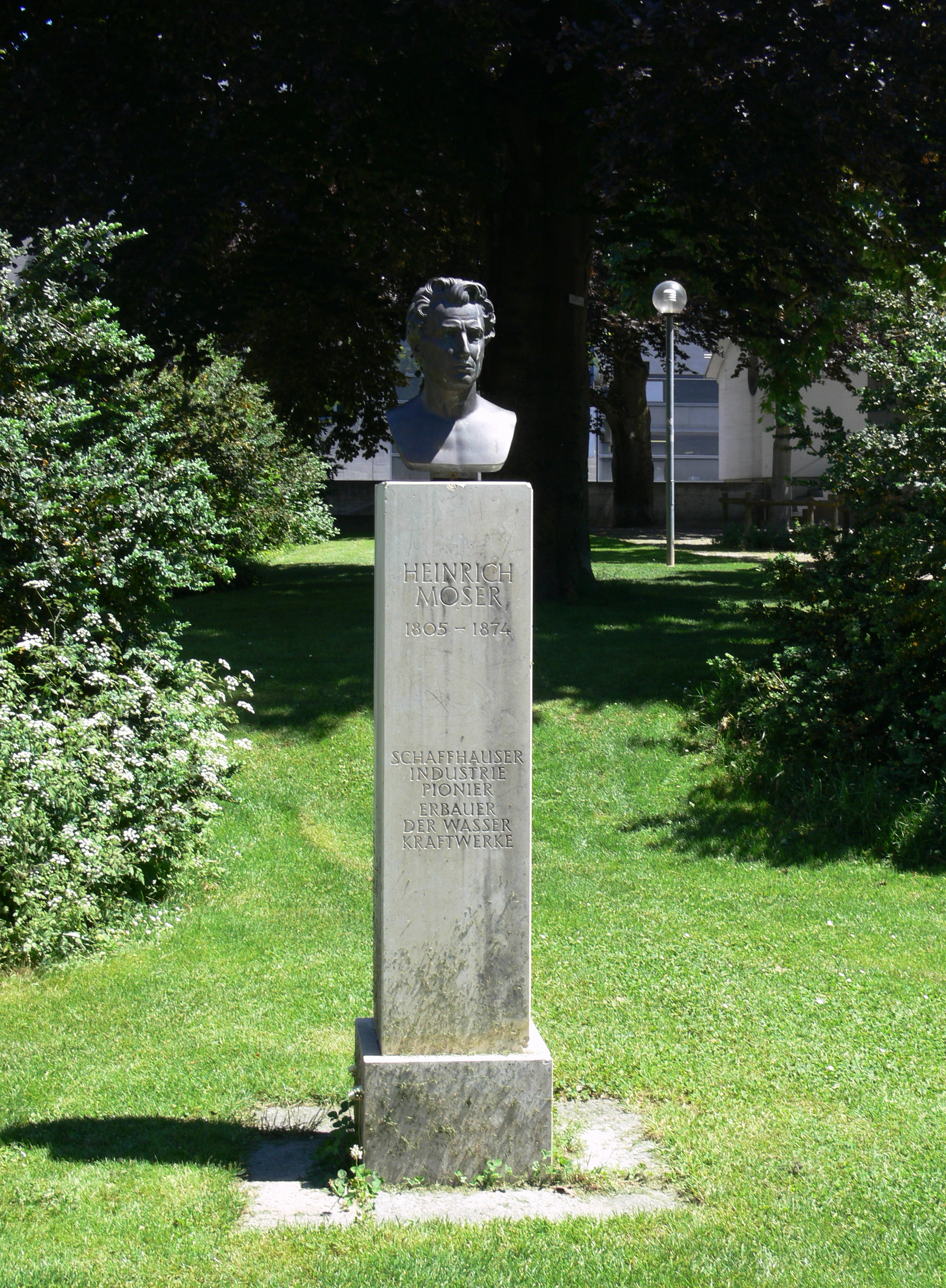
A bust of Heinrich Moser in Schaffhausen, the town he left and then came home to. Photo: Wikimedia Commons, CC BY 3.0.
Moser returned to Schaffhausen in 1848 a wealthy man and threw himself into being an industrialist, opening watchmaking workshops and building a dam and turbine on the Rhine to power them. He died in 1874, and the company was split up among its managing directors. The Swiss operation in Le Locle ended up with the family of Paul Girard, and the Russian side of the business was expropriated outright during the October Revolution in 1918. That was the end of the original story, though it took a while for everyone to admit it.
The long slow fade, then the reboot

After the wars, the remnants of Moser carried on in Le Locle as a small maker of precision lever-escapement watches, the kind of company that fills a line in old watchmaking directories and not much else. The quartz crisis hit it like it hit everybody else, and in 1979 the factory was absorbed into the Dixi-Mécanique group, trading under the mangled name “Hy Moser & Cie.” For the next quarter century, the brand effectively slept.
It woke up in 2002, when Dr. Jürgen Lange, founder of the hairspring firm Precision Engineering, joined forces with Roger Nicholas Balsiger, Heinrich Moser’s great-grandson and now the company’s honorary chairman. They founded Moser Schaffhausen AG and formally relaunched the H. Moser & Cie brand in 2005. The first new watches debuted at Baselworld 2006: the Mayu, the Monard, the Monard Date, and the Perpetual 1. That perpetual calendar, with its radically simplified display, won the Grand Prix d’Horlogerie de Genève prize for complicated watches in its debut year. The revival was bankrolled by Thomas Straumann, the dental-implant heir, and by his own later accounting it was an expensive hobby: Bloomberg reported the venture cost him over 100 million Swiss francs. By 2012 the brand was, in Edouard Meylan’s own words, in the red with almost no public awareness. It was nearly the end of the second act too.
Vladimir Lenin’s silver H. Moser pocket watch, made in the 1900s (State Historical Museum, Moscow). Photo: Wikimedia Commons, CC BY-SA 4.0.
The Meylans take the wheel
In 2012, MELB Holding, the family group run by Georges-Henri Meylan and Bill Muirhead, took majority control of H. Moser & Cie, with Straumann keeping a minority stake. The credentials were serious. Meylan had been CEO of Audemars Piguet, Muirhead had run finance at Breguet before the Swatch Group takeover. That same year the group also bought the struggling independent brand Hautlence and integrated Precision Engineering, the sister company that makes hairsprings and escapement components in Schaffhausen. In April 2013, Georges-Henri’s son Edouard Meylan became CEO of Moser, and the brand got a personality transplant.
The new management leaned hard into being the independent industry’s loudmouth. There was a “Very Rare” campaign, an unusually competent digital presence, and a string of annual provocations unveiled at SIHH that we will get to in a moment. Hautlence, meanwhile, stalled through the COVID years and was quietly put on hold while Moser accelerated. The strategy worked. Moser grew by roughly half in 2023 and kept climbing, and the brand that was in the red in 2012 now makes around 3,000 to 4,000 watches a year with about a hundred employees, more than twenty in-house calibres developed since 2005, and a minority stake in the complication specialist Agenhor. In 2028 it plans to move into a renovated 6,000-square-metre building on the SIG Areal site across from the Rhine Falls, nicknamed the Moser Ship, with capacity for more than 8,000 pieces a year.
The watches
Strip away the name and the marketing, and what Moser actually sells is a house style built on two things: outrageous dials and quietly brilliant movements. The signature is the fumé dial, a smoked gradient that fades from a light center to a dark edge, usually over a sunburst pattern, reportedly made in a two-hundred-step process. In 2015 Moser pushed the minimalism further with its Concept dials: no logo, no indices, no markings at all, just hands over a gradient. It also does dials in Vantablack, the blackest black available, which absorb almost all visible light and make the watch look like a hole in your wrist.
The collections are straightforward. The Endeavour is the dressy flagship and the largest line: perpetual calendars with a famously legible layout (date at three, month on a central hand, leap-year indicator tucked on the caseback), perpetual moonphases, tourbillons, and a minute repeater. The Pioneer is the sportier line, launched in the mid-2010s; its Cylindrical Tourbillon Skeleton won the GPHG tourbillon prize in 2022. The Heritage line borrows from the Schaffhausen museum pieces, the Venturer is a classical dress line, and the Streamliner is the integrated-bracelet steel sports watch. On the technical side, Moser developed its own Straumann hairspring with Precision Engineering, unveiled at Baselworld 2007, and builds nearly everything except cases, bracelets, sapphire crystals, and jewels in-house.

An original Henry Moser & Cie pocket chronograph in gold, made in 1917 (Musée d’Horlogerie du Locle). Photo: Wikimedia Commons, CC BY-SA 3.0.
The stunts
Starting in 2016, Moser began unveiling one deliberately provocative watch per year at SIHH, and this is where the brand’s reputation as the industry’s court jester comes from. The 2016 entry was the Swiss Alp Watch, a rectangular mechanical watch that looked exactly like an Apple Watch, introduced with a video parodying Apple’s product launches and the tagline “upgrade to a mechanical watch.” In 2017 came the Swiss Mad Watch, a case made from actual Swiss cheese set in resin, marketed as “the most Swiss watch ever created.” In 2018 Moser produced the Swiss Icons Watch, a mashup of famous design elements from the big Swiss houses meant to criticize an industry it saw as creatively bankrupt. The big houses did not find it funny, the watch was withdrawn before the show, and the message got lost in the outrage.
In 2019 came the Nature Watch, covered in live Swiss plants, a jab at environmental marketing. And in 2021 the Swiss Alp Watch saga got its finale: the Final Upgrade, with a Vantablack dial and a mechanical version of the spinning loading icon, fifty pieces at $30,800, described as needing “no updates required, no lousy autonomy, no unnecessary features, no annoying notifications.” Some of these were genuinely funny. Some were calculated to get exactly the coverage they got. All of them were made by a company producing a few thousand watches a year, punching far above its weight in the attention economy. Whether that is charming or irritating depends on how much patience you have for watch brands with opinions.
Why it matters
Here is the honest version. The 1828 founding date on Moser’s marketing is doing a lot of heavy lifting. The original company died in stages between 1874 and 1979, and the current one is a twenty-year-old revival wearing a two-hundred-year-old name, which puts it in the company of every other zombie brand in this industry. The difference is that the people running the revival built something real underneath the name. The perpetual calendar is a genuinely clever piece of engineering, the fumé dials are the best in the business, the in-house hairspring capability is something most brands Moser’s size can only dream of, and the family ownership means nobody in Geneva or Biel is telling Edouard Meylan what to do.
The drawbacks are real too. The production is tiny, the prices are not (entry-level sits well into five figures), and the stunt marketing that made the brand famous can make it hard to take seriously as the serious manufacture it clearly wants to be. The cheese watch got more press than any perpetual calendar ever will, and that is probably fine with them. If you want a watch from an independent manufacture that actually makes its own stuff and has a sense of humor about an industry that takes itself deadly seriously, this is one of the few places to look. Just know that the heritage is mostly scaffolding. The watchmaking is the point.
Official site: h-moser.com
Thanks for reading this.

