
Dior is the other great Paris fashion house that decided to make watches, and the story rhymes with Chanel’s: fashion money, a Swiss manufacture, real watchmakers, an audience of fashion customers. The difference is that Dior is owned by LVMH, which means its watches get Zenith movements and shared manufacture resources. It also means the watch division answers to Bernard Arnault’s empire. Different funding structure, same fundamental situation.
Monsieur Dior

Christian Dior in 1954. Photo: Wikimedia Commons, public domain.
Christian Dior founded his couture house in 1946 at 30 Avenue Montaigne in Paris, backed by the industrialist Marcel Boussac. His first collection in 1947, the “New Look,” remade women’s fashion after the war: nipped waists, full skirts, unapologetic luxury. He dressed Hollywood stars, landed the cover of Time in 1957, and died that same year at 52.
The house cycled through designers the way fashion houses do. Yves Saint Laurent was 21 when he took over. Then Marc Bohan, Gianfranco Ferré, John Galliano, Raf Simons, Maria Grazia Chiuri. In the eighties, Bernard Arnault bought into the company and eventually folded Dior into LVMH, the luxury conglomerate he controls. Dior is now the crown jewel of the largest luxury group on earth. The watch division is a rounding error in that empire, which cuts both ways.
The watch project
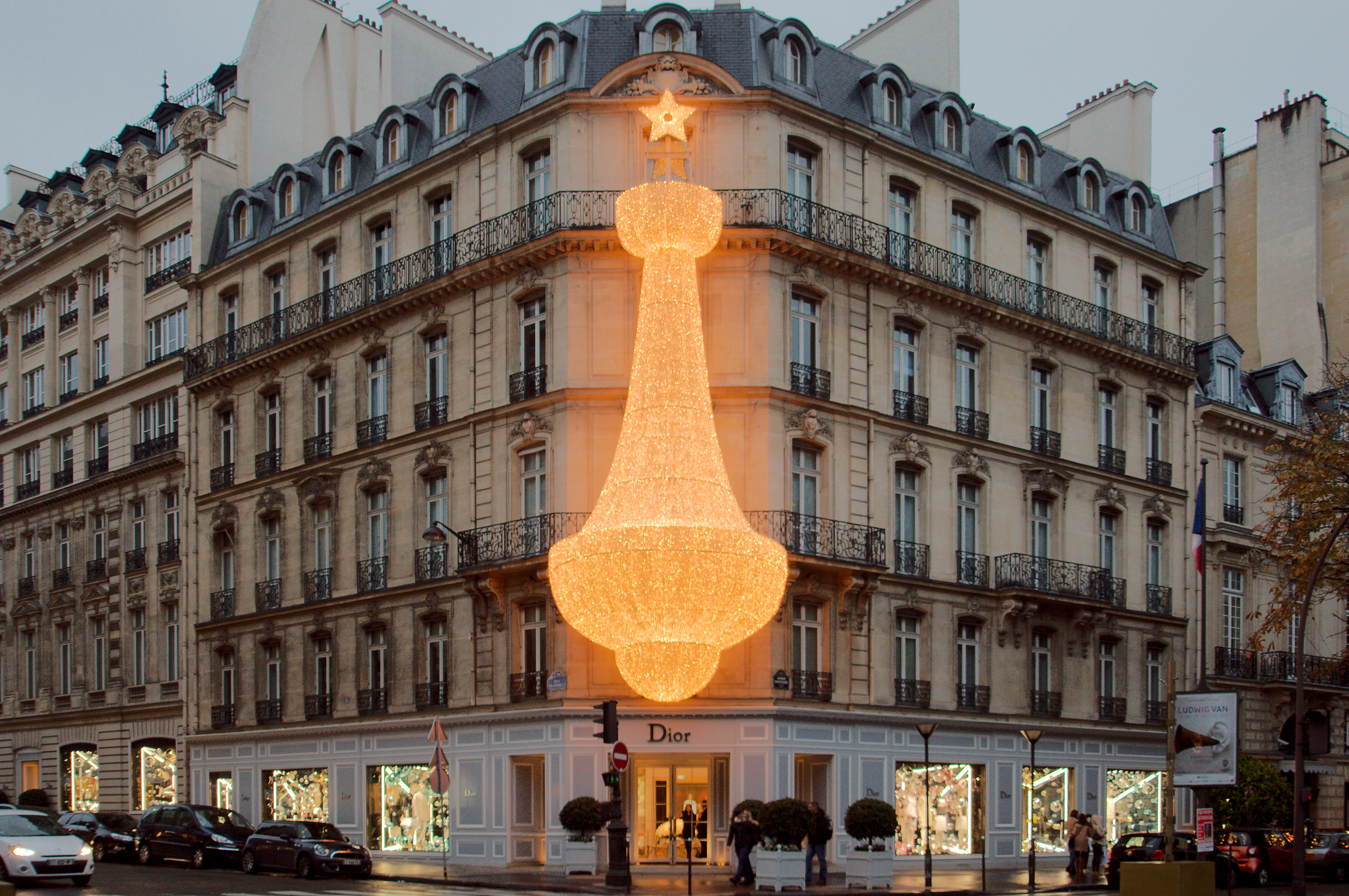
30 Avenue Montaigne, where it all started. Photo: Wikimedia Commons, CC BY 2.0.
Dior was the first fashion house to move into luxury watches. The debut collection was made by a Swiss subsidiary owned by Bulova, of all companies. The Black Moon series came in 1975. It was not until the late eighties, under LVMH, that Dior started making serious timepieces.
In 2001, Dior opened Les Ateliers Horlogers Dior in La Chaux-de-Fonds, its own development and manufacturing arm. The first tourbillon followed in 2008. This is the Chanel playbook: buy the factory, hire the watchmakers, spend real money. LVMH’s ownership helps here. Dior can borrow expertise from Zenith, its sister company, and from La Fabrique du Temps, Louis Vuitton’s manufacture. Few fashion brands have a Zenith on speed dial.
Chiffre Rouge
In 2004, Hedi Slimane, then running Dior Homme, designed the Chiffre Rouge. It was Dior’s first men’s automatic watch. Asymmetric case, crown at four o’clock, red accents, the number 8 in the date window (Monsieur Dior’s lucky number; he called red “the colour of life”). It was a genuinely good-looking watch with real design personality.
Then Dior killed it. Around 2015, the Chiffre Rouge disappeared from the lineup. No explanation that satisfied anyone. The men’s watch line went quiet for nearly a decade. It came back in 2024 for the twentieth anniversary, with Zenith-derived movements running at 5Hz. The revival is good. The gap is the story. A watch line that vanishes for ten years is not a watchmaker’s priority. It is a fashion house’s side project, subject to the whims of creative directors and corporate strategy.
The women’s watches
This is where Dior actually shines, because the brand understands women’s jewelry watches in a way most Swiss manufacturers do not. Victoire de Castellane, Dior’s fine jewelry designer, created La D de Dior. The Dior VIII launched in 2011 in ceramic, with the “Dior Inversé” caliber putting an openworked rotor on the dial side. Yes, the ceramic sports watch was chasing Chanel’s J12. Everyone chased the J12.
The Grand Bal, from 2013, is the standout. The oscillating weight is decorated like a ball gown skirt and mounted on the dial side, so the “skirt” twirls as the wrist moves. It is playful, technically interesting, and completely Dior. A Swiss manufacture would never think of this. A fashion house did.
Why it matters
Dior’s watchmaking is better than it has any right to be, and that is because LVMH throws real resources at it: a manufacture, Zenith calibers, genuine investment. The Grand Bal is a legitimately creative watch. The revived Chiffre Rouge is a good men’s watch.
But the audience is fashion customers, not watch people. The men’s line died for a decade because nobody at the top cared enough to keep it alive. The ceramic watches followed Chanel’s lead. And the whole division exists at the pleasure of a conglomerate that could redirect the funding tomorrow. Dior makes good watches. Whether Dior is a watchmaker is a different question.
Official site: dior.com
Thanks for reading this.

