
There is a type of watch person who will tell you, unprompted, at a dinner party, that A. Lange & Söhne makes the best watches in the world. Not the most expensive, not the most famous, the best. And then they will show you a photo of a movement on their phone, zoomed in on a tiny hand-engraved flower on something called a balance cock, and they will look at you the way a man looks at his newborn. I know this because I have been that man. I am sorry.
A. Lange & Söhne is a German watchmaker from a tiny Saxon town called Glashütte, and the short version of their story is: founded 1845, destroyed by war and communism, resurrected from nothing in 1990 by a 65-year-old man with no factory, no employees, and no machinery, now making about five thousand watches a year that collectors fight each other to buy. It is the best comeback story in watches, and watches are full of comeback stories.
The history, which is genuinely wild
Ferdinand Adolph Lange was a Dresden watchmaker who, in 1845, talked the Saxon government into loaning him money to start a watch company in Glashütte, a poor mining town in the Erzgebirge mountains. The pitch was basically: give me money, I will teach your poor miners to make watches, everyone wins. It was a government retraining program, 1845 style, and it went better than teaching truckers to code. It worked. He brought division of labor to German watchmaking, introduced the metric system to it, invented the three-quarter plate that is still the visual signature of a Glashütte movement, and built the company into one of the great names in precision horology. Kaiser Wilhelm II wore one. So did the Ottoman Sultan. The Russian Tsar had several.
Then the twentieth century happened. During the Second World War, Lange did what every German manufacturer did: it produced for the war effort, including the oversized B-Uhr pilot watches for the Luftwaffe. That is part of the story, no sense pretending otherwise. The main factory was bombed on the last night of the war. Then the Soviets showed up, and in 1948 the East German state nationalized the company out of existence. The Lange family lost everything. For forty years, there was no A. Lange & Söhne. The name survived only in museums and auction catalogs.
Enter Walter Lange. Great-grandson of Ferdinand. In 1990, at age 65, after the Berlin Wall fell, he went back to Glashütte and re-registered the company. He had, by his own account: no watches, no employees, no premises, no machinery. What he had was the name, the history, and what Germans call Sitzfleisch, which roughly translates to “the ability to sit still and work until the job is done.” On October 24, 1994, the new A. Lange & Söhne presented its first four watches: the Lange 1, the Arkade, the Saxonia, and a tourbillon called “Pour le Mérite.” The watch world lost its mind. Here was a company that had not existed for four decades, showing up with movements finished to a level most Swiss brands could not match. Richemont bought a majority stake in 2000, which is how you know it worked.
Walter Lange died in 2017. His motto, “There is something one should expect not only of a watch, but also of oneself: to never stand still,” is still the company’s guiding principle. Which is a lot of pressure to put on a wristwatch, but they pull it off.
What makes a Lange a Lange
Flip one over. That is the whole pitch. Lange movements are made of untreated German silver, which is not actually silver, it is a copper-nickel-zinc alloy that develops a warm golden patina over time. The plates are three-quarter plate, covering most of the movement the way Ferdinand designed it in the 1860s. The balance cock, the little bridge holding the balance wheel, is hand-engraved with a floral pattern, and no two are exactly alike because a human being did it with a graver. The screws are blued steel set in gold chatons. The jewels sit in screwed gold settings instead of being pressed in. Every part, even the ones you will never see, is finished to a standard that would make a Swiss watchmaker nervous.
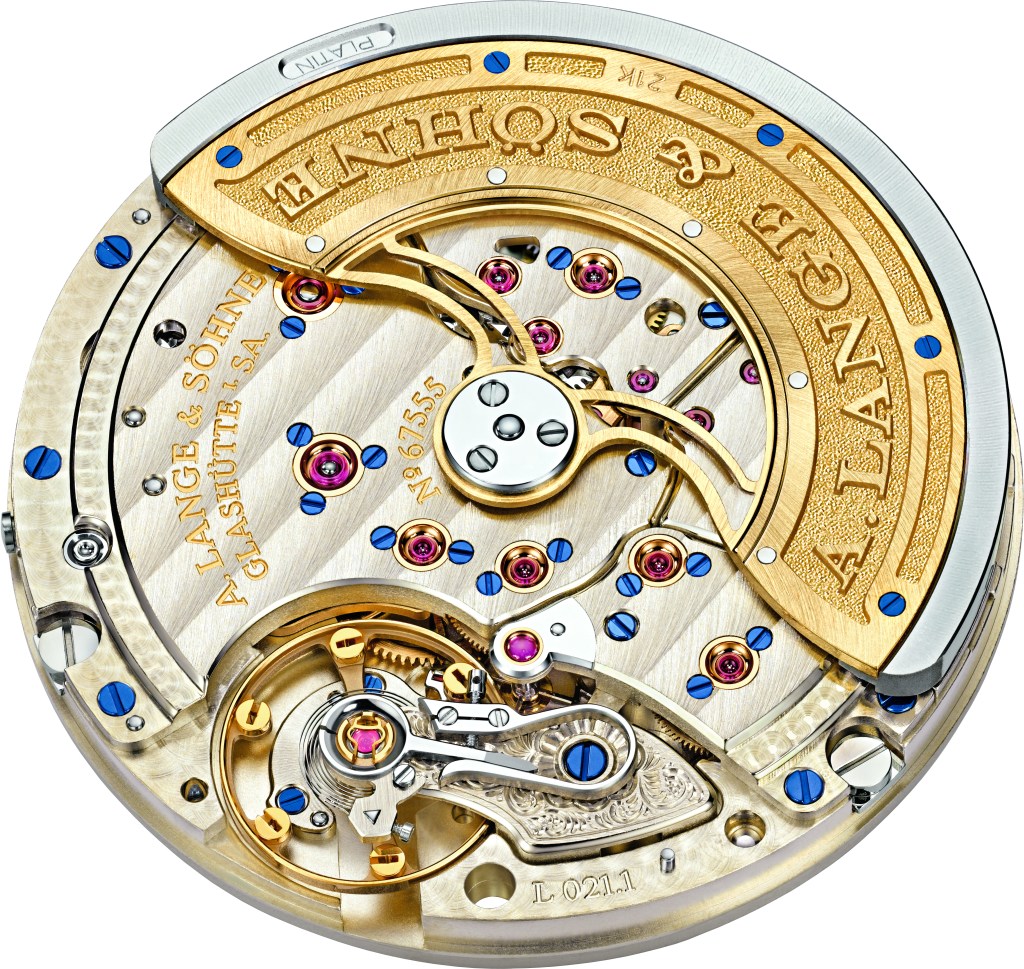
They also assemble every movement twice. Once to make sure it works, then they take it apart, finish everything, and assemble it again. This is insane. This is why the watches cost what they cost.
The greatest hits
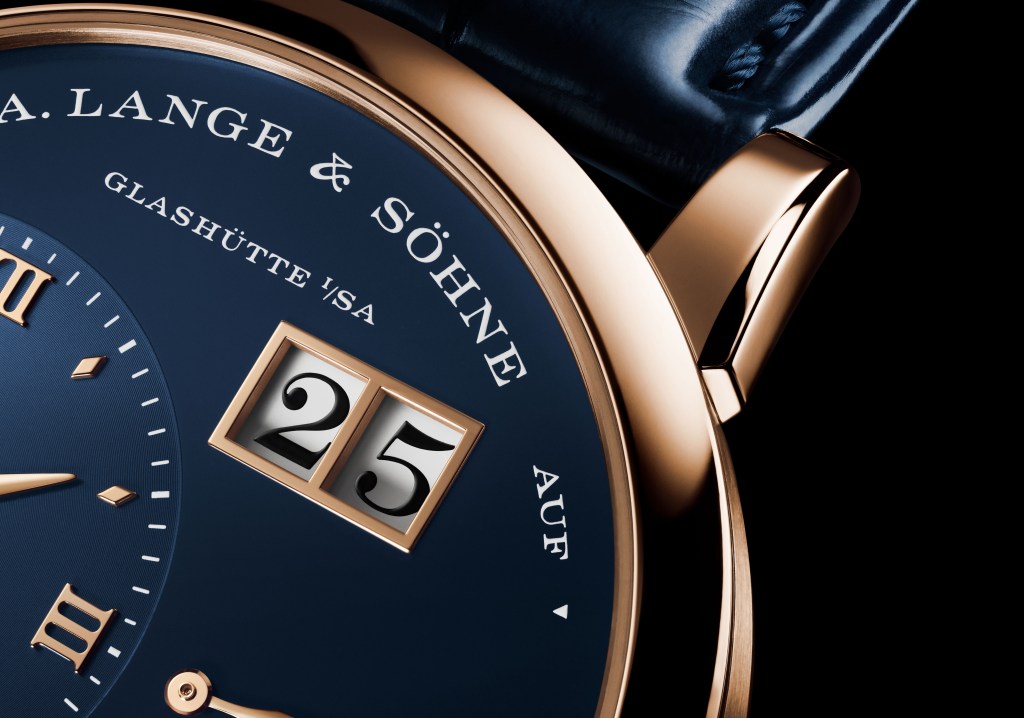
Lange 1: the one. Launched 1994, still the flagship. Off-center dial, outsized date inspired by the five-minute clock in Dresden’s Semper Opera House (Ferdinand helped build the original), power reserve indicator that says AUF and AB because it is German and it does not care about your feelings. If you buy one Lange, this is the one.
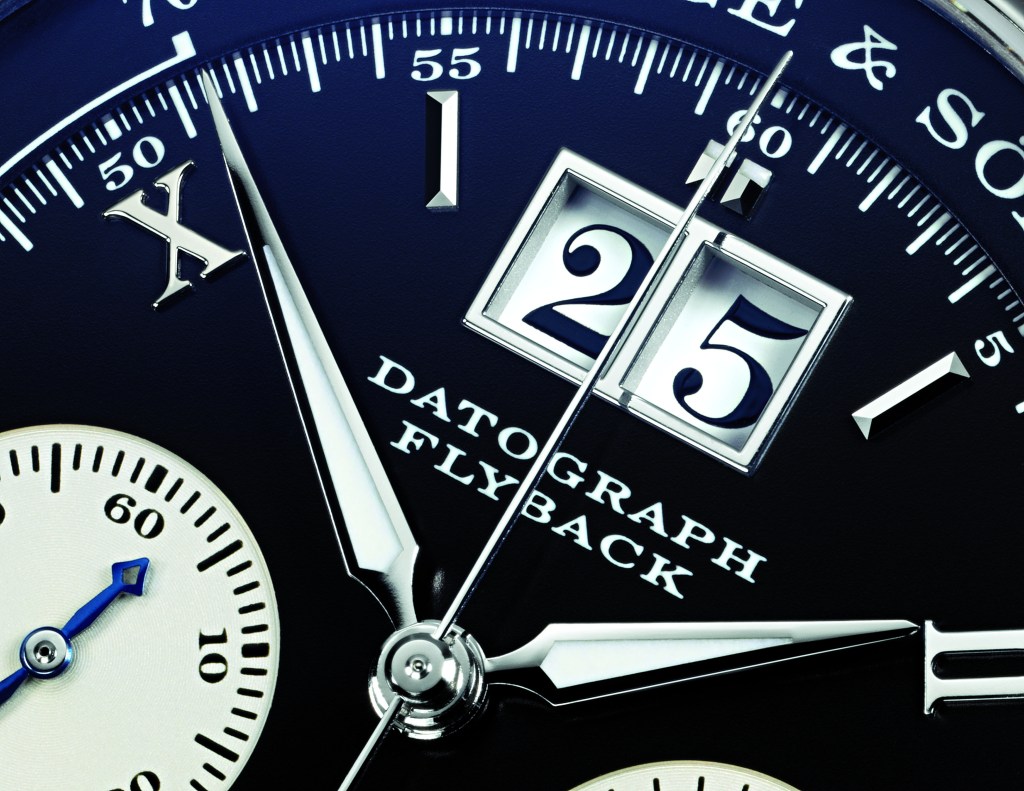
Datograph: launched 1999, the chronograph that made collectors weep. Flyback chronograph, and the movement is so beautiful people buy the watch just to look at the back. The Datograph is the reason a generation of collectors learned the word “flyback.”
Zeitwerk: launched 2009. A mechanical watch with jumping digital hours and minutes. Sounds like a contradiction, works like a miracle. The numerals are on discs, they jump precisely on the minute, and the whole thing is powered by a mainspring. Nobody else does this.
1815: the classic line, named for Ferdinand’s birth year. Includes the 1815 Chronograph and the 1815 Up/Down with power reserve.
Saxonia: the dress watch line. Thin, clean, the “I have taste and I do not need to shout about it” watch.
Odysseus: launched 2019, Lange’s first stainless steel sports watch with a bracelet. The watch world acted like the Pope had bought a motorcycle. It has a big date and a day display and water resistance to 120 meters, which for Lange is basically a dive watch.
Why it matters
A. Lange & Söhne proved that German watchmaking was not a historical footnote. When Walter Lange restarted the company in 1990, Glashütte was a depressed post-communist town with no watch industry to speak of. Today it is the center of German haute horlogerie, with Lange, Glashütte Original, Nomos, and Moritz Grossmann all building watches there. One man with a name and a grudge rebuilt an entire industry. He reminds me of myself, except instead of rebuilding an industry I have a watch blog nobody reads.
They also proved that you can compete with the Swiss holy trinity (Patek, Audemars Piguet, Vacheron) without being Swiss, without being old in the continuous sense, and without playing by Geneva’s rules. A Lange does not look like a Patek. It looks like a Lange. The German silver, the three-quarter plate, the outsized date, the hand engraving: it is a completely different visual language, and it is every bit as serious.
Official site: alange-soehne.com
Thanks for reading this.

