
The rotor is the swinging weight inside every automatic watch, the part that turns your daily fidgeting into wound mainspring. It is usually a semicircular slab of heavy metal pivoted at the center of the movement, and it is the single most recognizable part of the automatic: flip over a watch with a display back and the rotor is the big thing sweeping around. The whole history of the automatic is, in a real sense, the history of this one part getting better at its job.
An ETA 2824, the archetypal full-rotor automatic. The rotor covers most of the movement. Photo: Wikimedia Commons, CC BY-SA 3.0.
Full circle vs bumper
The first rotors could not spin all the way around. John Harwood’s 1923 self-winding watch used a weight that swung back and forth, bouncing off spring bumpers at each end of its arc, winding the mainspring as it went. Bumper automatics worked, and companies like Omega built them for years, but the weight only ever traveled part of a circle, which limited how much energy each swing could harvest. The breakthrough came in 1931 with the Rolex Oyster Perpetual: a rotor that rotated a full 360 degrees, winding as it went, with no bumpers and no dead ends. That is the architecture nearly every automatic still uses. The full rotor harvests energy from every direction of wrist motion, which is why a modern automatic can stay wound through an ordinary day at a desk.
Mounting and materials
A rotor is heavy by design, and a heavy thing spinning on a pivot is a wear problem waiting to happen. The classic fix arrived in 1948 with the Eterna-Matic, which mounted the rotor on ball bearings, five tiny ones arranged in a circle, cutting friction and wear so dramatically that the setup became the industry template. Modern rotors run on ball-bearing races as a matter of course, and the weight itself is usually made from something dense: tungsten is common because it packs a lot of mass into a thin disc, and high-end movements sometimes use gold, partly for the same density and partly because a gold rotor looks fantastic through a display back. Some brands skeletonize the rotor or engrave it, since it is the first thing you see. It is decoration with a day job.

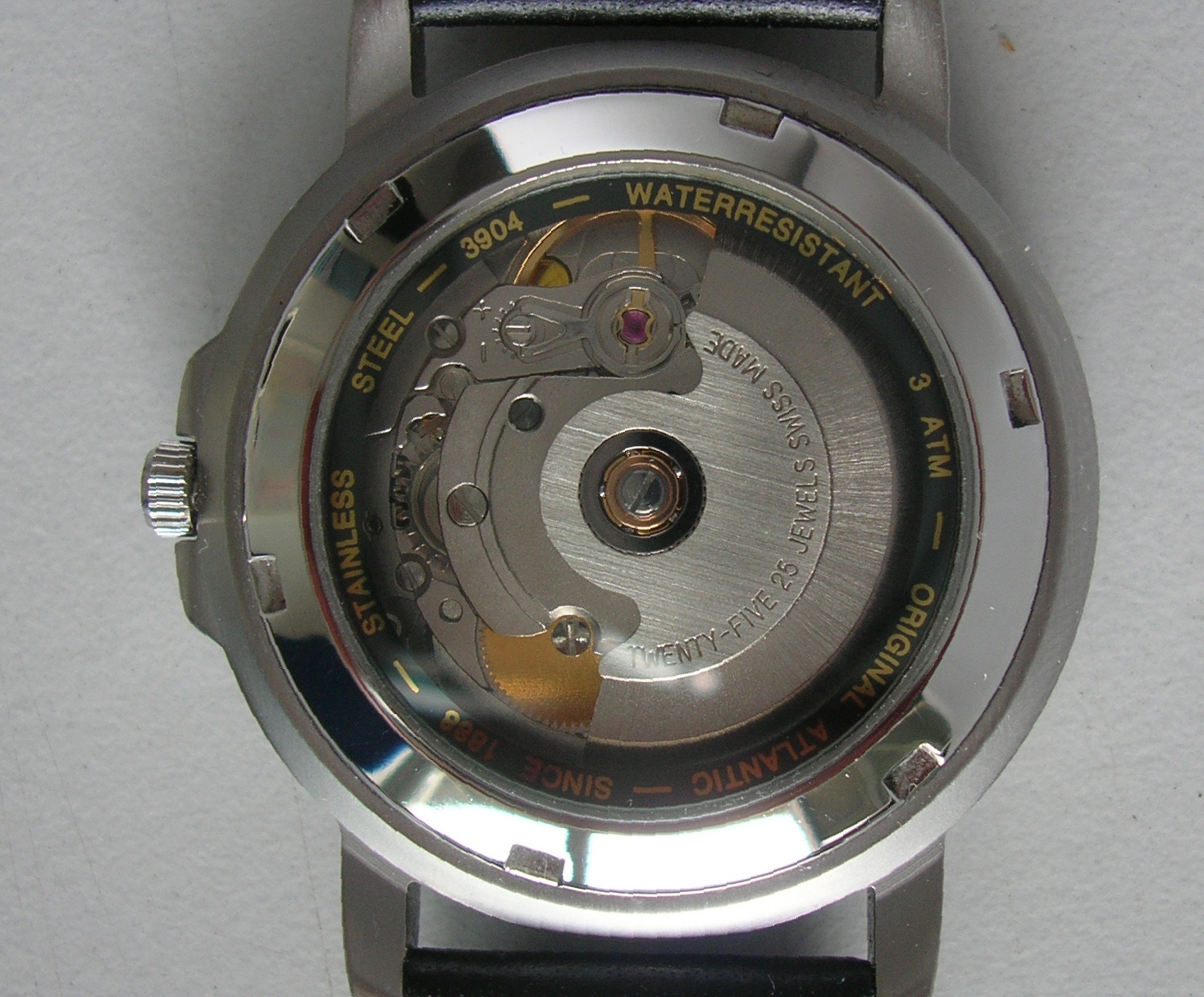
A rotor up close, in a Stowa Antea. Heavy, balanced, and built to swing for decades. Photo: Wikimedia Commons, CC BY-SA 2.0.
Where the rotor is going
The full central rotor won, but it has two costs: it adds thickness, since it sits on top of the movement, and it hides the movement underneath, which bothers people who buy display backs to look at the works. The industry’s answers to those complaints have their own pages: the micro-rotor, sunk into the plate to keep things thin, and the peripheral rotor, moved out to the edge so the movement stays fully visible. The ordinary central rotor is not going anywhere, though. It is simple, it is efficient, and after ninety years it is still the default answer to the question of how to wind a watch with a wrist.
Why it matters
The rotor is the part of the watch that connects the machine to your body. Everything else in the movement is about precision. The rotor is about you: how much you move, how the watch rides your wrist, whether it is wound when you pick it up on Monday morning. Harwood’s bumper weight and Rolex’s full rotor and Eterna’s ball bearings were all attempts to harvest more of that motion with less waste, and the modern automatic is the accumulated result. When you feel that faint swing on your wrist, that is a century of engineering saying hello.
Thanks for reading this.

