
Put two oscillators near each other and they start keeping time together. Christiaan Huygens discovered this in 1665 with pendulum clocks, and watchmakers have been exploiting it ever since: two balance wheels, influencing each other through whatever connects them, will fall into step and then steady each other. It is called resonance, and in a watch it acts like a self-correcting system. When a knock disturbs one balance, the other pulls it back into line.

One of Christiaan Huygens’s pendulum clocks. In 1665 he noticed two of them, hung on the same beam, falling into step. Photo: Wikimedia Commons, public domain.
Huygens’s odd sympathy
In 1665, the Dutch scientist Christiaan Huygens hung two pendulum clocks he had built himself on the same wooden structure in his house in The Hague, and noticed they kept ending up swinging in perfect opposition, no matter how he started them. He called it an odd sympathy. His guess was that tiny vibrations traveling through the beam were coupling the two pendulums, and three and a half centuries later, researchers with laser monitoring and computer models confirmed he was right. The effect only works when the two oscillators are closely matched, which is why Huygens’s clocks, built as a pair, did it so readily. It was a parlor curiosity for centuries. Then watchmakers realized it could be a regulator.
Resonance in a watch
The idea made the jump from clocks to watches in the 1700s: Antide Janvier and Abraham-Louis Breguet both built resonance timepieces, using the effect to steady the rate. In a wristwatch, the setup is two complete balance assemblies sitting close together, close enough that each one’s motion nudges the other. They take turns acting as exciter and resonator, trading tiny pushes until their beats lock together. The payoff is stability. A shock that speeds one balance up will slow the other down by the same amount, and the coupled pair drags itself back to agreement, shrugging off disturbances that would knock a single balance off its rhythm. It only works if the two balances are adjusted to nearly identical rates first, which is brutally fussy work, and that fussiness is why you rarely see it.
The modern resonance watches
François-Paul Journe brought resonance to the wristwatch in 2000 with the Chronomètre à Résonance, the first watch to use the phenomenon with no mechanical connection between the two balances at all, just acoustic coupling through the air and the movement plates. It won best complicated watch at the Grand Prix d’Horlogerie de Genève in 2010, and it remains the reference for the whole idea. In 2016, Armin Strom took a different route with the Mirrored Force Resonance: two balances visibly beating in opposition on the dial, linked by a patented flexible coupling spring developed with the Swiss research center CSEM. Same physics, opposite presentation. Journe hides the magic inside; Armin Strom puts it on stage.
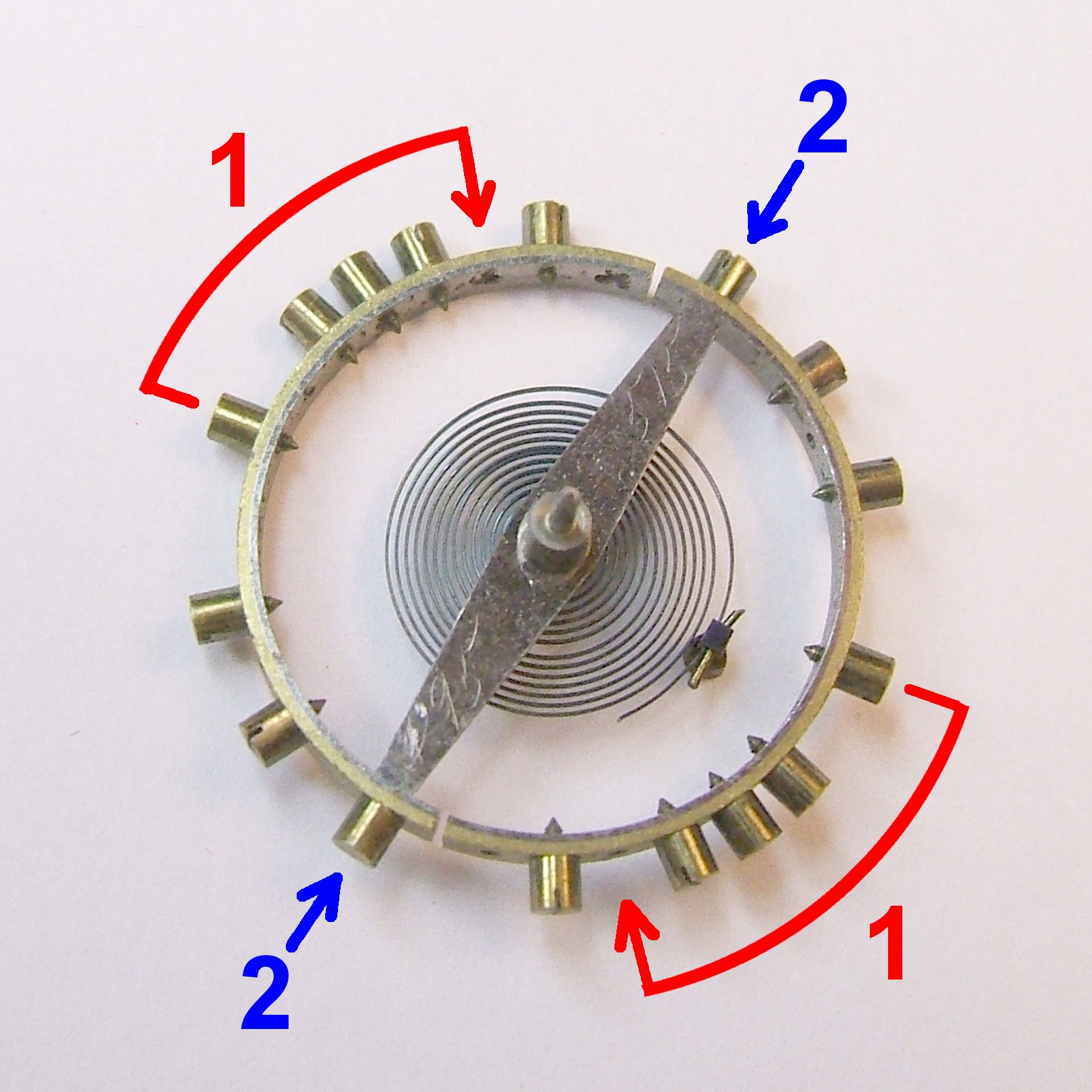
A balance wheel. Put two of these in careful conversation and they keep each other honest. Photo: Wikimedia Commons, public domain.
Why it matters
Resonance matters because it is one of the few genuinely different answers to the oldest question in watchmaking: how do you keep the beat steady? Almost every other solution is about isolating the oscillator from the world. Resonance does the opposite. It pairs the oscillator with a twin and lets the two of them sort it out together, the way Huygens’s clocks did on a wooden beam in 1665. Three hundred and sixty years later, it is still the most elegant trick in the book, and still one of the hardest to pull off.
Thanks for reading this.

