
The hairspring is the thin coiled spring that governs the balance wheel, and it is the single most important part for accuracy in a mechanical watch. It breathes in and out as the balance swings, and its stiffness sets the rate: stiffer spring, faster beat. It is thinner than a human hair, absurdly delicate, and the entire history of precision watchmaking is largely the history of making this little spring behave.

A Breguet overcoil: the raised outer curve keeps the spring breathing concentrically. Photo: Wikimedia Commons, CC BY-SA 4.0.
The Breguet overcoil, 1795
A flat spiral hairspring does not expand evenly. As it breathes, the coils shift off-center, nudging the balance and making the rate depend on position. Abraham-Louis Breguet’s fix, from 1795, was to raise the outer curve of the spring up and over, the overcoil, so the spring expands concentrically around its center. It is a small geometric trick with a large payoff: better isochronism, less positional error. High-end movements still use Breguet overcoils today, more than two centuries later, which tells you how right he got it. When you see a hairspring with that elegant raised terminal curve, you are looking at 1795.
Nivarox and the temperature problem
Steel hairsprings change stiffness with temperature, so a watch ran differently in summer and winter. The definitive answer came from Reinhard Straumann, a Swiss engineer who developed a nickel-iron alloy with almost no change in elasticity across temperatures. Perfected in 1933 and patented in 1935, he called it Nivarox, and it became the standard hairspring material for the entire industry. Most mechanical watches made since have a Nivarox spring inside, whether the dial says so or not. It is one of those invisible victories: a material so good that everyone forgot there was ever a problem.
Silicon: the modern challenger
Silicon hairsprings are the biggest change to the breed in a century. Ulysse Nardin put the first ones in the Freak in 2001. Patek Philippe followed with its Spiromax, unveiled at BaselWorld 2006, and Rolex introduced the Syloxi in 2014 on calibre 2236. Silicon is anti-magnetic, immune to temperature swings, needs no lubrication, and can be etched into shapes no metal spring could hold. The traditionalists grumbled, as traditionalists do, and then the springs proved themselves. Paired with a balance assembly, a silicon hairspring is about as close to a perfect oscillator as watchmaking has built.
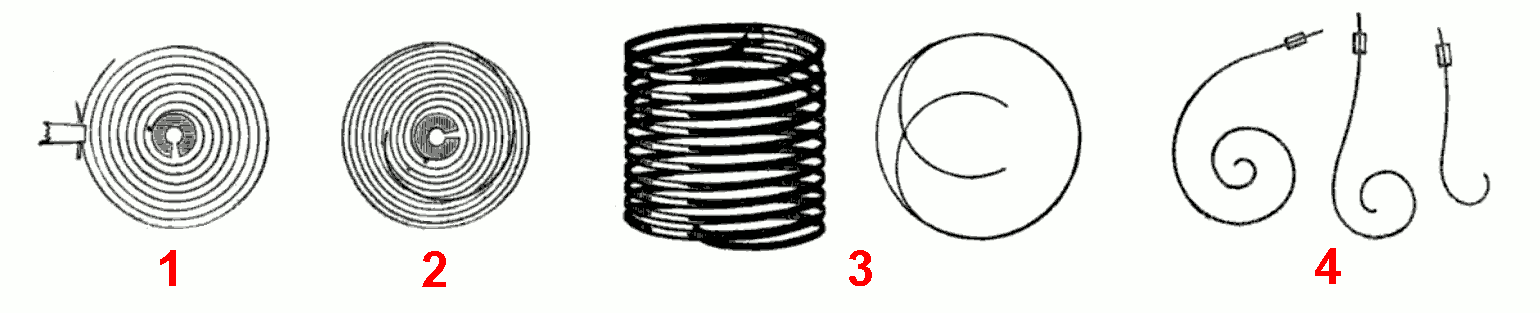
Hairspring varieties, from flat spirals to overcoils. Photo: Wikimedia Commons, public domain.
Why it matters
The hairspring is where accuracy lives. Mainsprings store energy, gear trains transmit it, escapements meter it, but the hairspring decides how fast time gets divided, and everything downstream is just counting. Two centuries of metallurgy, from blued steel to Nivarox to silicon, have all been aimed at this one coil. When someone tells you a mechanical watch is obsolete technology, the hairspring is the quiet rebuttal: a component refined for 350 years that still has no equal at its job.
Thanks for reading this.

