
A free-sprung balance has no regulator index. Instead of pins that change the hairspring’s effective length, the rate is set by adjusting weights on the balance wheel itself, moving mass in or out to change its inertia. Nothing sits on the spring, nothing can get knocked out of place, and the spring breathes exactly as it was designed to. It is harder to adjust and better in every other way, which is why the best movements use it.
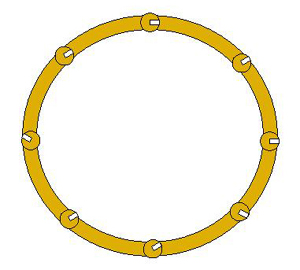
How the Gyromax’s rotating weights adjust the balance. Photo: Wikimedia Commons, public domain.
How it works
Move weight outward on a spinning wheel and it turns more slowly. Move it inward and it speeds up. A free-sprung balance puts that physics to work: screws or rotatable weights on the rim let a watchmaker shift the wheel’s moment of inertia with precision. Turning a pair of opposing weights outward slows the rate, turning them inward speeds it up, and because the adjustment is on the wheel rather than the spring, the hairspring itself is never touched, pinched, or distorted. The classic version uses screws on the outside of the rim. The modern version hides the weights inside it.
Gyromax and Microstella
Patek Philippe patented the Gyromax balance in 1949, with a second patent in 1951, and first used it in watches in 1952. Instead of screws sticking out of the rim, the Gyromax has small rotatable weights recessed into the top of the wheel, each heavier on one side. Turn a weight and its heavy side moves in or out, changing the inertia. No protruding screws means less air resistance and room for a larger-diameter wheel. Rolex developed the same idea independently as Microstella: small star-shaped gold screws on the inside of the rim, adjusted with a special tool. Both systems do the same job, and both are still in production, which is a long run for a 1940s idea.

The parts of a balance assembly. Photo: Wikimedia Commons, CC BY-SA 4.0.
Why the best movements prefer them
An index regulator is a compromise: convenient to adjust, easy to disturb. A free-sprung balance has no such weak point. Once set, it stays set through shocks, service, and decades of wear, because there is simply nothing to knock loose. The tradeoff is that adjusting one takes real skill and proper timing equipment, which is why you find them in high-end movements and not in budget ones. It is the difference between a guitar with tuning pegs and one with locking tuners: one is easier to adjust badly, the other stays where you put it.
Why it matters
Free-sprung balances are a quiet marker of quality. When a brand specs one, it is telling you the movement was designed to hold its rate for the long haul, not just to pass a bench test. The Gyromax has been in production for over seventy years, the Microstella nearly as long, and neither has been bettered at its job. In a hobby that loves visible complications, the free-sprung balance is invisible engineering at its best: you will never see it work, and you will benefit from it every day.
Thanks for reading this.

