

In 1998, Seiko released a wristwatch with a 16-bit processor, 2 megabytes of memory, an 8-direction joystick, and a battery life of about 30 hours. It was called the Ruputer, and it had a reasonable claim to being the world’s first smartwatch. Nobody bought it. Seventeen years later Apple released its own watch, and this time everybody bought one, and the Swiss watch industry had the worst scare of its life since quartz.
The early stabs
The Ruputer, launched by Seiko Instruments in June 1998, was a genuine wrist computer. It had a 3.6 MHz processor, 128 KB of RAM, a 102 by 64 pixel monochrome LCD, an infrared port, a serial interface, and a software development kit so programmers could write new apps for it in C. It was also two inches wide, cost $300, and died after 30 hours of real use. Later attempts had the same problem in different packaging. The Fossil Wrist PDA of 2003 ran Palm OS and came with a stylus, which tells you most of what you need to know about wearing it. The technology was not ready, the batteries were not ready, and honestly, nobody’s wrist was ready either.
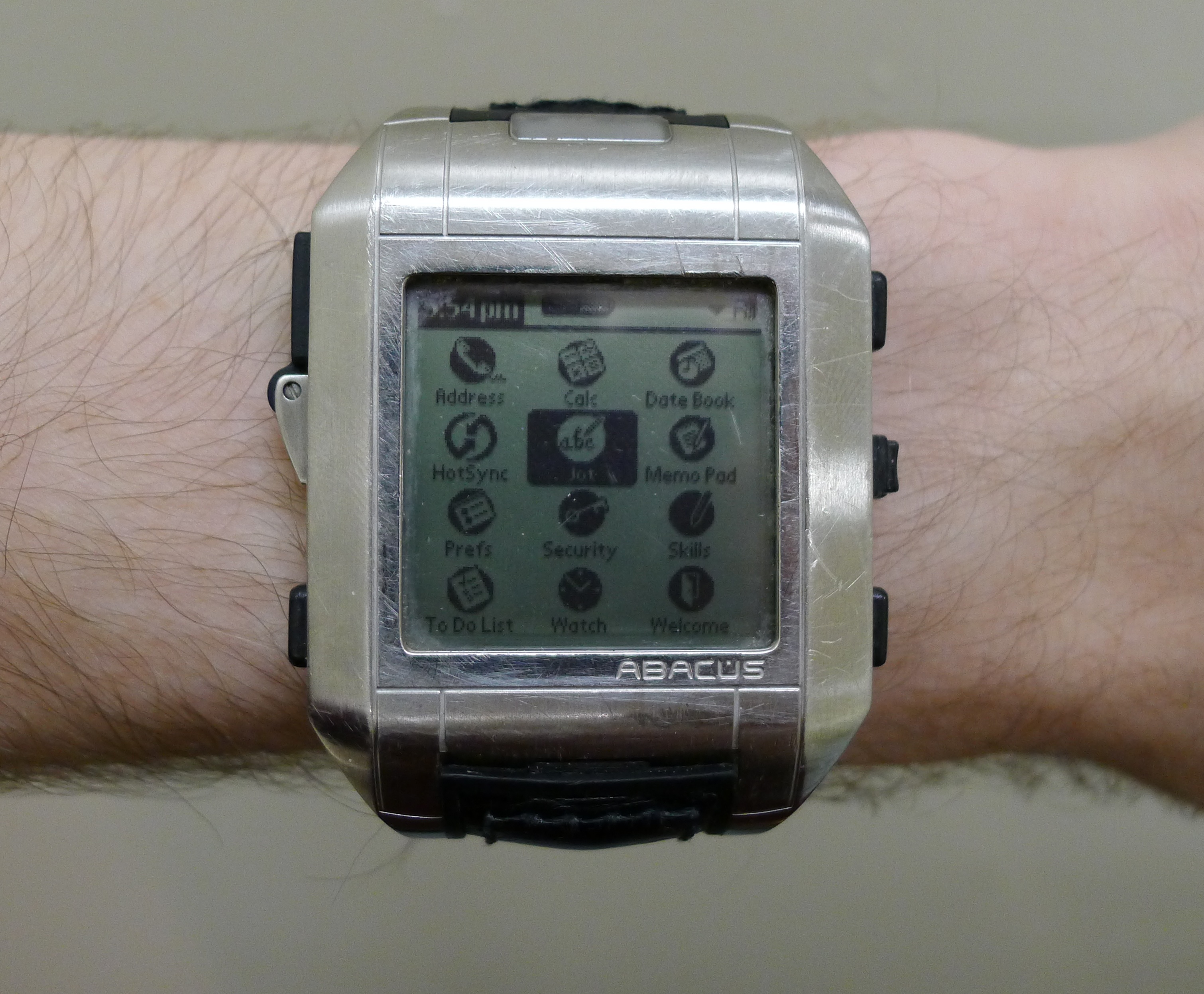
The Fossil Wrist PDA (2003), running Palm OS, stylus included. Photo: Wikimedia Commons, GFDL.
2015: Apple shows up for real
The Apple Watch was announced in September 2014 and went on sale April 24, 2015. Notifications, fitness tracking, apps, heart rate, a screen that lit up your wrist like a tiny phone. It did not compete with a Rolex Submariner. It competed with the $300 to $1,000 quartz and entry-level mechanical watches, hitting accessible Swiss unit volume and consumer attention particularly hard. If you sold a $500 quartz watch, 2015 was the year your customers started spending that money in an Apple Store instead. The low end of Switzerland got hollowed out, and everyone in Geneva and La Chaux-de-Fonds knew it.
The Swiss answer, in two flavors
TAG Heuer reacted first and loudest. Jean-Claude Biver, the LVMH watch chief, had mocked the Apple Watch as looking designed by a student, then announced at Baselworld in March 2015 that TAG Heuer would build its own connected watch with Google and Intel. The TAG Heuer Connected launched that November at around $1,500, running Android Wear on an Intel chip, and Biver called it his biggest announcement in forty years in the industry. It sold in the tens of thousands and later evolved into the Connected Modular line. It was a real attempt, and it kept TAG in the conversation, but it was still an Android watch in a Swiss case.
Frederique Constant took the opposite bet the same year. Its Horological Smartwatch looked like a completely normal analog watch and hid a connected module inside that tracked activity and sleep and synced to your phone, no screen at all. Two philosophies, side by side: give people the computer on their wrist, or give them the watch they already wanted with quiet smarts underneath. Montblanc joined in 2017 with the Summit, a Wear OS watch notable for having standard 22mm lugs, a small but telling admission that watch people care about straps. Hublot, Movado, and others dipped toes in too. There was some dignity in the responses and some panic, often from the same companies in the same year.

An Apple Watch, the device that did to the low end of the Swiss industry what quartz did to all of it. Photo: Wikimedia Commons, CC BY-SA 4.0.
The real problem: obsolescence
A mechanical watch from 1960 still works. A smartwatch from 2015 is a dead battery with no software updates and a charger you lost three apartments ago. The whole promise of a fine watch is that it outlives you. The whole reality of consumer tech is that it expires in three years. Nobody in Switzerland has squared that circle, because it may not be squarable. A screen cannot be an heirloom. So the smartwatch never really became a Swiss watch thing. It became an Apple thing and a Samsung thing, and the Swiss went back to selling permanence.
Why it matters
This was the second time in fifty years that electronics blindsided the industry, and the industry’s answer was basically the same both times: double down on what tech cannot copy. Quartz taught Switzerland to sell craft and heritage instead of accuracy. The smartwatch taught it to sell longevity and jewelry instead of features. The smartwatch won the wrist-computer war completely and lost the heirloom war just as completely, and there is no reason both sides cannot live with that outcome.
Thanks for reading this.

